
Bitcoin Sluggish Demand Blamed for $10K Plunge In a Week

Bitcoin's price plunged over $10K within a week, driven by reduced market demand, ETF outflows, and expectations for Fed rate cuts, signaling potential future corrections if demand doesn't recover.
After hitting a new all-time high just last Thursday, Bitcoin’s price has plummeted by over $10,000 in a week.
A new analysis suggests the sharp correction stems from a key factor: a slowdown in demand across the Bitcoin market.
Bitcoin Demand Slowing Down
Julio Moreno, head of research at on-chain platform CryptoQuant, shared this view in an X post on Wednesday. He stated, “Bitcoin’s overall demand growth slowdown, including purchases from ETFs and Strategy, is behind the current price pause/correction.”
Bitcoin’s price had briefly bottomed out on August 1st, when concerns about a recession flared up after a weak US non-farm payrolls report. That same day, US spot Bitcoin ETFs saw $812 million in net outflows, according to Soso Value data.
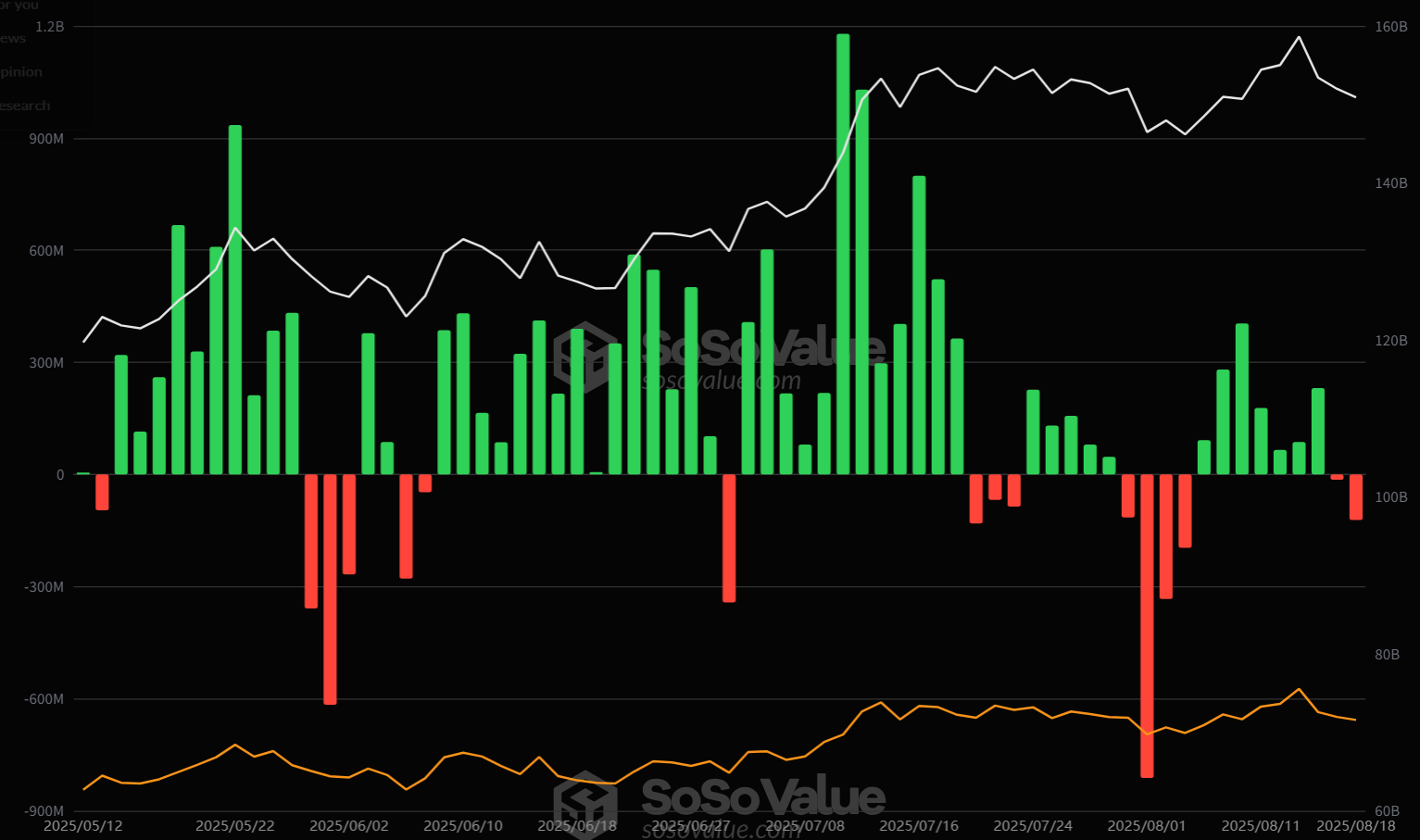 Daily Net Inflows/Outflows of U.S. Spot Bitcoin ETFs. Source: SoSo Value
However, from August 6, when the price rally began, the ETFs recorded seven consecutive days of net inflows. This trend reversed last Thursday with the July Producer Price Index’s release, returning to net outflows. The outflow volume wasn’t very large, yet Bitcoin’s price dropped sharply in comparison.
Moreno explained that on-chain demand metrics mirror this exact pattern. He argues that this correction isn’t due to the sudden actions of a single entity like an ETF or MicroStrategy, but rather a widespread decline in demand among most market participants.
For example, CryptoQuant’s Apparent Demand metric showed a reading of 147.3703K on August 1, a similar price level. However, on August 20, the same metric had nearly halved to 64.787K.
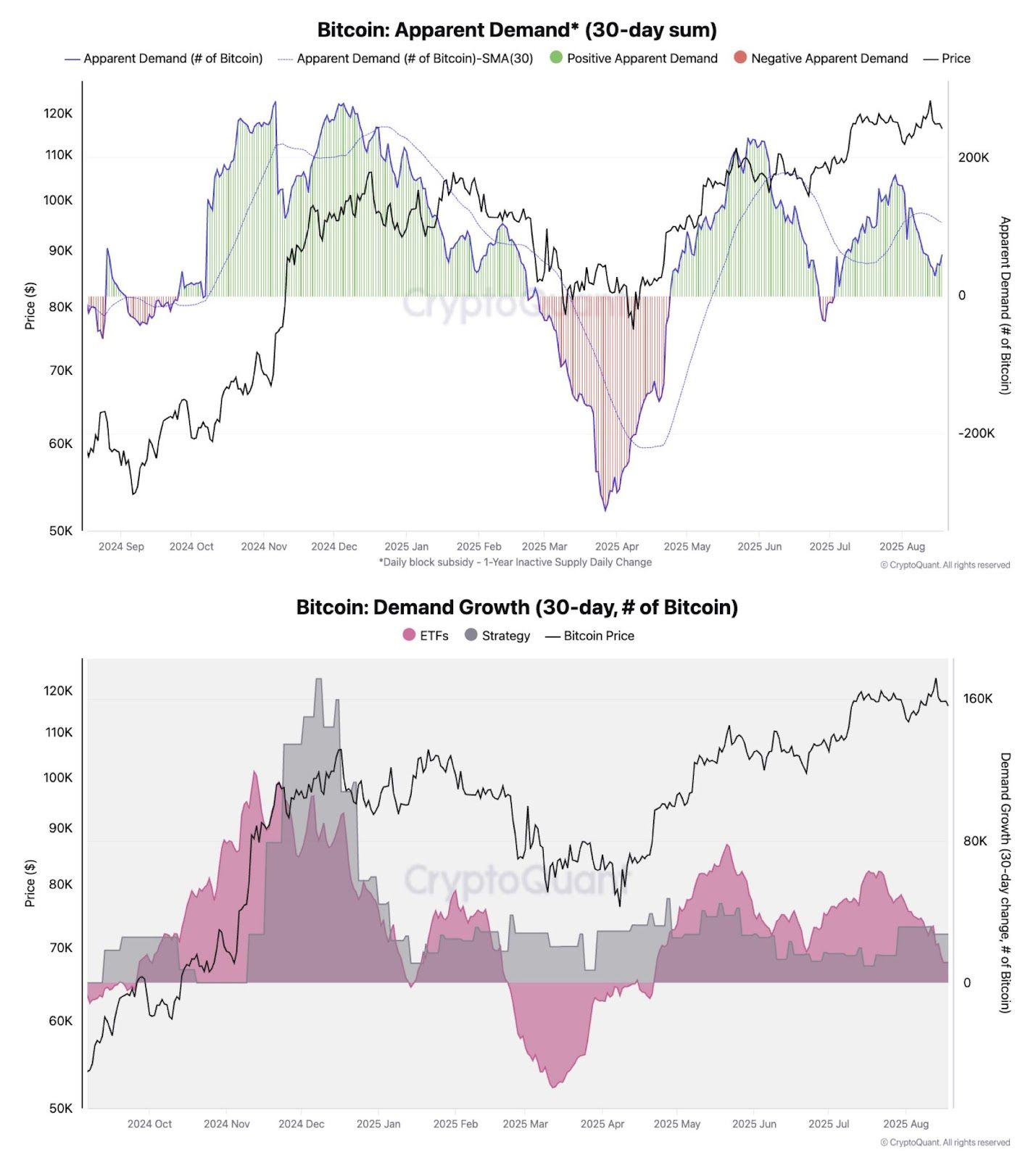 Bitcoin: Apparent Demand & Bitcoin: Demand Growth. Source: CryptoQuant
While Bitcoin’s price surged and then returned to its starting point over the past 15 days, market demand essentially dropped by half. This suggests that if market sentiment doesn’t recover, Bitcoin could face further corrections.
The market likely needs a macroeconomic catalyst to boost overall demand, such as renewed expectations of a Fed rate cut. According to CME’s FedWatch data, market participants anticipate two rate cuts this year, with an 86% probability of a 25 basis point cut at the September FOMC meeting.
For comparison, last Thursday, when Bitcoin’s price approached $124,000, the market priced in three rate cuts this year and a 98% chance of a cut in September.
Disclaimer: The content of this article solely reflects the author's opinion and does not represent the platform in any capacity. This article is not intended to serve as a reference for making investment decisions.
You may also like
How much CPO demand will Nvidia Rubin Ultra generate? Bernstein: Optical value per Pod will increase fivefold
Bernstein believes that the co-packaged optics (CPO) and fiber demand driven by Nvidia's Rubin Ultra architecture will surge significantly, with the optical content per Pod rising from $1 million to $5.4 million. This will propel the size of Nvidia's optical ecosystem market to $46.8 billion by 2028 (a 91% annual increase). Although the industry faces supply bottlenecks with InP substrates, the outlook remains positive. The institution reiterates its “outperform” rating for Lumentum, Coherent, and Ciena.

UBS Q3 implements a two-way strategy with gold options, heavily invests in technology stocks, and builds positions in SK Hynix (SKHY.US)
UBS Group (UBS.US) has submitted its Q3 holdings report (13F) as of September 30, 2026.

SpaceX (SPCX.US) reportedly attempts “de-Nvidiaization” at the rack level: developing Kessel cabinets to bypass L6 compute boards, purchasing only chips
SemiAnalysis: SpaceX has developed its own Kessel cabinet, bypassing Nvidia's L6 cards to provide more options for manufacturing its own hardware.

$3.7 billion “data center power equipment prepayments” abandoned! What did "the most active buyer of gas turbines", SoftBank, see?
In the second quarter of fiscal year 2026, SoftBank reported a net loss of $7.1 billion, primarily due to a $3.7 billion impairment charge from a $9.5 billion advance payment for power generation equipment for US data centers—of which about $2.9 billion was non-refundable and effectively lost. The CFO admitted that SoftBank placed orders before the project plan was finalized, and is now conducting a comprehensive review of its procurement strategy. "The most aggressive purchaser of gas turbines has now written off the deposit in this way."
Crypto prices
More


