
Ethereum Nears $4K as $4B Supply Overhang Looms: Analysts Fear Deeper Losses

Ethereum (ETH) is struggling to hold above $4,200 after a sharp sell-off triggered widespread liquidations across the crypto market. It has dropped nearly 9% over the past week, with traders bracing for a potential retest of the $4,100 level.
Data from CoinGlass shows that more than $178 million in positions were liquidated in the past 24 hours, with ETH long traders suffering the biggest blow, over $127 million wiped out.
A notable case saw one Hyperliquid trader lose nearly $6.2 million after re-entering ETH longs too aggressively, turning months of gains into heavy losses within just two days.
This volatility comes as Ethereum’s exit queue for staking withdrawals has surged to 910,461 ETH, worth about $3.91 billion, signaling an upcoming wave of supply that could pressure prices further.
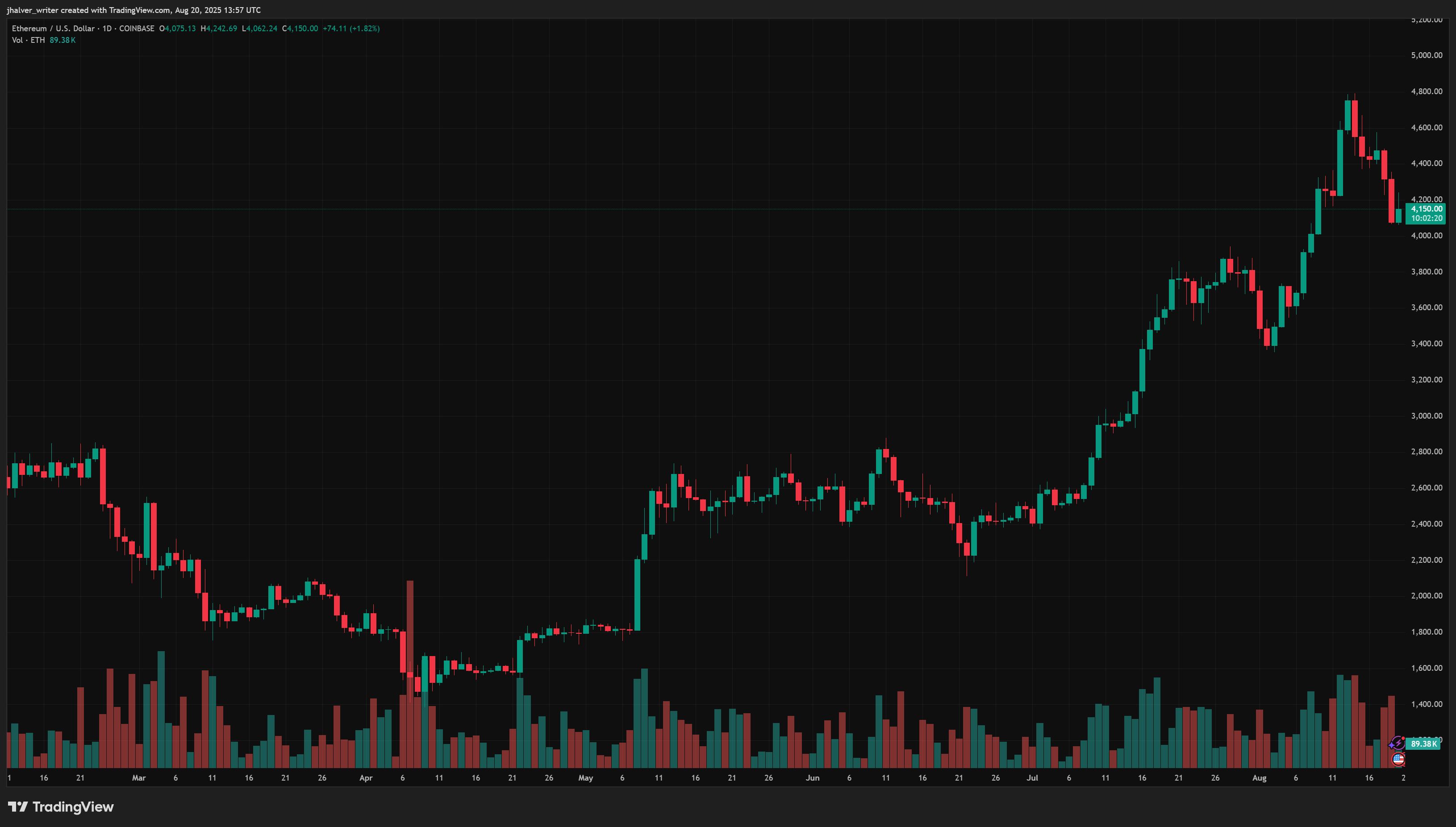
ETH's price losing momentum on the daily chart. Source: ETHUSD on Tradingview
Institutional Investors Step in Despite Market Jitters
Despite retail pain, large institutional players appear to be buying the dip. Bitmine Immersion, the biggest publicly traded ETH holder, recently added 52,475 ETH, bringing its holdings to nearly $6.6 billion.
SharpLink followed suit, purchasing 143,593 ETH at $4,648, though its position is now underwater.
Blockchain trackers also flagged new inflows from FalconX-linked wallets worth over $38 million. This suggests that while short-term sentiment remains shaky, big-money investors continue to accumulate ETH, betting on its long-term value.
Ethereum (ETH) Analysts Warn of Deeper Losses Before Recovery
Market experts caution that Ethereum may remain under pressure as macroeconomic uncertainty looms ahead of the U.S. Federal Reserve’s Jackson Hole meeting. Pessimistic tone from Fed Chair Jerome Powell could trigger further risk-off sentiment across crypto and equities.
On-chain activity has also weakened. Active Ethereum addresses have dropped nearly 28% in August, signaling waning retail participation. Network growth has slowed as well, raising questions about near-term demand.
Still, analysts see long-term upside once the market absorbs the $4B staking unlock. Some forecasts remain bullish, with Ethereum projected to reach between $6,000–$8,000 by year-end if institutional flows persist.
For now, however, the critical question remains: can ETH defend $4,000, or will supply pressure drag it into a deeper correction?
Cover image from ChatGPT, ETHUSD chart from Tradingview
Disclaimer: The content of this article solely reflects the author's opinion and does not represent the platform in any capacity. This article is not intended to serve as a reference for making investment decisions.
You may also like
How much CPO demand will Nvidia Rubin Ultra generate? Bernstein: Optical value per Pod will increase fivefold
Bernstein believes that the co-packaged optics (CPO) and fiber demand driven by Nvidia's Rubin Ultra architecture will surge significantly, with the optical content per Pod rising from $1 million to $5.4 million. This will propel the size of Nvidia's optical ecosystem market to $46.8 billion by 2028 (a 91% annual increase). Although the industry faces supply bottlenecks with InP substrates, the outlook remains positive. The institution reiterates its “outperform” rating for Lumentum, Coherent, and Ciena.

UBS Q3 implements a two-way strategy with gold options, heavily invests in technology stocks, and builds positions in SK Hynix (SKHY.US)
UBS Group (UBS.US) has submitted its Q3 holdings report (13F) as of September 30, 2026.

SpaceX (SPCX.US) reportedly attempts “de-Nvidiaization” at the rack level: developing Kessel cabinets to bypass L6 compute boards, purchasing only chips
SemiAnalysis: SpaceX has developed its own Kessel cabinet, bypassing Nvidia's L6 cards to provide more options for manufacturing its own hardware.

$3.7 billion “data center power equipment prepayments” abandoned! What did "the most active buyer of gas turbines", SoftBank, see?
In the second quarter of fiscal year 2026, SoftBank reported a net loss of $7.1 billion, primarily due to a $3.7 billion impairment charge from a $9.5 billion advance payment for power generation equipment for US data centers—of which about $2.9 billion was non-refundable and effectively lost. The CFO admitted that SoftBank placed orders before the project plan was finalized, and is now conducting a comprehensive review of its procurement strategy. "The most aggressive purchaser of gas turbines has now written off the deposit in this way."
Crypto prices
More


