Bitget App
Trade smarter
Buy cryptoMarketsTradeFuturesStocksEarnInstitutionAI & More
Bio Protocol (BIO) To Soar Further? Key Harmonic Pattern Signals Potential Upside Move

Bio Protocol (BIO) To Soar Further? Key Harmonic Pattern Signals Potential Upside Move

CoinsProbeCoinsProbe2025/08/20 23:35
By:Nilesh Hembade

Date: Tue, Aug 19, 2025 | 06:50 AM GMT

The cryptocurrency market is experiencing notable selling pressure as Ethereum (ETH) slips back to $4,250 from its recent high of $4,780. This weakness has extended to several major altcoins .

Yet, despite the broader pullback, Bio Protocol (BIO) has managed to remain resilient, posting a 10% gain on the day and extending its monthly rally to over 100%. Adding to the bullish case, BIO’s chart is now highlighting a harmonic formation that suggests further upside could be on the horizon.

Bio Protocol (BIO) To Soar Further? Key Harmonic Pattern Signals Potential Upside Move image 0 Source: Coinmarketcap

Harmonic Pattern Hints at Potential Bounce

On the 4-hour chart, BIO is forming a Bearish ABCD harmonic pattern. While technically labeled as bearish, this setup usually involves a strong bullish CD-leg rally before the Potential Reversal Zone (PRZ) becomes relevant.

The structure began with a rally from Point A near $0.0559 to Point B, before BIO retraced to Point C around $0.0956, where buyers re-entered with conviction. Since then, the token has surged higher and is currently trading near $0.1380, with price action confirming the unfolding of the CD leg.
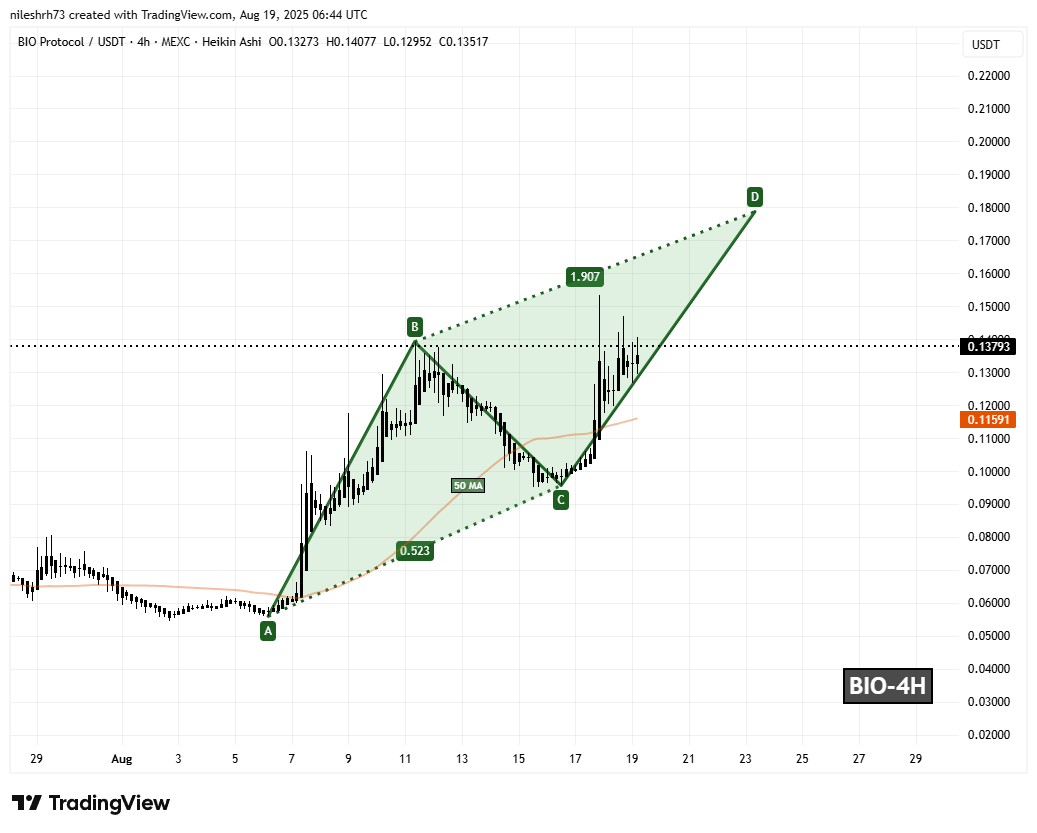
Bio Protocol (BIO) To Soar Further? Key Harmonic Pattern Signals Potential Upside Move image 1 Bio Protocol (BIO) Daily Chart/Coinsprobe (Source: Tradingview)

The 1.90 Fibonacci extension of the BC leg projects Point D near $0.1787, marking a key upside target that traders are closely eyeing as the next potential resistance zone.

What’s Next for BIO?

If bullish momentum continues, BIO could push toward the $0.1787 PRZ, a level that could serve as both a profit-taking zone and a test of market strength. Historically, harmonic patterns often encounter heavy resistance at these completion zones, leading to either consolidation or a corrective pullback.


0
0

Disclaimer: The content of this article solely reflects the author's opinion and does not represent the platform in any capacity. This article is not intended to serve as a reference for making investment decisions.

Understand the market, then trade.
Bitget offers one-stop trading for cryptocurrencies, stocks, and gold.
Trade now!

You may also like

How much CPO demand will Nvidia Rubin Ultra generate? Bernstein: Optical value per Pod will increase fivefold

Bernstein believes that the co-packaged optics (CPO) and fiber demand driven by Nvidia's Rubin Ultra architecture will surge significantly, with the optical content per Pod rising from $1 million to $5.4 million. This will propel the size of Nvidia's optical ecosystem market to $46.8 billion by 2028 (a 91% annual increase). Although the industry faces supply bottlenecks with InP substrates, the outlook remains positive. The institution reiterates its “outperform” rating for Lumentum, Coherent, and Ciena.

华尔街见闻•2026/11/11 08:47
How much CPO demand will Nvidia Rubin Ultra generate? Bernstein: Optical value per Pod will increase fivefold

UBS Q3 implements a two-way strategy with gold options, heavily invests in technology stocks, and builds positions in SK Hynix (SKHY.US)

UBS Group (UBS.US) has submitted its Q3 holdings report (13F) as of September 30, 2026.

智通财经•2026/11/11 08:22
UBS Q3 implements a two-way strategy with gold options, heavily invests in technology stocks, and builds positions in SK Hynix (SKHY.US)

SpaceX (SPCX.US) reportedly attempts “de-Nvidiaization” at the rack level: developing Kessel cabinets to bypass L6 compute boards, purchasing only chips

SemiAnalysis: SpaceX has developed its own Kessel cabinet, bypassing Nvidia's L6 cards to provide more options for manufacturing its own hardware.

智通财经•2026/11/11 08:20
SpaceX (SPCX.US) reportedly attempts “de-Nvidiaization” at the rack level: developing Kessel cabinets to bypass L6 compute boards, purchasing only chips

