
PBOC Reshapes Markets With Liquidity Boost

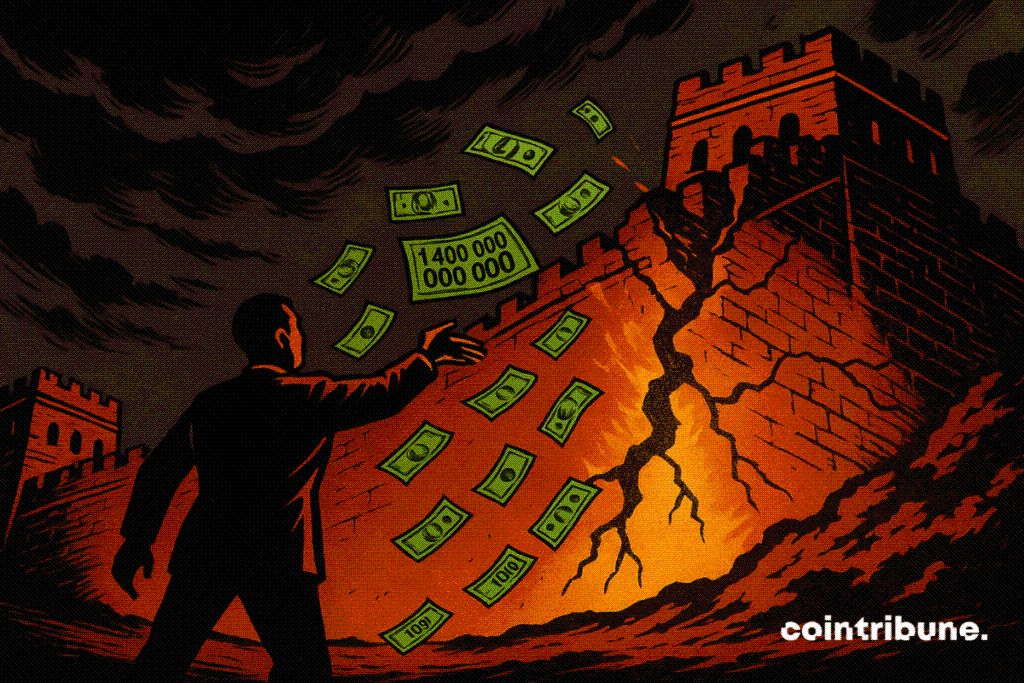
Faced with a wave of critical maturities on $4,000 billion of debt, Beijing launched an unprecedented monetary response. In August, the People’s Bank of China injected $1,400 billion to avoid the suffocation of its bond market. More than an emergency measure, this intervention marks a strategic turning point in managing Chinese financial flows. In a context of global tensions, this technical gesture speaks volumes about Beijing’s determination to maintain control over its economic cycle.
In brief
- The People’s Bank of China (PBOC) injected $1,400 billion to prevent a liquidity crisis linked to the maturity of $4,000 billion of short-term debt.
- This intervention is part of a defensive strategy, marked by a rate cut and a deliberate flattening of the yield curve.
- Targeted measures have been implemented to support SMEs and strategic sectors, notably tech and clean energy.
- Despite this massive support, some sectors remain fragile, particularly real estate, still weighed down by debt and unsold inventory.
A defensive monetary response to systemic risk
Faced with the massive $4,000 billion maturity of negotiable certificates of deposit (NCDs) expected this year, the People’s Bank of China (PBOC) opted for a large-scale strategy, while the country remains insensitive to threats and is getting rid of US debt .
It injected $1,400 billion into the financial system through reverse repo operations, while lowering the rate on these transactions to 1.4 %. This response aims to avoid a freeze in the interbank market and prevent any short-term funding disruption.
The central bank shifts from a reactive stance to preventive liquidity management. By acting upstream, Beijing intends to defuse any systemic instability that could weaken the core of its bond market.
This intervention is part of the continuity of a set of measures already launched in May, with quick and targeted effects on yields and the yield curve. The main levers mobilized by the PBOC include :
- A 0.5 point cut in the reserve requirement ratio (RRR) to free up bank liquidity ;
- A 10 basis point cut in benchmark rates, in a context of short-term debt tensions ;
- Sectoral refinancing lines, mainly oriented toward SMEs and strategic technology companies ;
- A marked flattening of the yield curve, with a tightening to less than 50 basis points between 1-year and 10-year bonds, reflecting the PBOC’s desire to contain volatility ;
- Normalization of credit spreads, restoring appeal to sovereign bonds and AAA-rated securities as low-risk carry assets.
This immediate stabilization strategy aims to restore confidence in short-term debt instruments while repositioning domestic bond assets as safe havens within the Chinese financial system.
A reallocation of capital and risky trades
Beyond immediate stabilization, the PBOC’s intervention has triggered significant movements in capital allocation. The MSCI China index has jumped 21.3 % since the start of support measures, driven by sectors targeted by Chinese industrial strategy.
Investment flows are clearly redeployed toward AI, semiconductors, and clean energy. This sectoral orientation is a strong signal: the PBOC uses its monetary leverage to direct flows toward long-term growth pillars, in a context of economic transition.
Meanwhile, new financial tools have been introduced to further ease markets: extension of the Bond Connect Southbound, authorization for rehypothecation, and development of cross-currency repos.
These instruments aim to strengthen liquidity on short-term securities and attract foreign investors. The DR007, 7-day interbank benchmark rate, remains stable around 1.4 %, consolidating the appeal of these low-volatility carries.
However, this dynamic masks another reality: non-sovereign credits, notably those from local government financing vehicles (LGFVs), continue to present high structural risks. Despite a 300 billion yuan refinancing program intended to facilitate the purchase of unsold homes, the real estate sector remains under pressure and poorly aligned with Beijing’s strategic priorities.
This PBOC intervention resonates on crypto markets, especially for bitcoin, often seen as an alternative store of value during monetary instability. Some analysts see an indirect signal : the more central banks inject, the more decentralized assets gain relevance against systemic risks.
By strengthening liquidity in strategically judged segments and favoring specific bonds, the PBOC redefines the rules of the game for investors, both local and international. In the short term, stability seems assured. However, this sophisticated monetary engineering, as was the case during the injection of 300 billion yuan into its banking system via an MLF operation , if it fails to restore structural balance in entire credit segments, could exacerbate imbalances between favored and fragile sectors in China.
Disclaimer: The content of this article solely reflects the author's opinion and does not represent the platform in any capacity. This article is not intended to serve as a reference for making investment decisions.
You may also like
How much CPO demand will Nvidia Rubin Ultra generate? Bernstein: Optical value per Pod will increase fivefold
Bernstein believes that the co-packaged optics (CPO) and fiber demand driven by Nvidia's Rubin Ultra architecture will surge significantly, with the optical content per Pod rising from $1 million to $5.4 million. This will propel the size of Nvidia's optical ecosystem market to $46.8 billion by 2028 (a 91% annual increase). Although the industry faces supply bottlenecks with InP substrates, the outlook remains positive. The institution reiterates its “outperform” rating for Lumentum, Coherent, and Ciena.

UBS Q3 implements a two-way strategy with gold options, heavily invests in technology stocks, and builds positions in SK Hynix (SKHY.US)
UBS Group (UBS.US) has submitted its Q3 holdings report (13F) as of September 30, 2026.

SpaceX (SPCX.US) reportedly attempts “de-Nvidiaization” at the rack level: developing Kessel cabinets to bypass L6 compute boards, purchasing only chips
SemiAnalysis: SpaceX has developed its own Kessel cabinet, bypassing Nvidia's L6 cards to provide more options for manufacturing its own hardware.

$3.7 billion “data center power equipment prepayments” abandoned! What did "the most active buyer of gas turbines", SoftBank, see?
In the second quarter of fiscal year 2026, SoftBank reported a net loss of $7.1 billion, primarily due to a $3.7 billion impairment charge from a $9.5 billion advance payment for power generation equipment for US data centers—of which about $2.9 billion was non-refundable and effectively lost. The CFO admitted that SoftBank placed orders before the project plan was finalized, and is now conducting a comprehensive review of its procurement strategy. "The most aggressive purchaser of gas turbines has now written off the deposit in this way."
Crypto prices
More


