
Is MicroStrategy’s Bitcoin Flywheel Facing Its First Real Stress Test?

MicroStrategy’s stock is no longer closely tracking Bitcoin’s price, marking a potential turning point for the company’s Bitcoin-driven strategy. New competitors and market changes threaten to erode the unique financial model that has allowed MicroStrategy to accumulate Bitcoin at scale.
For the first time in its history, MicroStrategy (MSTR) is seeing its share price premium detach from Bitcoin’s performance.
These changes are happening amidst the growth of Bitcoin (BTC) proxy plays, with MicroStrategy, now Strategy, being the largest corporate holder of the pioneer crypto.
MicroStrategy’s Premium Breaks From Bitcoin
The divergence raises questions about the sustainability of Michael Saylor’s financial model. Additional concerns include whether new entrants in the Digital Asset Treasury (DAT) market are eroding the company’s unique role as Wall Street’s gateway to Bitcoin.
In hindsight, MicroStrategy’s ability to accumulate Bitcoin at scale has always relied on a simple reflexive mechanism. When its stock trades at a premium to net asset value (mNAV), it can issue shares, raise cash, and buy BTC accretively.
This financial alchemy has been the cornerstone of Saylor’s strategy since 2020.
However, according to researcher Joseph Ayoub, the emergence of multiple DATs is weakening that flywheel.
“For the first time in its history, it looks like the discount strongly correlated with Bitcoin’s price has diverged…Perhaps as a function of other DATs launching in the market… I don’t see this premium returning meaningfully again,” Ayoub wrote.
If correct, this would mark a decisive turning point because then MicroStrategy’s ability to fund new Bitcoin purchases through equity issuance may be permanently impaired.
DATs are equity companies that sell shares to purchase digital assets. Since 2020, the Digital Asset Treasury model has mushroomed from roughly $10 billion in NAV to over $100 billion.
By comparison, Bitcoin ETFs (exchange-traded funds) now account for around $150 billion. DATs appeal to investors because they offer equity exposure to crypto assets, often at significant premiums.
Ayoub describes them as modern closed-end funds. Unlike ETFs, most DATs cannot redeem shares for underlying assets. This leaves valuation tied to market sentiment rather than direct redemption mechanisms.
That dynamic recalls the Grayscale Bitcoin Trust (GBTC), which traded at massive premiums before crashing to a 50% discount during the 2022 bear market.
Nic Carter of Castle Island Ventures notes the historical parallels. Quoting a post from Be Water, he compared today’s DAT boom to the investment trust mania of the 1920s, citing many similarities.
excellent post from @bewaterltd. compares the DATs (bitcoin access vehicles I call them) with the investment trust (closed end mutual fund) mania of the 1920s. many, many similarities.
— nic carter (@nic__carter) July 27, 2025
Risks Mount for Saylor’s MicroStrategy
The premium’s decline comes as Saylor faces mounting scrutiny over MicroStrategy’s concentrated exposure to Bitcoin. As BeInCrypto previously reported, some investors view the firm’s recent update as amplifying Bitcoin’s volatility. This would expose equity holders to risks more akin to leveraged ETFs than a traditional software company.
If MSTR trades persistently at a discount, several consequences follow. Shareholder lawsuits could demand redemptions closer to NAV.
Regulators could reclassify MicroStrategy as an investment company by recalling precedents like Tonopah Mining in the 1940s and the GBTC saga in 2021. Such a move would impose stricter rules or force structural changes.
Against this backdrop, Ayoub warns that equity-financed Bitcoin treasuries have a saturation point.
“After there’s enough supply to absorb artificial & immature DAT demand, the unwind will begin…That is not too distant a future,” he wrote.
Data on Bitcoin Treasuries shows MicroStrategy holds nearly 630,000 BTC with manageable debt levels.
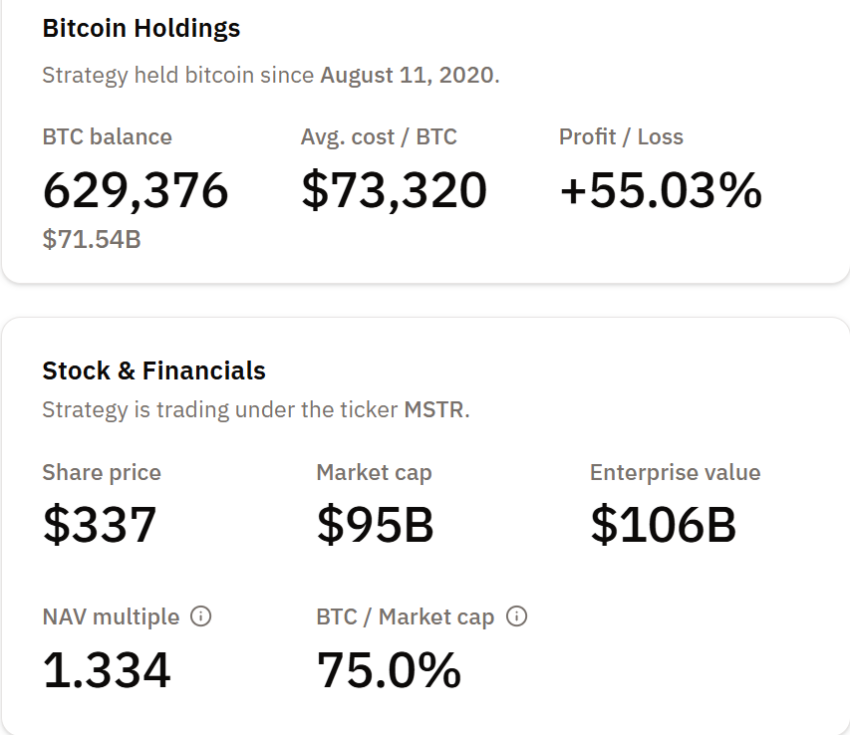 MicroStrategy BTC Holdings. Source:
However, the decoupling of its premium may signal that its once-virtuous cycle is breaking down.
If so, the company that turned corporate Bitcoin strategy into financial alchemy may face its toughest test yet from the erosion of its own unique advantage rather than a bear market.
“I think the entire DAT thing is going to come down to who has a bear market strategy to mitigate severe discount to mNAV and who doesn’t. Those that don’t will have forced liquidations. Those with the right bear market strategy that allows for future compounding of NAV will survive and then thrive and should experience higher valuations,” wrote investor Raoul Pal.
Disclaimer: The content of this article solely reflects the author's opinion and does not represent the platform in any capacity. This article is not intended to serve as a reference for making investment decisions.
You may also like
How much CPO demand will Nvidia Rubin Ultra generate? Bernstein: Optical value per Pod will increase fivefold
Bernstein believes that the co-packaged optics (CPO) and fiber demand driven by Nvidia's Rubin Ultra architecture will surge significantly, with the optical content per Pod rising from $1 million to $5.4 million. This will propel the size of Nvidia's optical ecosystem market to $46.8 billion by 2028 (a 91% annual increase). Although the industry faces supply bottlenecks with InP substrates, the outlook remains positive. The institution reiterates its “outperform” rating for Lumentum, Coherent, and Ciena.

UBS Q3 implements a two-way strategy with gold options, heavily invests in technology stocks, and builds positions in SK Hynix (SKHY.US)
UBS Group (UBS.US) has submitted its Q3 holdings report (13F) as of September 30, 2026.

SpaceX (SPCX.US) reportedly attempts “de-Nvidiaization” at the rack level: developing Kessel cabinets to bypass L6 compute boards, purchasing only chips
SemiAnalysis: SpaceX has developed its own Kessel cabinet, bypassing Nvidia's L6 cards to provide more options for manufacturing its own hardware.

$3.7 billion “data center power equipment prepayments” abandoned! What did "the most active buyer of gas turbines", SoftBank, see?
In the second quarter of fiscal year 2026, SoftBank reported a net loss of $7.1 billion, primarily due to a $3.7 billion impairment charge from a $9.5 billion advance payment for power generation equipment for US data centers—of which about $2.9 billion was non-refundable and effectively lost. The CFO admitted that SoftBank placed orders before the project plan was finalized, and is now conducting a comprehensive review of its procurement strategy. "The most aggressive purchaser of gas turbines has now written off the deposit in this way."
Crypto prices
More


