
Experts Warn Bitcoin Could Face a 51% Attack as Mining Centralizes

Bitcoin faces its highest centralization risk in over a decade as Foundry and AntPool surpass 51% hashrate control. While a costly attack is unlikely, the perception alone could shake investor trust in Bitcoin’s decentralized foundation.
Data shows that two major mining pools currently control over 51% of Bitcoin’s total mining power.
Bitcoin has long been considered a symbol of decentralization and financial independence. However, the latest development reveals the downside of concentration within the PoW mechanism.
Could Bitcoin face a 51% attack?
According to analyst Jacob King, Foundry currently holds a 33.63% market share of Bitcoin’s mining hashrate, while AntPool accounts for 17.94%. Together, these two pools dominate over 50% of the network’s hashrate, raising concerns about centralization in Bitcoin mining.
This means that if these two Bitcoin mining pools were to combine, they would surpass the 51% threshold of hashrate control. In theory, this would open the possibility for an attack aimed at manipulating the network.
“Once reality sets in about how centralized, manipulated, and useless Bitcoin truly is, everything will collapse faster than ever. It’s essentially a giant game of musical chairs!” Jacob shared.
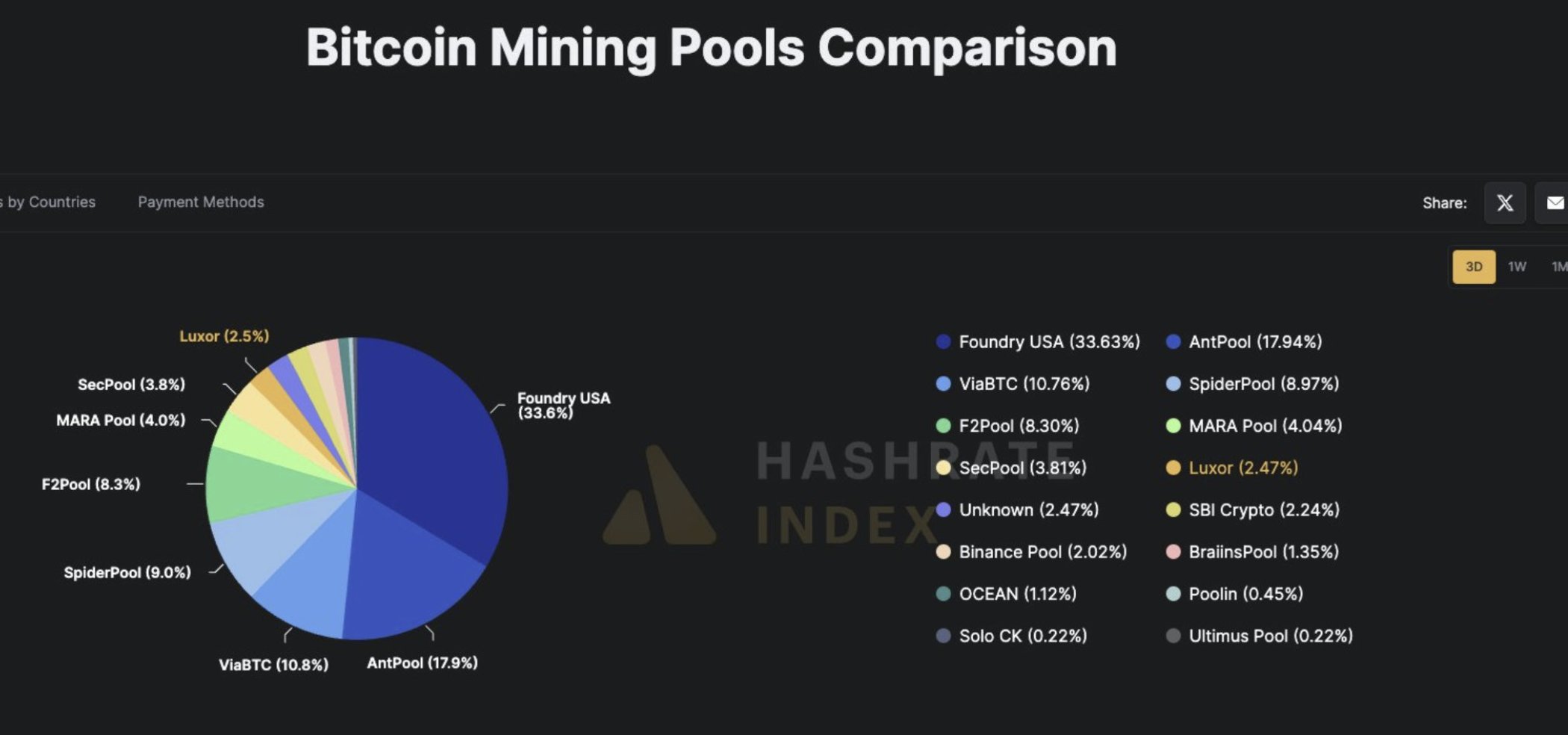 Market share of Bitcoin mining pools. Source:
Jacob King on X
Some community members have also openly acknowledged that Bitcoin mining has become “extremely centralized.” Statistics from Evan Van Ness show that three mining pools frequently hold over 80% of the global hashrate.
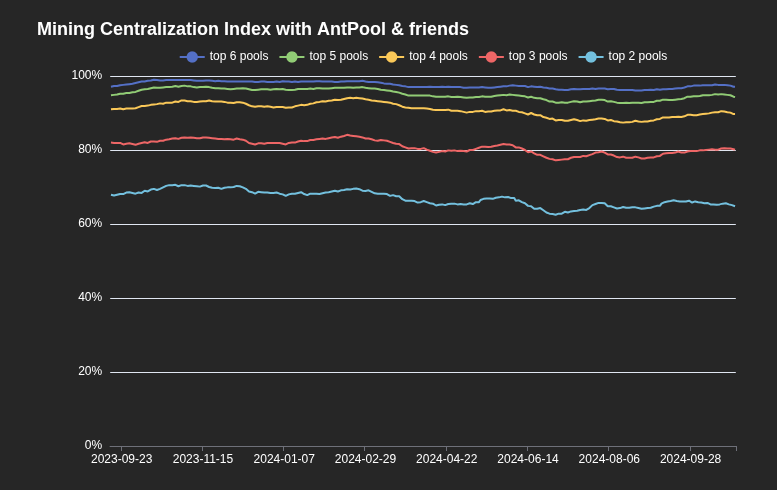 Top 3 pools holding more than 80% of the hashrate. Source:
Evan Van Ness on X
This is the first time mining concentration has reached such a dangerous threshold in more than a decade. It has shaken the community’s confidence in decentralization, Bitcoin’s foundation. Many experts are questioning whether the Proof-of-Work (PoW) mechanism remains suitable to serve as the backbone of the global financial system. Its vulnerabilities, such as the risk of a 51% attack, raise concerns about its long-term viability.
Some analysts warn that this situation could transform Bitcoin from a decentralized asset into a perceived “risk and burden” for institutional investors. This shift could also impact the broader financial system.
If a 51% attack were to occur, the controlling mining pools could manipulate transaction validation and block or reverse confirmed transactions. This could also enable double-spending, compromising the Bitcoin network’s integrity. Such a scenario would cause financial losses and destroy confidence in Bitcoin as a safe-haven asset.
Although hashrate and difficulty are currently at a record high, concerns over a potential 51% attack have added psychological pressure to the market.
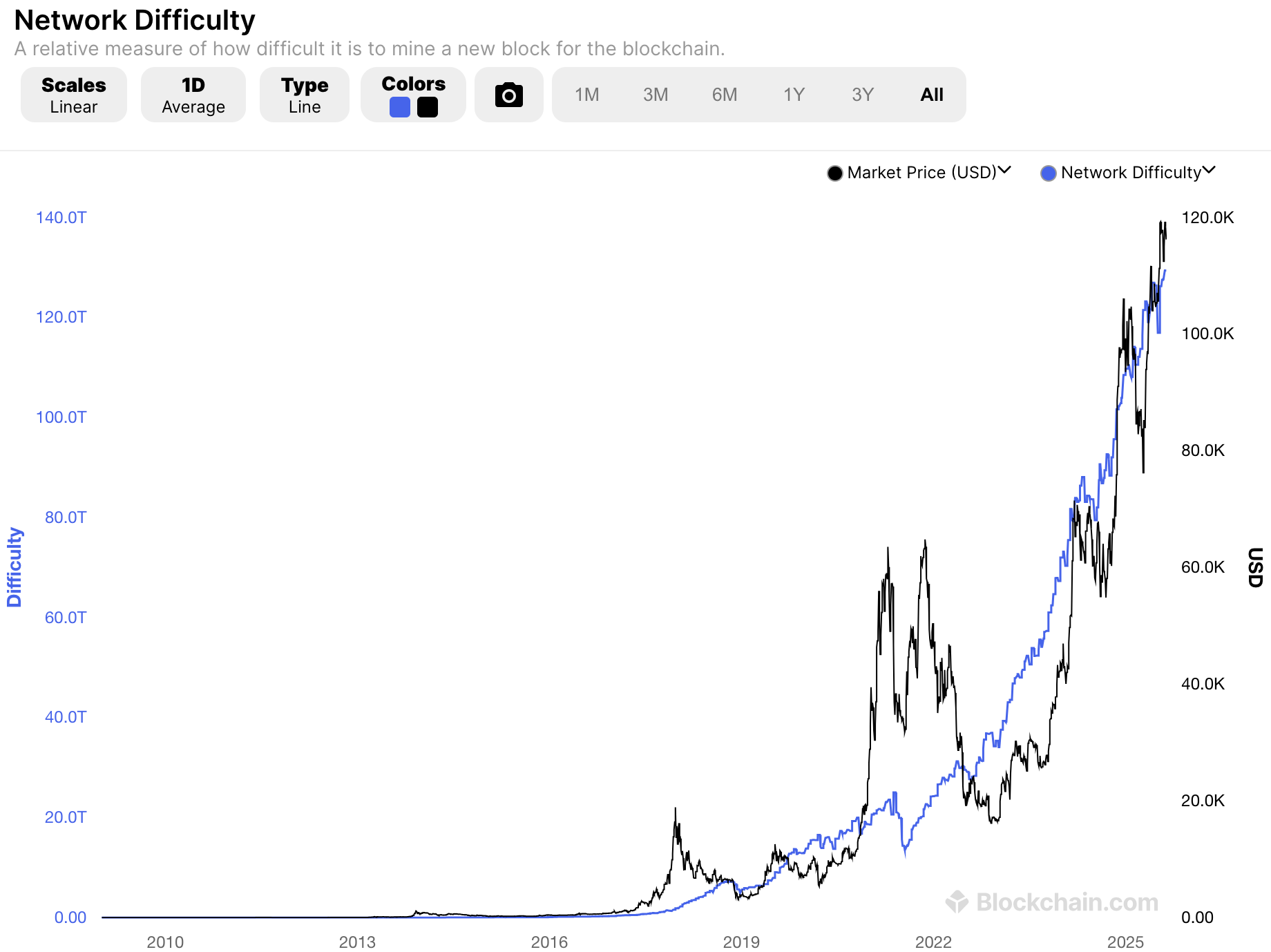 Bitcoin difficulty. Source:
Blockchain.com
Experts note that executing a 51% attack on Bitcoin is extremely costly, requiring substantial infrastructure and energy resources. This high barrier makes such an attack logistically challenging despite the concentration of mining power.
Moreover, the economic incentives of mining pools may limit the likelihood of a 51% attack, as it could cause Bitcoin’s price to collapse. Such a collapse would directly harm those who control the hashrate themselves.
Nevertheless, the perception that Bitcoin is vulnerable to a 51% attack can generate significant concern among investors. This fear alone is sufficient to raise worries about systemic risk.
Disclaimer: The content of this article solely reflects the author's opinion and does not represent the platform in any capacity. This article is not intended to serve as a reference for making investment decisions.
You may also like
How much CPO demand will Nvidia Rubin Ultra generate? Bernstein: Optical value per Pod will increase fivefold
Bernstein believes that the co-packaged optics (CPO) and fiber demand driven by Nvidia's Rubin Ultra architecture will surge significantly, with the optical content per Pod rising from $1 million to $5.4 million. This will propel the size of Nvidia's optical ecosystem market to $46.8 billion by 2028 (a 91% annual increase). Although the industry faces supply bottlenecks with InP substrates, the outlook remains positive. The institution reiterates its “outperform” rating for Lumentum, Coherent, and Ciena.

UBS Q3 implements a two-way strategy with gold options, heavily invests in technology stocks, and builds positions in SK Hynix (SKHY.US)
UBS Group (UBS.US) has submitted its Q3 holdings report (13F) as of September 30, 2026.

SpaceX (SPCX.US) reportedly attempts “de-Nvidiaization” at the rack level: developing Kessel cabinets to bypass L6 compute boards, purchasing only chips
SemiAnalysis: SpaceX has developed its own Kessel cabinet, bypassing Nvidia's L6 cards to provide more options for manufacturing its own hardware.

$3.7 billion “data center power equipment prepayments” abandoned! What did "the most active buyer of gas turbines", SoftBank, see?
In the second quarter of fiscal year 2026, SoftBank reported a net loss of $7.1 billion, primarily due to a $3.7 billion impairment charge from a $9.5 billion advance payment for power generation equipment for US data centers—of which about $2.9 billion was non-refundable and effectively lost. The CFO admitted that SoftBank placed orders before the project plan was finalized, and is now conducting a comprehensive review of its procurement strategy. "The most aggressive purchaser of gas turbines has now written off the deposit in this way."
Crypto prices
More


