

Ethereum trader loss: a prominent trader turned $125,000 into tens of millions but lost most gains after reopening an ETH long; he secured a final $6.9M before a later market crash erased nearly all remaining profits.
-
“Easy come, easy go” — massive gains reversed
-
Trader peaked with $43M in profit then closed for $6.9M before re-entering a losing ETH long
-
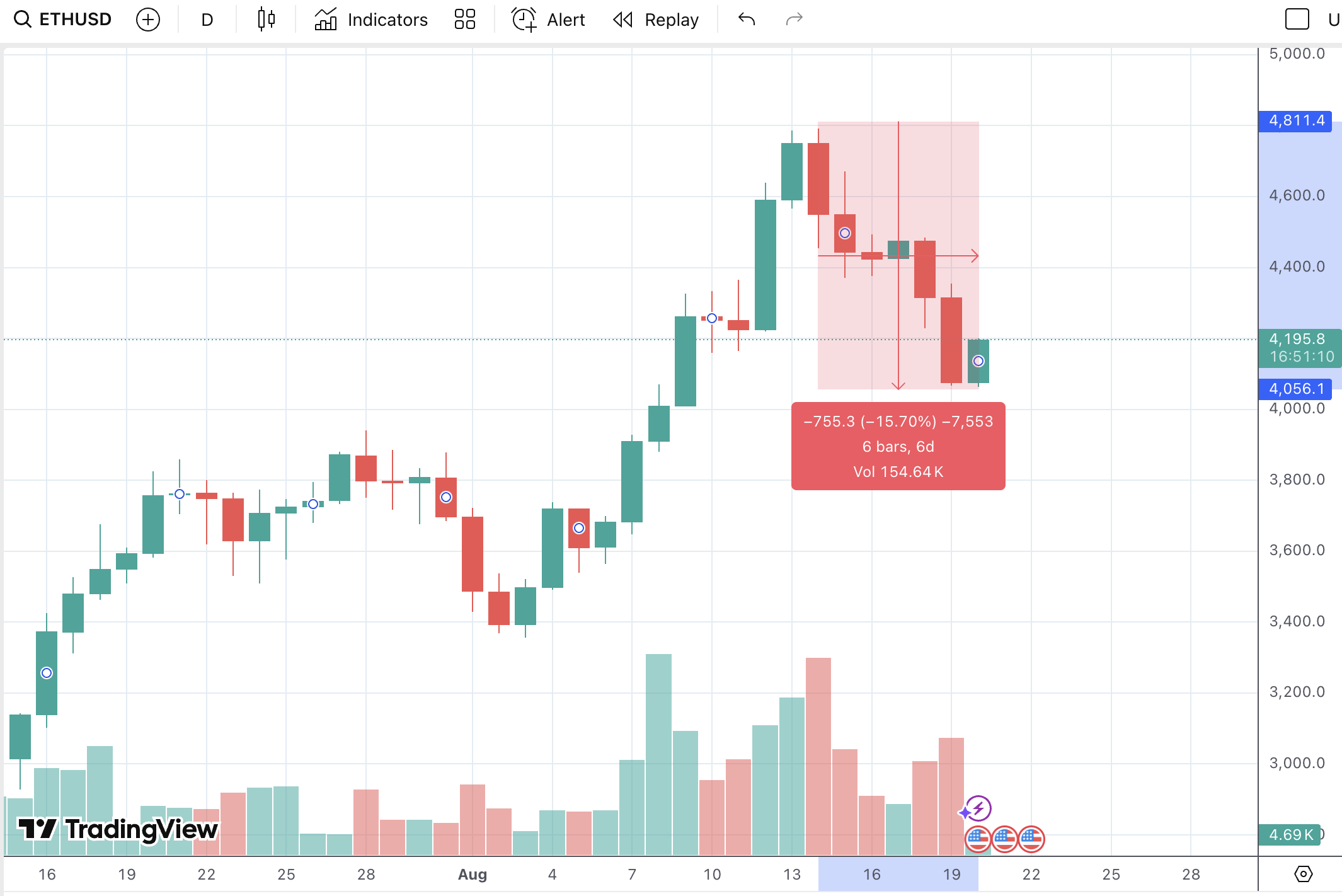
Market moved from a $4,791 local peak to a 16% intraday correction; account now ~$771,000
Ethereum trader loss: concise coverage and analysis of the ETH long liquidation, market drivers, and lessons—read on for key takeaways and next steps.
- “Easy come, easy go”
- 16% correction
A prominent trader recently lost more than $6 million after going long on Ethereum (ETH) on the verge of another market correction. The trader went from having $43 million in peak profit to securing only minor gains after reopening a new position during a volatile pullback.
What happened to the Ethereum trader?
The Ethereum trader loss occurred after a dramatic run-up and a subsequent re-entry into an ETH long that reversed most gains. The account peaked with roughly $43 million in profit, closed at $6.9 million on Aug. 18, then reopened a long and declined to about $771,000 after the recent crash.
How did the trader build such large gains?
The trader turned an initial $125,000 into $29.6 million in four months by compounding profits and repeatedly reinvesting gains into an ETH long. Over time the position swelled to an estimated $303 million notional exposure, producing an account high of approximately $43 million in unrealized profit.
Why did the trader lose most gains after the market correction?
After peaking, Ethereum experienced heightened volatility. Strong ETF inflows and corporate interest extended the rally, pushing ETH to $4,791. When momentum stalled, ETH dropped to an intraday low near $4,064 — a 16% correction from the local peak. The trader reopened a large long during that period and the subsequent downturn erased nearly all remaining profits.
Plain-text source mention: Lookonchain reported the trader’s re-entry and final account value without attaching external links.
When did the trader close and secure profits?
On Aug. 18 the trader closed all ETH longs, locking in a realized profit of $6.9 million. Though far below the peak account high, that exit still represented a 55X return on the original capital before the later re-entry wiped most gains.
What does a 16% correction mean for ETH price action?
A 16% correction from a local peak indicates a sharp short-term pullback, often driven by profit-taking, liquidations or macro risk events. For Ethereum, the move from $4,791 to roughly $4,064 marked a fast retracement that triggered losses for leveraged longs and large directional exposures.
Frequently Asked Questions
How much did the trader initially invest and how fast did gains compound?
The trader started with $125,000 and compounded returns aggressively, turning that into $29.6 million over four months by reinvesting profits into a concentrated ETH long position.
Is the trader still profitable after the crash?
Yes. Despite losing nearly all earlier gains, the trader remains up roughly 5X from the original capital with an account value around $771,000, per reported on-chain activity.
Key Takeaways
- Rapid compounding amplifies both gains and risk: Reinvesting profits into a single leveraged asset can produce large returns and catastrophic drawdowns.
- Timing and exits matter: Closing positions at peaks or during extended rallies can preserve large realized gains.
- Risk controls are essential: Position limits, stop-losses and partial profit-taking help manage volatility and protect capital.
Conclusion
This Ethereum trader loss exemplifies how concentrated, leveraged positions can produce outsized returns and equally steep reversals. COINOTAG coverage highlights the account’s path from $125K to $43M in peak profit, a realized $6.9M exit, and a later re-entry that left the account near $771K after a 16% ETH correction. Traders should prioritize risk management and consider scaling strategies to protect gains.





