
Meta to Downsize AI Division, Prompting Token Declines

Meta’s decision to cut back on AI investment and restructure its division is causing turbulence in the AI token market, with price drops seen across major assets.
A new report claims that Meta is preparing to downsize its AI division, dismissing high-level executives and introducing third-party software in its product offerings.
This has caused a lot of chaos for the AI-related token sector, which saw price drops across nearly all its leading assets. This may not precipitate a true crash, but it’s certainly a concerning sign.
Will Meta Pull Back From AI?
Meta, the parent company of Facebook and Instagram, has invested in several Web3 initiatives over the years, but it’s going all in on AI. The firm has worked on AI construction for several years, investing over $14 billion in the technology.
According to a report from The New York Times, however, Meta might be pulling back its commitments. This has understandably made some industry commentators nervous.
I think Mark Zuckerberg could single-handedly engineer a recession if and when he ever decides to scale back Meta’s AI investments.
— Conor Sen (@conorsen) August 19, 2025
Specifically, the report claims that Meta is restructuring and downsizing its AI division. This includes several high-level executives planning to leave the company, allowing third-party contractors to power its AI-centric products, and other such measures.
Token Market Tremors
So, how could this impact crypto’s AI sector? The two markets are thoroughly intertwined; AI tokens are a large market, and crypto miners are pivoting to data center construction.
Last week, OpenAI CEO Sam Altman claimed that the AI market is currently in a bubble, prompting anxiety about the related token market.
If Meta starts pulling back from AI, it might cause this bubble to pop. In the last hour, all but two of the top 30 best-performing AI tokens have depreciated in value, highlighting the concern.
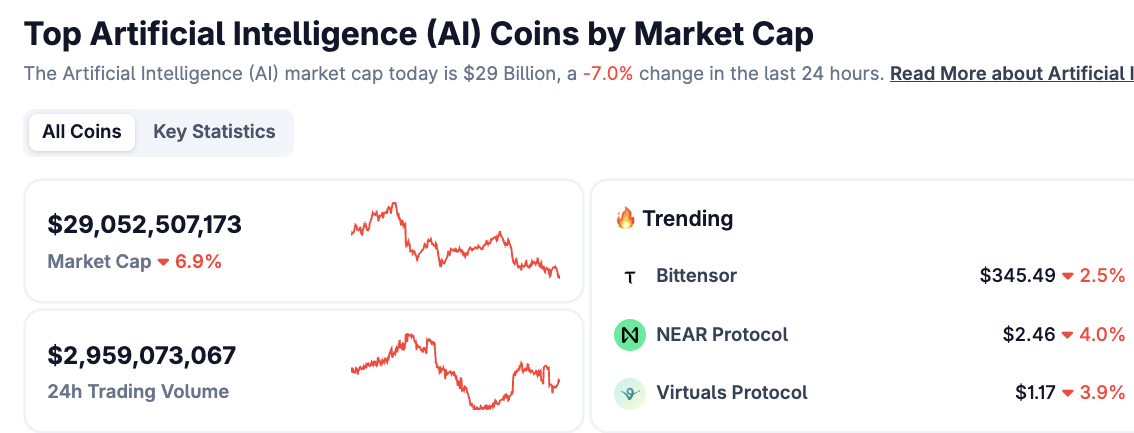 AI Tokens React to Meta Downsizing. Source:
CoinGecko
Meta recently suffered a scandal involving its AI department, where Reuters obtained documents showing the company’s internal guidelines, showing a disturbing tolerance for generating romantic or sensual content for underage users.
In other words, this scandal may also have a prominent role in Meta’s corporate restructuring plans. It’s unclear what exactly is responsible for any of these changes, assuming that they’ll happen as the NYT described.
In any event, it’s difficult to extrapolate what the long-term impact of these changes will be. Still, AI cryptoassets are largely orbiting around big builders like Meta, and an unexpected downsizing could introduce a lot of chaos.
Disclaimer: The content of this article solely reflects the author's opinion and does not represent the platform in any capacity. This article is not intended to serve as a reference for making investment decisions.
You may also like
How much CPO demand will Nvidia Rubin Ultra generate? Bernstein: Optical value per Pod will increase fivefold
Bernstein believes that the co-packaged optics (CPO) and fiber demand driven by Nvidia's Rubin Ultra architecture will surge significantly, with the optical content per Pod rising from $1 million to $5.4 million. This will propel the size of Nvidia's optical ecosystem market to $46.8 billion by 2028 (a 91% annual increase). Although the industry faces supply bottlenecks with InP substrates, the outlook remains positive. The institution reiterates its “outperform” rating for Lumentum, Coherent, and Ciena.

UBS Q3 implements a two-way strategy with gold options, heavily invests in technology stocks, and builds positions in SK Hynix (SKHY.US)
UBS Group (UBS.US) has submitted its Q3 holdings report (13F) as of September 30, 2026.

SpaceX (SPCX.US) reportedly attempts “de-Nvidiaization” at the rack level: developing Kessel cabinets to bypass L6 compute boards, purchasing only chips
SemiAnalysis: SpaceX has developed its own Kessel cabinet, bypassing Nvidia's L6 cards to provide more options for manufacturing its own hardware.

$3.7 billion “data center power equipment prepayments” abandoned! What did "the most active buyer of gas turbines", SoftBank, see?
In the second quarter of fiscal year 2026, SoftBank reported a net loss of $7.1 billion, primarily due to a $3.7 billion impairment charge from a $9.5 billion advance payment for power generation equipment for US data centers—of which about $2.9 billion was non-refundable and effectively lost. The CFO admitted that SoftBank placed orders before the project plan was finalized, and is now conducting a comprehensive review of its procurement strategy. "The most aggressive purchaser of gas turbines has now written off the deposit in this way."
Crypto prices
More


