
Wyoming launches Frontier Stable Token FRNT on Ethereum, Solana, Avalanche, and more

Key Takeaways
- Wyoming has launched FRNT, the first state-issued, fully collateralized stablecoin in the US.
- FRNT enables fast, efficient government payments and is usable globally via Visa card platforms.
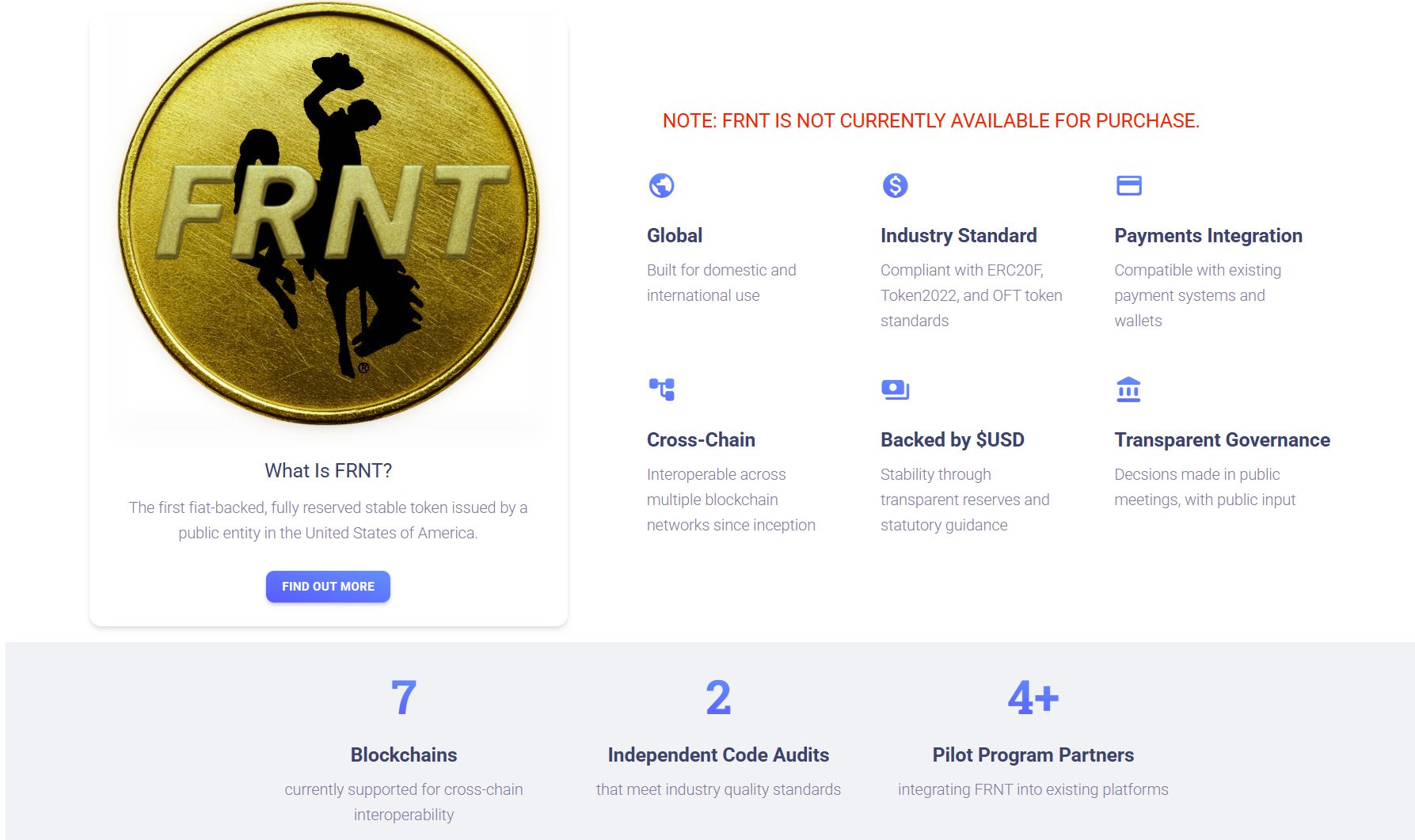
The Wyoming Stable Token Commission has launched the Frontier Stablecoin Token (FRNT) as the first dollar-pegged stablecoin issued by a US state government, which can be used for real-world transactions, according to a statement shared on Monday.
The Commission, created through the Wyoming Stable Token Act in 2023, provides governance and regulatory oversight for Wyoming’s pioneering stablecoin project.
As noted in the release, FRNT is built on Avalanche and stands out from other stablecoins as Wyoming law requires it to be overcollateralized, maintaining 102% reserves in short-term US Treasuries and dollars.
In addition to Avalanche, the token has been deployed on six other blockchains, including Arbitrum, Base, Ethereum, Optimism, Polygon, and Solana, according to the product page .
“While Wyoming has been the leading state for crypto, blockchain, and digital assets legislation for nearly a decade, the issuance of FRNT signals a paradigm shift,” said Anthony Apollo, Executive Director of the Wyoming Stable Token Commission. “In addition to regulation, public entities now have a model for innovation that can make government processes significantly more efficient.”
The state demonstrated FRNT’s utility in July 2025 through a pilot program with Hashfire, reducing government contractor payment timelines from 45 days to seconds, achieving a 99.9% efficiency improvement.
“The launch of FRNT marks the first in-production use case of a state-issued stablecoin in the United States, proving blockchain-powered government can be efficient, transparent, and designed for public good,” said John Wu, President of Ava Labs.
FRNT will be usable anywhere Visa is accepted, including through Apple Pay and Google Pay. The project combines oversight from the Wyoming Stable Token Commission, infrastructure from Avalanche, and fintech integration from Rain.
“Today’s launch is a powerful example of Rain’s mission in action. We build a financial infrastructure that makes stablecoins like FRNT instantly usable anywhere in the world,” said Farooq Malik, CEO & Co-founder of Rain.
Disclaimer: The content of this article solely reflects the author's opinion and does not represent the platform in any capacity. This article is not intended to serve as a reference for making investment decisions.
You may also like
How much CPO demand will Nvidia Rubin Ultra generate? Bernstein: Optical value per Pod will increase fivefold
Bernstein believes that the co-packaged optics (CPO) and fiber demand driven by Nvidia's Rubin Ultra architecture will surge significantly, with the optical content per Pod rising from $1 million to $5.4 million. This will propel the size of Nvidia's optical ecosystem market to $46.8 billion by 2028 (a 91% annual increase). Although the industry faces supply bottlenecks with InP substrates, the outlook remains positive. The institution reiterates its “outperform” rating for Lumentum, Coherent, and Ciena.

UBS Q3 implements a two-way strategy with gold options, heavily invests in technology stocks, and builds positions in SK Hynix (SKHY.US)
UBS Group (UBS.US) has submitted its Q3 holdings report (13F) as of September 30, 2026.

SpaceX (SPCX.US) reportedly attempts “de-Nvidiaization” at the rack level: developing Kessel cabinets to bypass L6 compute boards, purchasing only chips
SemiAnalysis: SpaceX has developed its own Kessel cabinet, bypassing Nvidia's L6 cards to provide more options for manufacturing its own hardware.

$3.7 billion “data center power equipment prepayments” abandoned! What did "the most active buyer of gas turbines", SoftBank, see?
In the second quarter of fiscal year 2026, SoftBank reported a net loss of $7.1 billion, primarily due to a $3.7 billion impairment charge from a $9.5 billion advance payment for power generation equipment for US data centers—of which about $2.9 billion was non-refundable and effectively lost. The CFO admitted that SoftBank placed orders before the project plan was finalized, and is now conducting a comprehensive review of its procurement strategy. "The most aggressive purchaser of gas turbines has now written off the deposit in this way."
Crypto prices
More


