
Will the GENIUS Act Secure U.S. Stablecoin Global Dominance?

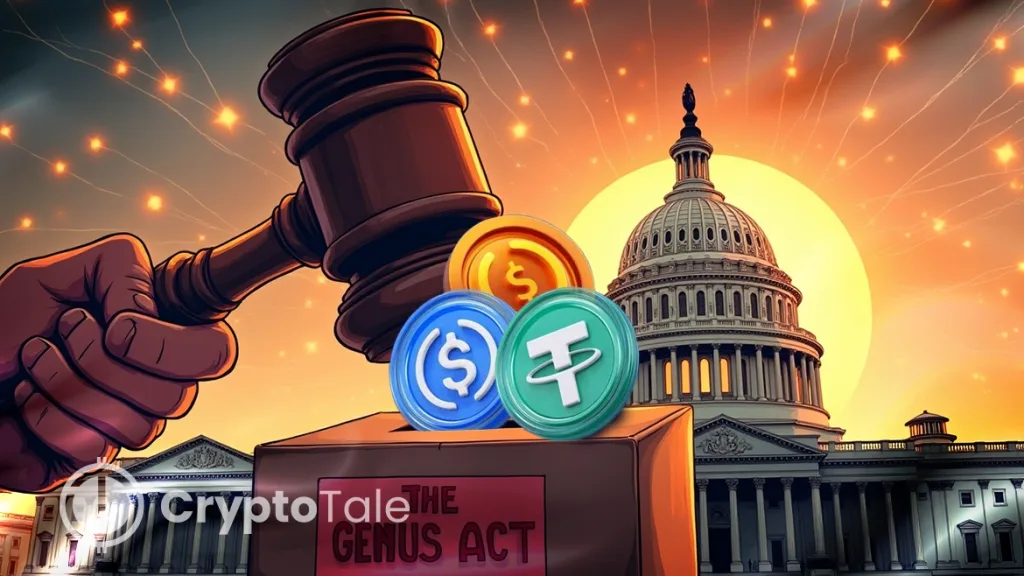
- The U.S. Treasury’s GENIUS Act seeks to regulate stablecoins and strengthen dollar usage.
- Japan and Hong Kong’s digital currency projects present growing challenges to U.S. efforts.
- The GENIUS Act aims to address risks and vulnerabilities in stablecoin adoption globally.
The U.S. Treasury has launched a public consultation on the GENIUS Act, a key piece of legislation aimed at regulating stablecoins. The consultation seeks input on how to oversee stablecoins and could accelerate the global adoption of dollar-backed digital currencies. This step is critical as the U.S. positions itself in the increasingly competitive digital finance market.
The GENIUS Act seeks to strengthen U.S. leadership in the stablecoin sector by establishing a clear regulatory framework for issuers. It also seeks to strengthen the U.S. dollar’s role in the digital economy. This legislation builds on President Trump’s Executive Order 14178, which allowed crypto investments in 401k plans. While this might not place the U.S. ahead of all global players, it ensures the country remains competitive.
Global Stablecoin Competition
Treasury Secretary Scott Bessent has characterized the GENIUS Act as a “win-win-win” for users, issuers, and the government alike. He believes that stablecoins would expand global access to the U.S. dollar and boost demand for U.S. Treasuries.
However, other countries, including Japan and Hong Kong, are already advancing their digital currency projects. The central bank of Japan is experimenting with stablecoin, and Hong Kong is progressing in projects related to its Central Bank Digital Currency (CBDC). Such efforts leave the U.S. attempts to dominate the world of digital finance with new competition. Although the GENIUS Act has good potential, there are quite a number of competitors in countries that are already on the way to developing digital currencies.
Circle CEO Jeremy Allaire has reviewed the GENIUS Act as a “step towards a safer, more transparent, and more inclusive financial system.” Although Allaire is optimistic, the instability of stablecoins, which includes regulatory weaknesses and volatility, remains a contentious issue.
The Challenges
Other international players, such as China and the European Union, are also proceeding with their own digital currencies. These projects would compete with the U.S., which may determine its future in the sphere of digital finance. Although the GENIUS Act offers clarity on regulations, this might not be sufficient to maintain American leadership over these global activities.
The consultation process would also evaluate technologies such as blockchain monitoring, artificial intelligence, and digital identity verification. Such technologies have the potential to combat illicit finance, yet they present a security challenge with privacy leakage and cybersecurity.
Related: Japan to Approve Yen-Backed Stablecoin JPYC To Challenge Dollar Power
The passage of the GENIUS Act marked a significant milestone in the U.S. digital finance landscape. It was among the first crypto-focused bills to pass through a Republican-majority Congress under Trump. As part of the GOP’s “crypto week” in July, the House also passed the Digital Asset Market Clarity (CLARITY) Act and the Anti-CBDC Surveillance State Act, both with bipartisan support.
The Senate, which would reconvene in September, has received these two bills and the GENIUS Act. r. Senate Banking Committee leaders have indicated that they would prioritize legislation around crypto market structure and aim to pass their version of the CLARITY Act by October.
While the GENIUS Act marks a pivotal point in U.S. stablecoin regulation, the country faces stiff competition from global players. Whether the U.S. could secure a competitive edge or just maintain its position remains uncertain. The coming months would reveal if the vision of a “win-win-win” for all stakeholders could be realized, or if the U.S. risks lagging behind in the evolving digital finance sector.
The post Will the GENIUS Act Secure U.S. Stablecoin Global Dominance? appeared first on Cryptotale
Disclaimer: The content of this article solely reflects the author's opinion and does not represent the platform in any capacity. This article is not intended to serve as a reference for making investment decisions.
You may also like
How much CPO demand will Nvidia Rubin Ultra generate? Bernstein: Optical value per Pod will increase fivefold
Bernstein believes that the co-packaged optics (CPO) and fiber demand driven by Nvidia's Rubin Ultra architecture will surge significantly, with the optical content per Pod rising from $1 million to $5.4 million. This will propel the size of Nvidia's optical ecosystem market to $46.8 billion by 2028 (a 91% annual increase). Although the industry faces supply bottlenecks with InP substrates, the outlook remains positive. The institution reiterates its “outperform” rating for Lumentum, Coherent, and Ciena.

UBS Q3 implements a two-way strategy with gold options, heavily invests in technology stocks, and builds positions in SK Hynix (SKHY.US)
UBS Group (UBS.US) has submitted its Q3 holdings report (13F) as of September 30, 2026.

SpaceX (SPCX.US) reportedly attempts “de-Nvidiaization” at the rack level: developing Kessel cabinets to bypass L6 compute boards, purchasing only chips
SemiAnalysis: SpaceX has developed its own Kessel cabinet, bypassing Nvidia's L6 cards to provide more options for manufacturing its own hardware.

$3.7 billion “data center power equipment prepayments” abandoned! What did "the most active buyer of gas turbines", SoftBank, see?
In the second quarter of fiscal year 2026, SoftBank reported a net loss of $7.1 billion, primarily due to a $3.7 billion impairment charge from a $9.5 billion advance payment for power generation equipment for US data centers—of which about $2.9 billion was non-refundable and effectively lost. The CFO admitted that SoftBank placed orders before the project plan was finalized, and is now conducting a comprehensive review of its procurement strategy. "The most aggressive purchaser of gas turbines has now written off the deposit in this way."
Crypto prices
More


