
Ether ETFs Surge to a Record of $2.85B While Bitcoin Trails


- Ethereum ETFs set a new record with $2.85 billion in inflows within a single week.
- Bitcoin ETFs showcased gains, posting $548 million, but trailed behind Ethereum.
- Institutional focus turned stronger toward Ethereum as its ETF assets multiplied.
Ethereum exchange-traded funds (ETFs) surged to record inflows of $2.85 billion last week, marking their strongest performance to date, while Bitcoin ETFs attracted $548 million, signaling weaker momentum. The analysis is conducted between August 11 to 15, marking a pivotal point in the competition between Bitcoin and Ethereum ETFs.
— Crypto Patel (@CryptoPatel) August 18, 2025
US Spot ETF Flows Last Week
Ethereum stole the spotlight: $2.85 BILLION in net inflows, its largest weekly inflow on record
This shows institutions are rotating heavier into $ETH exposure, signaling growing confidence in its…
Record-Breaking Ethereum Inflows
Dominating the market, BlackRock’s ETHA spearheaded the inflows, capturing $2.32 billion, while Fidelity’s FETH added $361.23 million. Grayscale’s Ether Mini Trust secured $219.58 million, although its ETHE counterpart posted a $71.57 million outflow.
Further, Vaneck’s ETHV contributed $14.36 million, Franklin’s EZET registered $8.48 million, Invesco’s QETH added $2.26 million, and 21Shares’ CETH captured $1.26 million. Collectively, these inflows created Ethereum’s largest single-week accumulation, confirming heightened institutional interest in Ether-based products.
Ethereum also recorded its largest daily inflow ever on August 11, with $1.02 billion. Later, on August 13, the second-largest daily inflow of $729 million was witnessed. This sequence of gains boosted Ethereum ETF net assets to $28.15 billion, now accounting for 5.3% of the asset’s total market capitalization.
Bitcoin’s Inflows Fall Short
As Ethereum ETFs gained the upper hand, Bitcoin ETFs trailed, although they showcased significant gains. BlackRock’s IBIT led inflows with $887.82 million, while Grayscale’s Bitcoin Mini Trust captured $32.97 million. Invesco’s BTCO followed with $4.90 million. Despite these entries, outflows weighed heavily on the sector. Ark 21Shares’ ARKB faced redemptions of $183.92 million, Grayscale’s GBTC shed $95.96 million, Fidelity’s FBTC posted $73.78 million in outflows, Bitwise’s BITB lost $18.36 million, and Vaneck’s HODL declined by $5.85 million.
The week came to a close with Bitcoin ETFs pulling in $547.82 million in net inflows amid market volatility. Trading volume hit $20.8 billion, more than Ethereum, scoring net inflows with relatively stronger consistency. In view, total ETF assets for Bitcoin grew to $150.89 billion, thereby establishing its dominance. However, the inflows never rose above the $500 million level, thus limiting their momentum within the week.
Ethereum’s ETF growth is being attributed to the decentralized finance ecosystem and the use of smart contracts. Analysts report that investors view the Ethereum-based products as scalable and liquid investment options, and the demand enabled the wholesalers to widen their product offerings with the inclusion of NEOS’ High Income Ethereum ETF, which uses liquidity as an investment strategy. With billions flowing into Ethereum ETFs, institutions are finding new foundations for long-term exposure.
On-Chain Data Snapshot
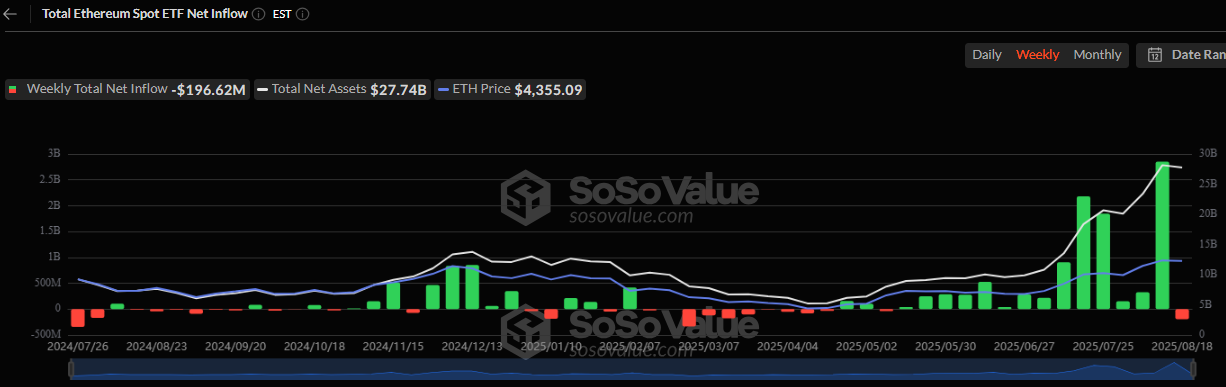
On-chain data from SoSoValue confirmed Ethereum spot ETFs logged a weekly net outflow of $196.62 million. Despite this, total net assets climbed to $27.74 billion while Ethereum’s market price rose to $4,355.09.
Source: SosoValue
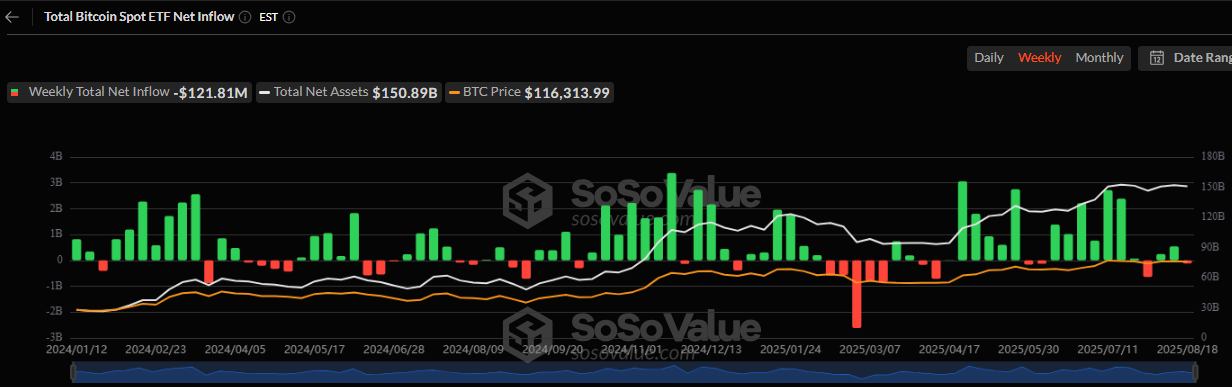
Funds channeled $121.81 million out of Bitcoin ETFs for the week, even as the total asset value swelled to $150.89 billion. The price of Bitcoin was set at $116,313.99, after volatile moves were witnessed in early 2025.
Source: SosoValue
Comparative performance shows stronger inflows into Ethereum ETFs, most prominently in July and August 2025, when there were repeated inflows of over a billion. While Bitcoin ETFs rank larger in scale, they decline in terms of consistent flows and investor appetite. Overall, the data points to a changing landscape where Ethereum ETF offerings are progressively positioning themselves to be the institutional alternative to Bitcoin.
Disclaimer: The content of this article solely reflects the author's opinion and does not represent the platform in any capacity. This article is not intended to serve as a reference for making investment decisions.
You may also like
How much CPO demand will Nvidia Rubin Ultra generate? Bernstein: Optical value per Pod will increase fivefold
Bernstein believes that the co-packaged optics (CPO) and fiber demand driven by Nvidia's Rubin Ultra architecture will surge significantly, with the optical content per Pod rising from $1 million to $5.4 million. This will propel the size of Nvidia's optical ecosystem market to $46.8 billion by 2028 (a 91% annual increase). Although the industry faces supply bottlenecks with InP substrates, the outlook remains positive. The institution reiterates its “outperform” rating for Lumentum, Coherent, and Ciena.

UBS Q3 implements a two-way strategy with gold options, heavily invests in technology stocks, and builds positions in SK Hynix (SKHY.US)
UBS Group (UBS.US) has submitted its Q3 holdings report (13F) as of September 30, 2026.

SpaceX (SPCX.US) reportedly attempts “de-Nvidiaization” at the rack level: developing Kessel cabinets to bypass L6 compute boards, purchasing only chips
SemiAnalysis: SpaceX has developed its own Kessel cabinet, bypassing Nvidia's L6 cards to provide more options for manufacturing its own hardware.

$3.7 billion “data center power equipment prepayments” abandoned! What did "the most active buyer of gas turbines", SoftBank, see?
In the second quarter of fiscal year 2026, SoftBank reported a net loss of $7.1 billion, primarily due to a $3.7 billion impairment charge from a $9.5 billion advance payment for power generation equipment for US data centers—of which about $2.9 billion was non-refundable and effectively lost. The CFO admitted that SoftBank placed orders before the project plan was finalized, and is now conducting a comprehensive review of its procurement strategy. "The most aggressive purchaser of gas turbines has now written off the deposit in this way."
Crypto prices
More


