
Here’s XRP Price by 2050 as the XRPL Burns 985,000 XRP a Year

With the XRPL burning nearly 1 million XRP every year, how could this supply reduction impact XRP price by 2050?
Notably, XRP’s total supply today stands at 99,985,821,508 (99.985 billion) tokens, slightly lower than the original 100 billion that launched with the network. This drop comes from its built-in burn mechanism, which permanently destroys a fraction of XRP during every transaction.
XRPL Burns Nearly 1M XRP Tokens a Year
However, the original architects did not design this system for its price impact. Despite this, several market watchers now believe that the ongoing supply reduction could help create a sense of scarcity that supports price growth.
However, the extent of such impact remains uncertain. As a result, we asked ChatGPT to model different outcomes through 2050. For context, XRP trades at $2.95 today. Considering this, the chatbot outlined three bullish scenarios based on adoption, liquidity growth, and global use cases.
XRP Price Prospects by 2050 With and Without Burns
In the first scenario, it assumed that banks, remittance companies, and fintechs will adopt XRP over the next 25 years. In this scenario, even without the burn, a compound annual growth rate of 6-8% could lift prices to between $18 and $25 by 2050.
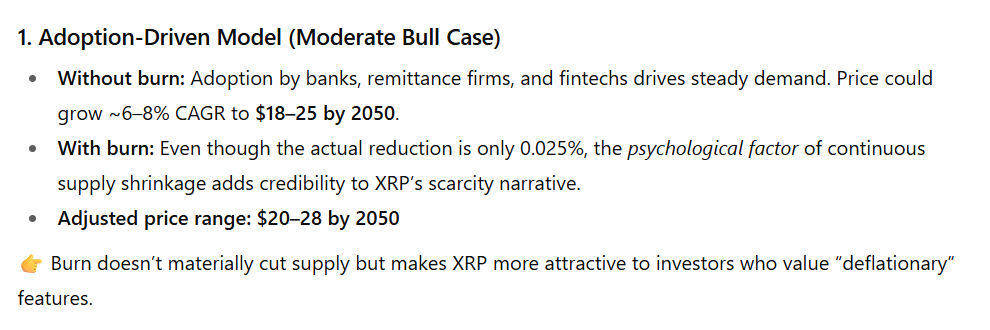
However, with the burn adding a sense of shrinking supply, ChatGPT suggests that the range could move slightly higher to $20 to $28. Here, the burn acts less as a mathematical driver and more as a psychological one.
Meanwhile, the second scenario imagines XRP becoming a major liquidity hub for cross-border payments, central bank digital currencies, and tokenized assets. If adoption grows at 12-15% annually, XRP could climb to $150 to $250 by 2050.
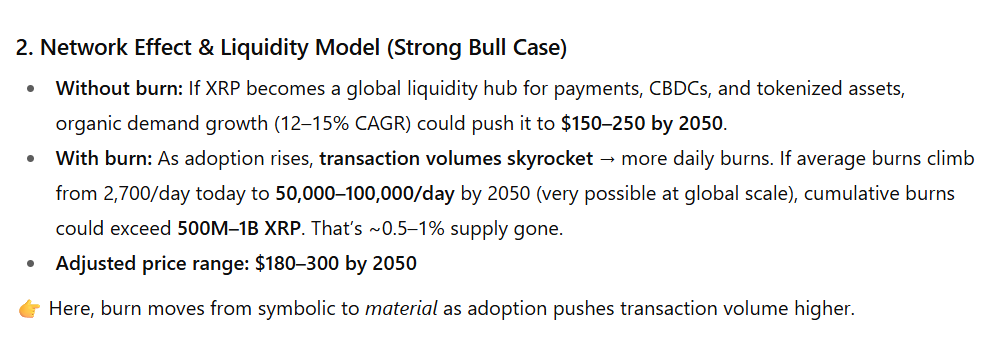
ChatGPT suggested that at this level of use, daily burns would rise as well. If the average burn rate grew from today’s 2,700 to as high as 100,000 tokens a day, the network could permanently remove 500 million to 1 billion XRP. This amounts to roughly 1% of the supply, which could push the price range higher to between $180 and $300.
In the third scenario, ChatGPT noted that XRP could serve as a neutral global reserve settlement asset for trillions in daily flows. Under this outlook, it predicts XRP to rise $1,000 to $2,500 without factoring in the burn.
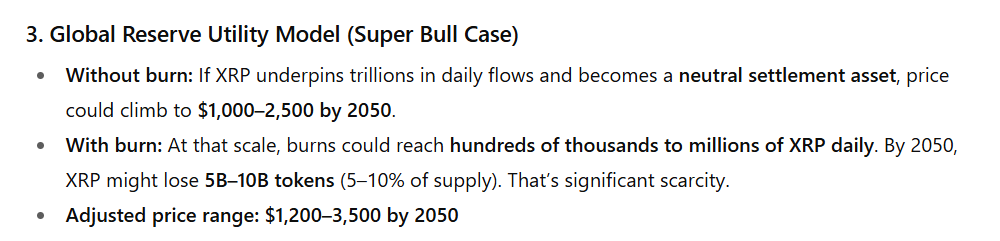
However, if activity grew so large that the network destroyed hundreds of thousands of tokens each day, XRP could lose 5 to 10 billion from its total supply. This 5-10% reduction would represent meaningful scarcity, raising potential valuations to $1,200 to $3,500.
Disclaimer: The content of this article solely reflects the author's opinion and does not represent the platform in any capacity. This article is not intended to serve as a reference for making investment decisions.
You may also like
How much CPO demand will Nvidia Rubin Ultra generate? Bernstein: Optical value per Pod will increase fivefold
Bernstein believes that the co-packaged optics (CPO) and fiber demand driven by Nvidia's Rubin Ultra architecture will surge significantly, with the optical content per Pod rising from $1 million to $5.4 million. This will propel the size of Nvidia's optical ecosystem market to $46.8 billion by 2028 (a 91% annual increase). Although the industry faces supply bottlenecks with InP substrates, the outlook remains positive. The institution reiterates its “outperform” rating for Lumentum, Coherent, and Ciena.

UBS Q3 implements a two-way strategy with gold options, heavily invests in technology stocks, and builds positions in SK Hynix (SKHY.US)
UBS Group (UBS.US) has submitted its Q3 holdings report (13F) as of September 30, 2026.

SpaceX (SPCX.US) reportedly attempts “de-Nvidiaization” at the rack level: developing Kessel cabinets to bypass L6 compute boards, purchasing only chips
SemiAnalysis: SpaceX has developed its own Kessel cabinet, bypassing Nvidia's L6 cards to provide more options for manufacturing its own hardware.

$3.7 billion “data center power equipment prepayments” abandoned! What did "the most active buyer of gas turbines", SoftBank, see?
In the second quarter of fiscal year 2026, SoftBank reported a net loss of $7.1 billion, primarily due to a $3.7 billion impairment charge from a $9.5 billion advance payment for power generation equipment for US data centers—of which about $2.9 billion was non-refundable and effectively lost. The CFO admitted that SoftBank placed orders before the project plan was finalized, and is now conducting a comprehensive review of its procurement strategy. "The most aggressive purchaser of gas turbines has now written off the deposit in this way."
Crypto prices
More


