
Ether ETFs hit record high with $3,75 billion in weekly inflows

- Ether ETFs concentrate the largest weekly volume in cryptocurrencies
- ETF trading hits historic high in the market
- Bitcoin and altcoins see more restrained flows
Cryptocurrency investment funds had a week marked by strong fundraising, led by products linked to Ether. Reports Recent data indicate that ETFs and ETPs totaled approximately US$3,75 billion in inflows in the week ending Friday, reflecting the enthusiasm surrounding the asset, which was traded at close to US$4.700.
Ether (ETH) is currently trading at $4.347,29, down 3,8% in the last 24 hours, a movement that reflects volatility even during a period of strong capital inflows into funds related to the token.
Despite the significant increase throughout the week, the movement was not linear. After four consecutive days of inflows, some investors reduced their positions on Friday, generating outflows in both Ether and Bitcoin funds, according to data from SoSoValue. Still, the final balance was largely positive for Ether ETFs.
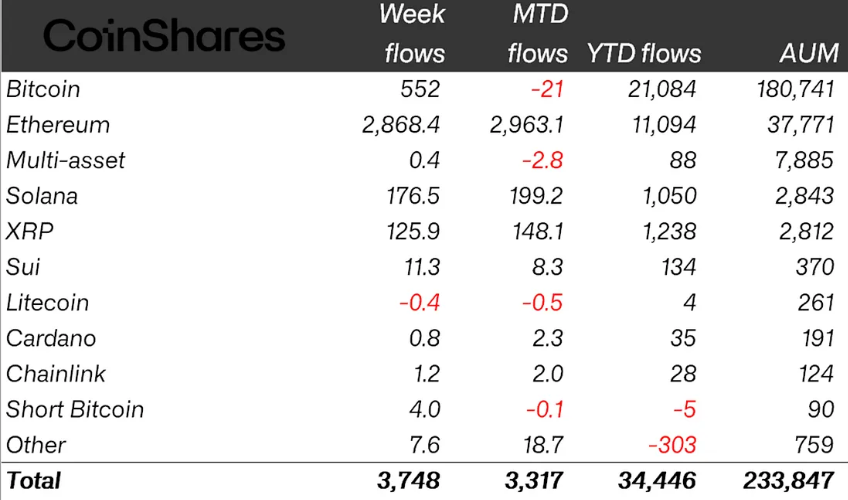
Bitcoin surpassed $124.000 on Wednesday, but its ETFs failed to attract the same level of interest. Inflows totaled $552 million, representing around 15% of the weekly volume. Ether-linked products accounted for approximately $2,9 billion, reinforcing the growing demand for exposure to this altcoin.
Other assets also saw significant movements. Solana received approximately $176,5 million in new inflows, while XRP attracted $125,9 million. Conversely, Litecoin and Toncoin saw small outflows, amounting to $0,4 million and $1 million, respectively.
According to Bloomberg analyst Eric Balchunas, the period represented a milestone for publicly traded cryptocurrency funds. He noted that, in just four trading days, spot Bitcoin and Ether ETFs moved $40 billion. "ETHSANITY: Weekly Ether ETF volume was about $17 billion, breaking a record. Man, they woke up in July," he commented.
The data also suggests a shift in the flow pattern. Inflow streaks have been shorter compared to previous months. Since August 5, Ether ETFs have raised $3,7 billion in just eight days, while Bitcoin ETFs have raised $1,3 billion in seven days. This shows that interest in Ether ETFs remains strong, albeit with shorter inflow intervals.
Disclaimer: The content of this article solely reflects the author's opinion and does not represent the platform in any capacity. This article is not intended to serve as a reference for making investment decisions.
You may also like
How much CPO demand will Nvidia Rubin Ultra generate? Bernstein: Optical value per Pod will increase fivefold
Bernstein believes that the co-packaged optics (CPO) and fiber demand driven by Nvidia's Rubin Ultra architecture will surge significantly, with the optical content per Pod rising from $1 million to $5.4 million. This will propel the size of Nvidia's optical ecosystem market to $46.8 billion by 2028 (a 91% annual increase). Although the industry faces supply bottlenecks with InP substrates, the outlook remains positive. The institution reiterates its “outperform” rating for Lumentum, Coherent, and Ciena.

UBS Q3 implements a two-way strategy with gold options, heavily invests in technology stocks, and builds positions in SK Hynix (SKHY.US)
UBS Group (UBS.US) has submitted its Q3 holdings report (13F) as of September 30, 2026.

SpaceX (SPCX.US) reportedly attempts “de-Nvidiaization” at the rack level: developing Kessel cabinets to bypass L6 compute boards, purchasing only chips
SemiAnalysis: SpaceX has developed its own Kessel cabinet, bypassing Nvidia's L6 cards to provide more options for manufacturing its own hardware.

$3.7 billion “data center power equipment prepayments” abandoned! What did "the most active buyer of gas turbines", SoftBank, see?
In the second quarter of fiscal year 2026, SoftBank reported a net loss of $7.1 billion, primarily due to a $3.7 billion impairment charge from a $9.5 billion advance payment for power generation equipment for US data centers—of which about $2.9 billion was non-refundable and effectively lost. The CFO admitted that SoftBank placed orders before the project plan was finalized, and is now conducting a comprehensive review of its procurement strategy. "The most aggressive purchaser of gas turbines has now written off the deposit in this way."
Crypto prices
More


