
Tokenized assets double in a year as Wall Street pushes into on-chain finance

Stablecoins still account for 90% of all RWAs, but other segments are growing quickly.
- RWA assets, excluding stablecoins, doubled on a yearly basis
- Private credit and tokenized treasuries are the fastest-growing RWA segment
- BlackRock’s BUIDL fund leads in the tokenized Treasury segment
Real-world assets have seen significant growth in the past year. On August 18, the total value of tokenized assets rose to $26,30 billion, up from $12.4 billion in the same time of year, according to the data from rwa.xyz.
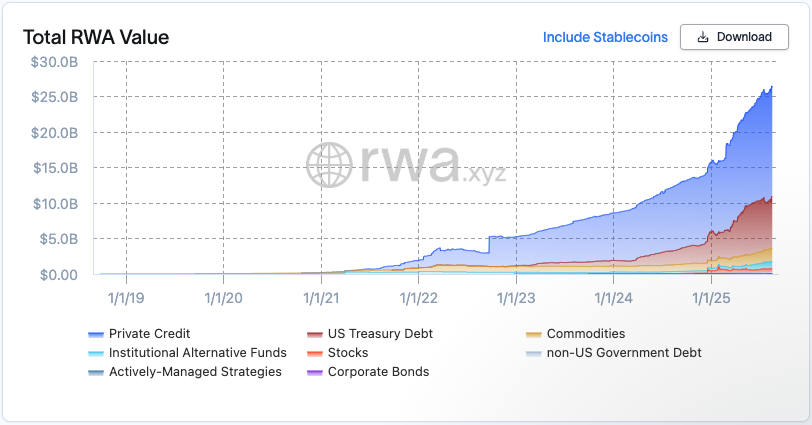 Total value of RWAs on-chain, excluding stablecoins, with breakdown by asset type | Source: RWA.xyz
Tokenized private credit was by far the biggest segment, accounting for more than half of all RWA value, at $15.3 billion. At the same time, tokenized treasuries were the segment that saw the biggest growth, rising 80% year to date to $7.31 billion.
BlackRock’s BUIDL fund, which offers tokenized U.S. Treasuries, leads among all RWA issuers, with $2.397 billion in value. Tether Gold (XAUT) tokenized gold is in second place, with $1.252 billion in value.
Why Wall Street is betting on RWAs
Tokenized assets offer investors an easier way to get exposure to traditional assets. For instance, private credit was typically available only to select banks and institutional investors. With RWAs, companies can look for funding from a broader range of investors.
The same goes for tokenized U.S. Treasuries, which offer an easy way for foreign investors to access this market. This enables Wall Street to grow the markets for its services, which is why many companies are jumping in.
Interestingly, stablecoins could be considered the biggest RWA segment. Technically tokenized cash, the total value of all stablecoins is currently $266.74 billion. This would make stablecoins over 90% of the RWA market if they were counted as RWA assets. Still, due to their different utility, they are usually not.
Disclaimer: The content of this article solely reflects the author's opinion and does not represent the platform in any capacity. This article is not intended to serve as a reference for making investment decisions.
You may also like
How much CPO demand will Nvidia Rubin Ultra generate? Bernstein: Optical value per Pod will increase fivefold
Bernstein believes that the co-packaged optics (CPO) and fiber demand driven by Nvidia's Rubin Ultra architecture will surge significantly, with the optical content per Pod rising from $1 million to $5.4 million. This will propel the size of Nvidia's optical ecosystem market to $46.8 billion by 2028 (a 91% annual increase). Although the industry faces supply bottlenecks with InP substrates, the outlook remains positive. The institution reiterates its “outperform” rating for Lumentum, Coherent, and Ciena.
UBS Q3 implements a two-way strategy with gold options, heavily invests in technology stocks, and builds positions in SK Hynix (SKHY.US)
UBS Group (UBS.US) has submitted its Q3 holdings report (13F) as of September 30, 2026.
SpaceX (SPCX.US) reportedly attempts “de-Nvidiaization” at the rack level: developing Kessel cabinets to bypass L6 compute boards, purchasing only chips
SemiAnalysis: SpaceX has developed its own Kessel cabinet, bypassing Nvidia's L6 cards to provide more options for manufacturing its own hardware.

$3.7 billion “data center power equipment prepayments” abandoned! What did "the most active buyer of gas turbines", SoftBank, see?
In the second quarter of fiscal year 2026, SoftBank reported a net loss of $7.1 billion, primarily due to a $3.7 billion impairment charge from a $9.5 billion advance payment for power generation equipment for US data centers—of which about $2.9 billion was non-refundable and effectively lost. The CFO admitted that SoftBank placed orders before the project plan was finalized, and is now conducting a comprehensive review of its procurement strategy. "The most aggressive purchaser of gas turbines has now written off the deposit in this way."
Crypto prices
More


