
Ethereum Bulls Retreat as $5,000 Dreams Fade; $4,063 in Sight

Ethereum bulls weaken after a failed recovery attempt, with bearish indicators pointing toward $4,063 while traders watch $4,793 resistance.
Leading altcoin Ethereum has trended downward since its failed attempt to reclaim its all-time high on August 13.
As sell-side pressure strengthens amid increased profit-taking, ETH’s price has slipped 10% in the past five days and is expected to continue declining.
Ethereum Bears Gain Control
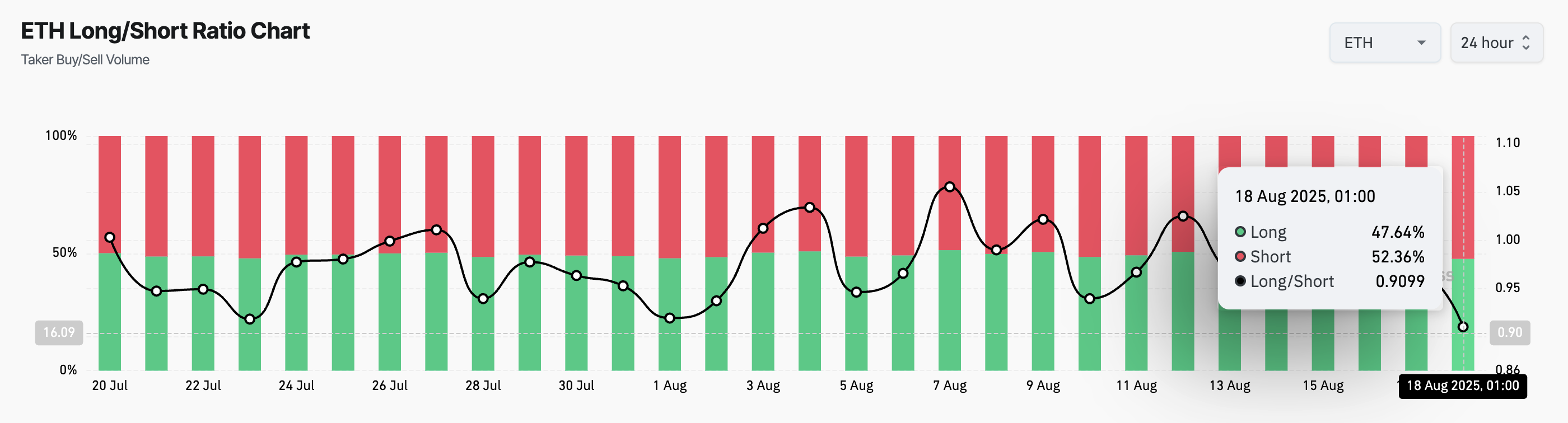
ETH’s long/short ratio has dropped to a 30-day low, reflecting traders’ growing caution and a decline in bullish sentiment. As of this writing, this ratio stands at 0.90.
For token TA and market updates: Want more token insights like this? Sign up for Editor Harsh Notariya’s Daily Crypto Newsletter here.
 ETH Long/Short Ratio. Source:
Coinglass
This ratio compares the number of long and short positions in a market. When an asset’s long/short ratio is above 1, there are more long than short positions, indicating that traders are predominantly betting on a price increase.
Conversely, as seen with ETH, a ratio under one suggests that most traders are positioning for a price drop. This highlights the growing bearish sentiment among ETH futures holders as expectations of sustained downside movements grow.
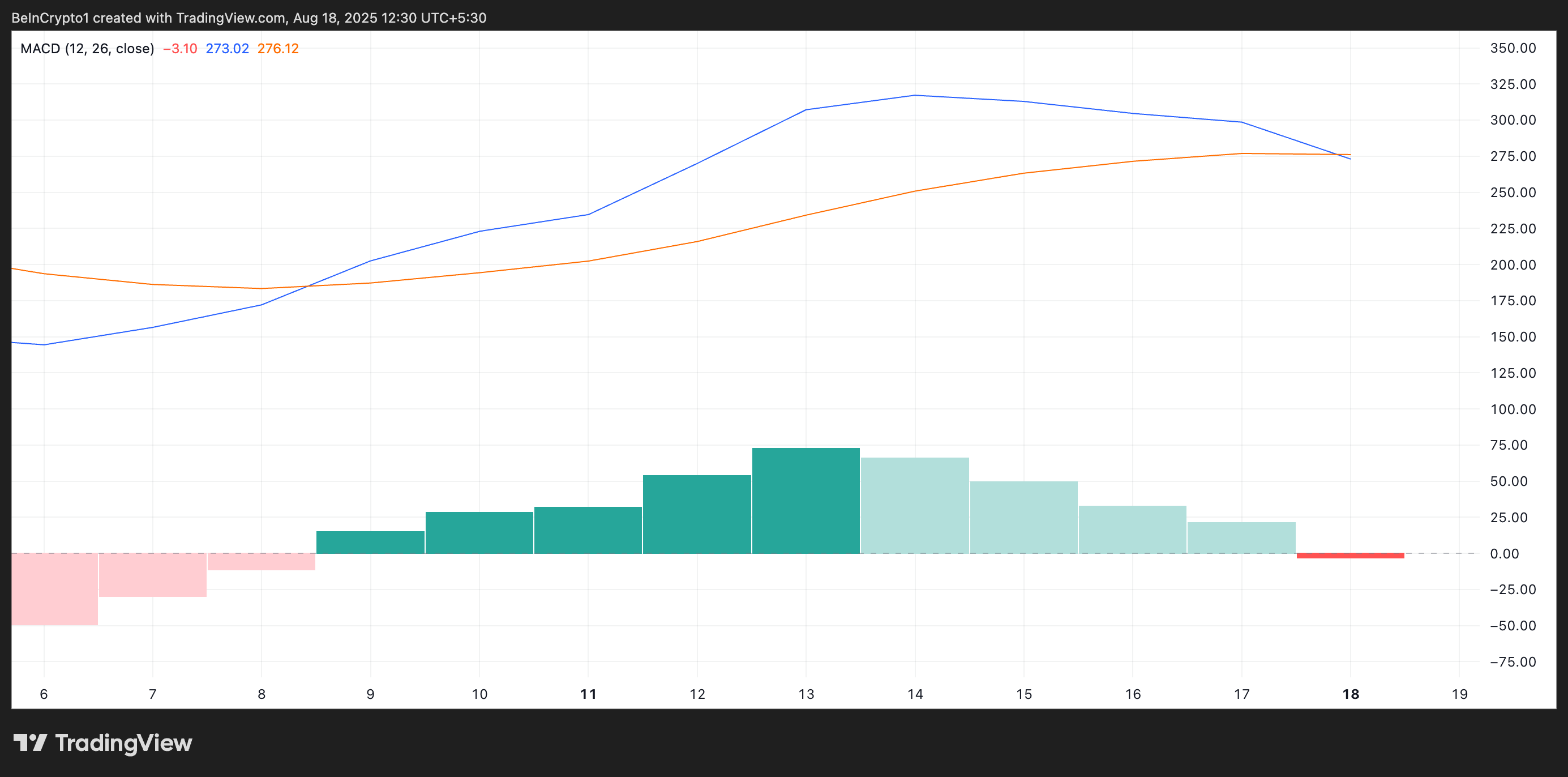
Moreover, the negative crossover in ETH’s Moving Average Convergence Divergence (MACD) during today’s session points to renewed seller dominance. At press time, the coin’s MACD line (blue) rests under its signal line (orange).
 ETH MACD. Source:
TradingView
The MACD indicator identifies trends and momentum in its price movement. It helps traders spot potential buy or sell signals through crossovers between the MACD and signal lines.
When the MACD line crosses below the signal line, it’s considered a bearish signal. It indicates that downward momentum is increasing, and sellers may be taking control.
ETH’s recent negative MACD crossover suggests that its price could continue to face selling pressure. This worsens the risk of a decline toward lower support levels near $4,000.
ETH Price Faces Critical Test
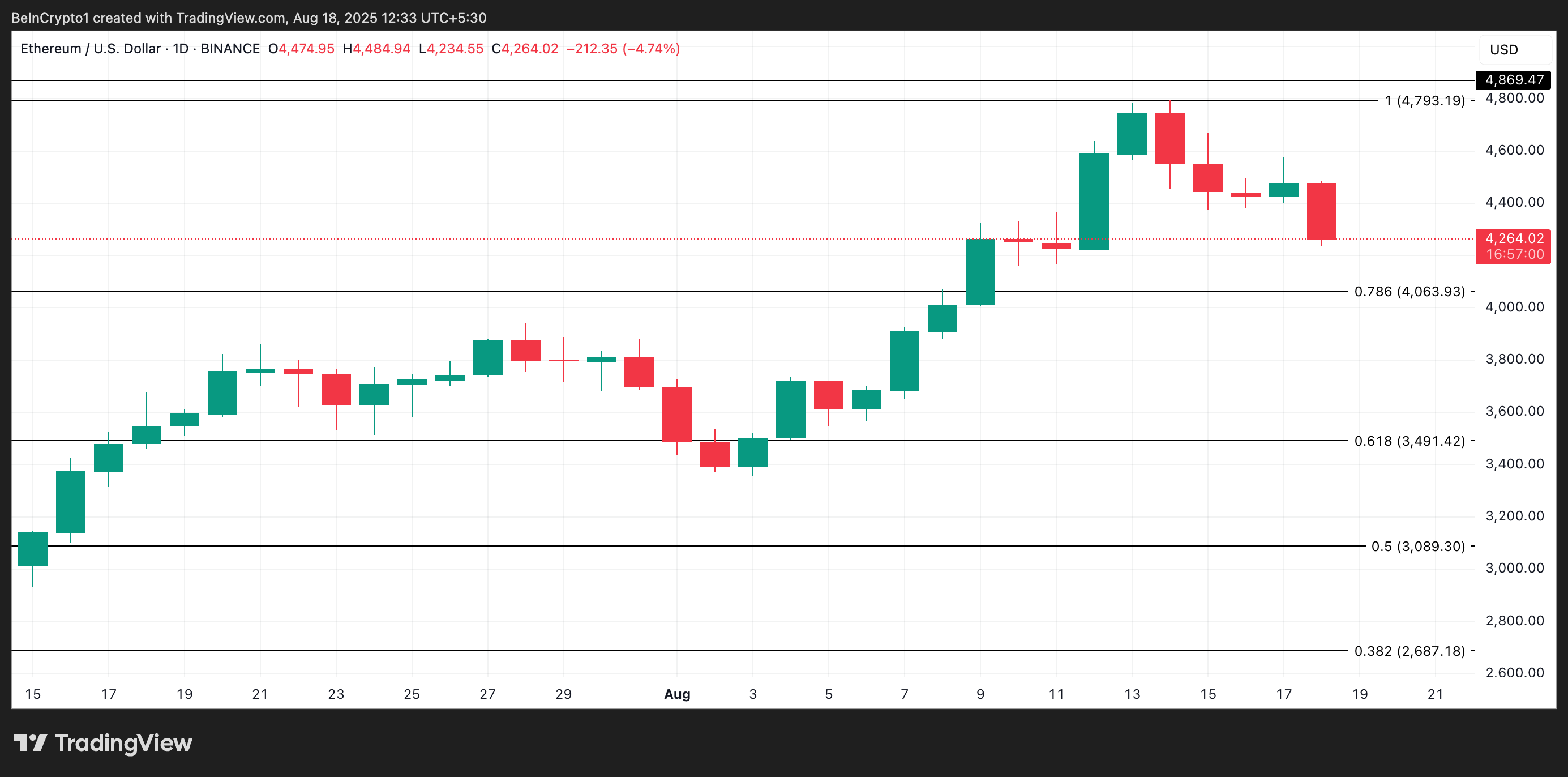
At press time, ETH trades at $4,224. If selloffs continue, the leading altcoin risks plunging toward $4,063. Should this price floor fail to hold, ETH’s price could drop to $3,491.
 ETH Price Analysis. Source:
TradingView
On the other hand, if new demand enters the market, it could drive the altcoin’s price up to $4,793. A successful break above this level could trigger a rally back to ETH’s all-time high of $4,869.
Disclaimer: The content of this article solely reflects the author's opinion and does not represent the platform in any capacity. This article is not intended to serve as a reference for making investment decisions.
You may also like
How much CPO demand will Nvidia Rubin Ultra generate? Bernstein: Optical value per Pod will increase fivefold
Bernstein believes that the co-packaged optics (CPO) and fiber demand driven by Nvidia's Rubin Ultra architecture will surge significantly, with the optical content per Pod rising from $1 million to $5.4 million. This will propel the size of Nvidia's optical ecosystem market to $46.8 billion by 2028 (a 91% annual increase). Although the industry faces supply bottlenecks with InP substrates, the outlook remains positive. The institution reiterates its “outperform” rating for Lumentum, Coherent, and Ciena.

UBS Q3 implements a two-way strategy with gold options, heavily invests in technology stocks, and builds positions in SK Hynix (SKHY.US)
UBS Group (UBS.US) has submitted its Q3 holdings report (13F) as of September 30, 2026.

SpaceX (SPCX.US) reportedly attempts “de-Nvidiaization” at the rack level: developing Kessel cabinets to bypass L6 compute boards, purchasing only chips
SemiAnalysis: SpaceX has developed its own Kessel cabinet, bypassing Nvidia's L6 cards to provide more options for manufacturing its own hardware.

$3.7 billion “data center power equipment prepayments” abandoned! What did "the most active buyer of gas turbines", SoftBank, see?
In the second quarter of fiscal year 2026, SoftBank reported a net loss of $7.1 billion, primarily due to a $3.7 billion impairment charge from a $9.5 billion advance payment for power generation equipment for US data centers—of which about $2.9 billion was non-refundable and effectively lost. The CFO admitted that SoftBank placed orders before the project plan was finalized, and is now conducting a comprehensive review of its procurement strategy. "The most aggressive purchaser of gas turbines has now written off the deposit in this way."
Crypto prices
More


