
Chainlink Price Jumps as Whales Accumulate and Supply Falls


- Whales now hold 648.36 million LINK, which equals 44 percent of the total supply.
- Exchange reserves fell to 163.4 M LINK, marking a drop from over 210M in late 2022.
- Support levels stand at $23.87 and $20.95 as bulls try to defend previous gains.
Chainlink has outperformed the broader market slump, gaining more than 5% in the past 24 hours and more than 140% in a year. While many altcoins are struggling to hold their recent gains, LINK has continued climbing, supported by whale accumulation and a shrinking supply on exchanges. This latest rally has made investors question whether the surge was a shift driven by fundamentals or was it simply speculative fuel driving a temporary spike.
Whale Activity and Exchange Balances
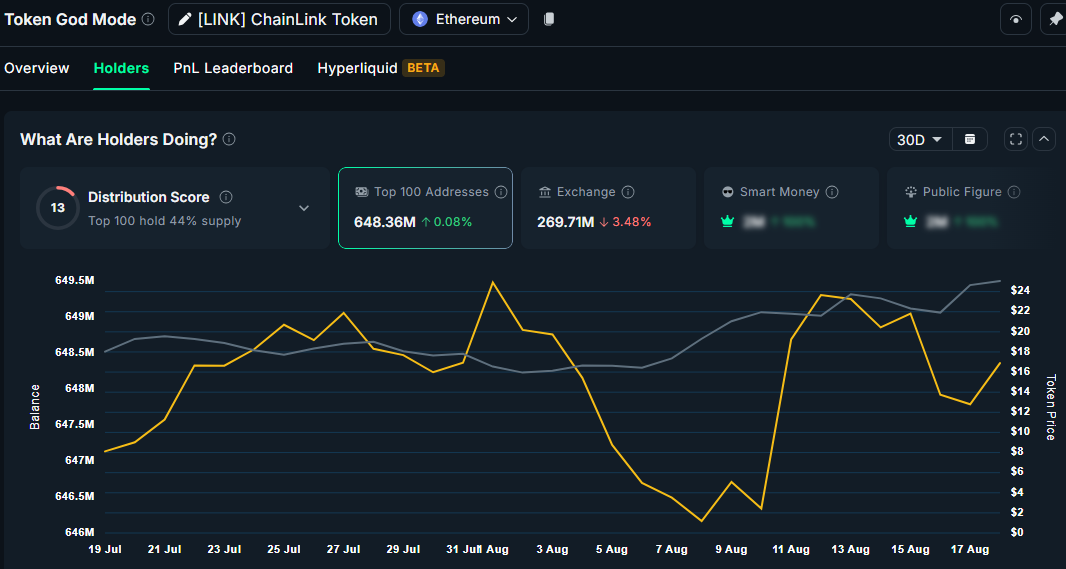
On-chain data from Nansen illustrates that whales and exchanges are moving in opposite directions. The top 100 addresses hold 648.36 million LINK, showing a 0.08% increase in the past 30 days. Added together, these addresses now are in control of 44% the supply.
 Source:
Nansen
Meanwhile, exchange balances dropped 3.48% to 269.71 million LINK, reducing liquidity available for trading. A distribution score of 13 reflects the strong concentration of LINK in the hands of large holders. From July 19 through late July, whale balances climbed above 648.5 million tokens before sliding to around 646M LINK in early August.
Exchange Reserves and Supply Pressure
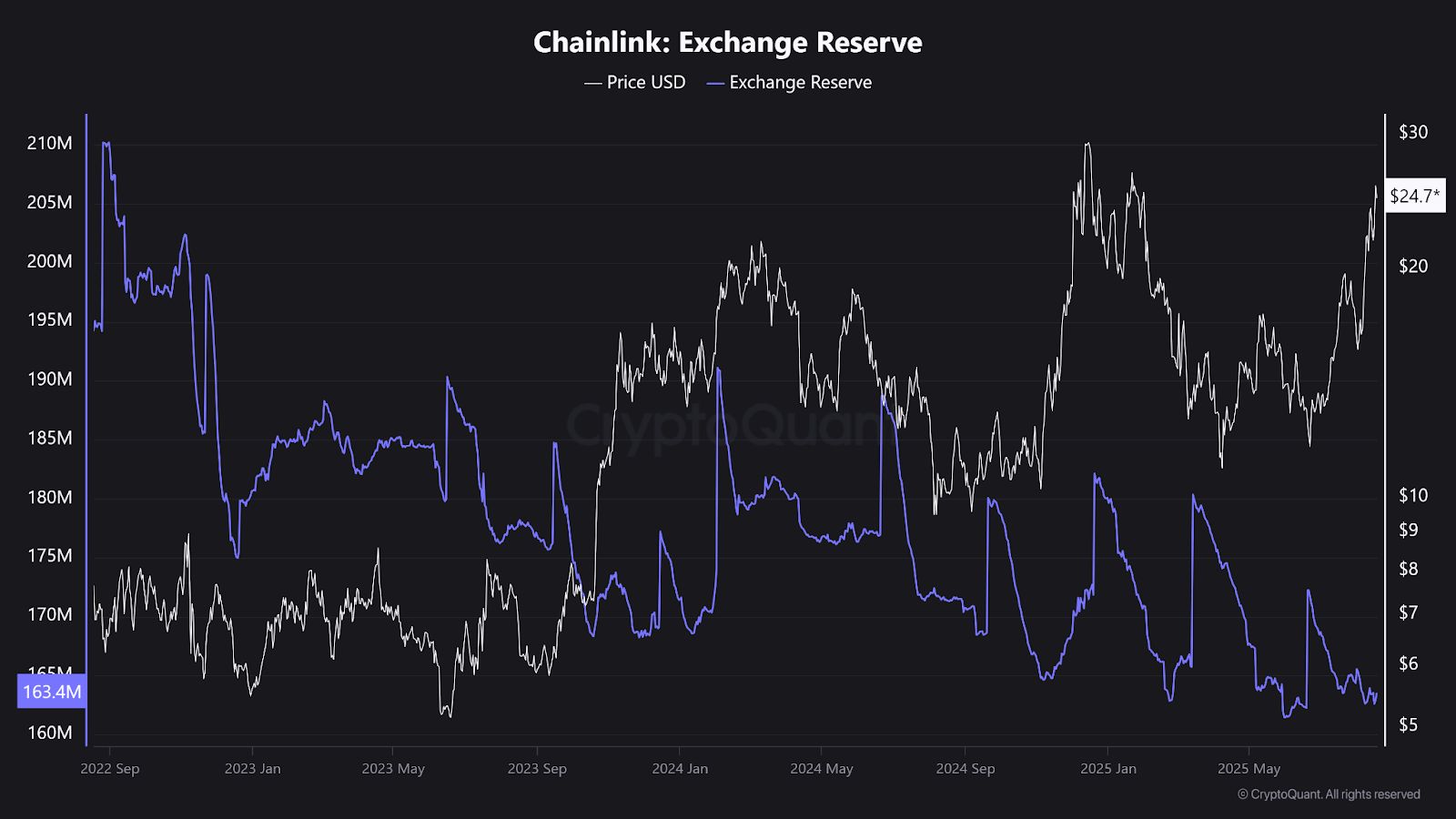
Data from CryptoQuant clearly shows a supply squeeze. Exchange reserves have dropped sharply to 163.4 million LINK, down from more than 210 million in late 2022.
 Source:
Cryptoquant
Each reserve decline since 2023 has gone hand-in-hand with upward reactions, often pushing LINK above $20. Just recently, the token rose to $24.7, its highest level in nearly two years, as reserves hit multi-year lows.
This consistent pattern shows that reduced reserves often accelerate demand-driven price gains. With fewer tokens available for sale, liquidity risks increase, which in turn strengthens upward volatility during accumulation periods.
Related: Chainlink Targets $30 as Whale Activity and OI Hit Records
Technical Breakout and Market Signals
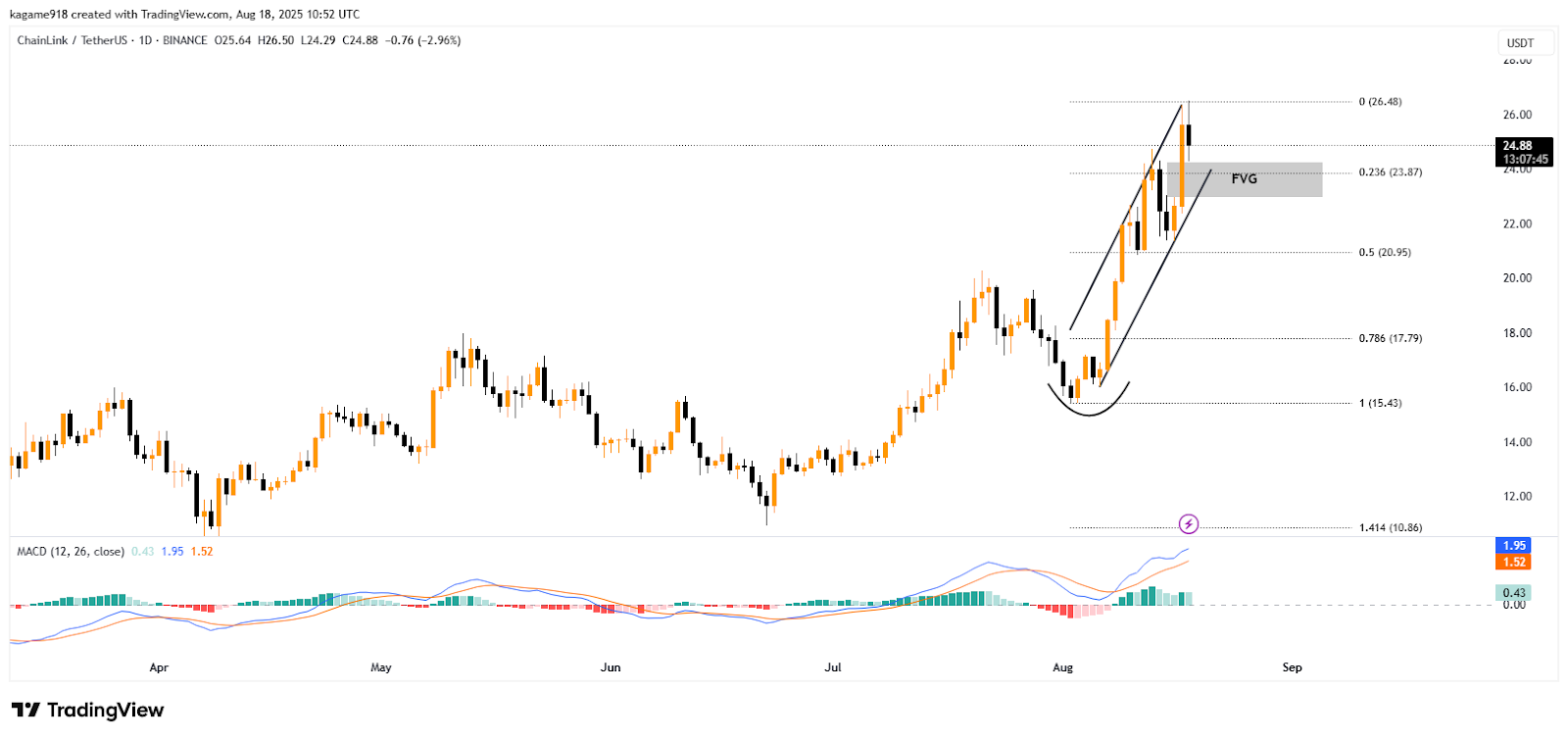
Data from TradingView shows a definite breakout to the upside. On August 18, an intraday dip of 2.96% occurred with the coin trading at $24.88 at press time. It was marked by a climb to $26.50 and a pullback to an intraday low of $24.29.
 Source:
TradingView
The price remains inside a steep ascending channel that holds a test on the upper boundary around $26.48, which incidentally also coincides with the 0% Fibonacci extension. Immediate support is seen at $23.87, equating with the 0.236 retracement and Fair Value Gap (FVG).
Further support remains at $20.95 on the 0.5 retracement and $17.79 on the 0.786. A full retracement would return to $15.43, while an extreme downside target could lie at the 1.414 Fibonacci extension of $10.86.The MACD still stays positive, with its line at 1.95 above the signal line at 1.52 and a histogram reading of 0.43. Although bullish performance continues, the histogram indicates a potential decline, suggesting a pause after the recent rally from below $16 in late July.
With whales accumulating and exchange reserves at multi-year lows, the market is likely to remain volatile. Reduced supply gives LINK long-term strength, with speculative trading driving sharp price swings, meaning the rally is fuelled by both fundamentals and speculation
The post Chainlink Price Jumps as Whales Accumulate and Supply Falls appeared first on Cryptotale.
Disclaimer: The content of this article solely reflects the author's opinion and does not represent the platform in any capacity. This article is not intended to serve as a reference for making investment decisions.
You may also like
How much CPO demand will Nvidia Rubin Ultra generate? Bernstein: Optical value per Pod will increase fivefold
Bernstein believes that the co-packaged optics (CPO) and fiber demand driven by Nvidia's Rubin Ultra architecture will surge significantly, with the optical content per Pod rising from $1 million to $5.4 million. This will propel the size of Nvidia's optical ecosystem market to $46.8 billion by 2028 (a 91% annual increase). Although the industry faces supply bottlenecks with InP substrates, the outlook remains positive. The institution reiterates its “outperform” rating for Lumentum, Coherent, and Ciena.

UBS Q3 implements a two-way strategy with gold options, heavily invests in technology stocks, and builds positions in SK Hynix (SKHY.US)
UBS Group (UBS.US) has submitted its Q3 holdings report (13F) as of September 30, 2026.

SpaceX (SPCX.US) reportedly attempts “de-Nvidiaization” at the rack level: developing Kessel cabinets to bypass L6 compute boards, purchasing only chips
SemiAnalysis: SpaceX has developed its own Kessel cabinet, bypassing Nvidia's L6 cards to provide more options for manufacturing its own hardware.

$3.7 billion “data center power equipment prepayments” abandoned! What did "the most active buyer of gas turbines", SoftBank, see?
In the second quarter of fiscal year 2026, SoftBank reported a net loss of $7.1 billion, primarily due to a $3.7 billion impairment charge from a $9.5 billion advance payment for power generation equipment for US data centers—of which about $2.9 billion was non-refundable and effectively lost. The CFO admitted that SoftBank placed orders before the project plan was finalized, and is now conducting a comprehensive review of its procurement strategy. "The most aggressive purchaser of gas turbines has now written off the deposit in this way."
Crypto prices
More


