
Bitcoin Wavers Before the "Ghost Month" and a Possible Return to $100,000

Bitcoin retreats below 117,000 dollars after a peak at 124,000. Between downward pressures linked to the ” Ghost Month ” in Asia and on-chain signals of resilience in the United States and Korea, the market hesitates. The threat of a drop to 100,000 dollars fuels tension.

Bitcoin drops after its record at $124,000: a confirmed bearish signal
After reaching a record of 124,000 dollars a few days ago, bitcoin underwent a nearly 6% drop, falling back below 117,000 dollars on August 14. The daily chart revealed a bearish engulfing pattern, a technical signal indicating a trend reversal. This episode marks the sharpest retreat of the month, reinforcing the idea of a consolidation phase.
Despite this correction, on-chain indicators highlight a strong market absorption capacity:
- The Coinbase Premium Index reached a monthly peak on August 14, evidence of increased demand in the United States.
- Meanwhile, the Kimchi Premium, an indicator specific to South Korea, returned to positive territory. Confirming a renewed appetite from local investors.
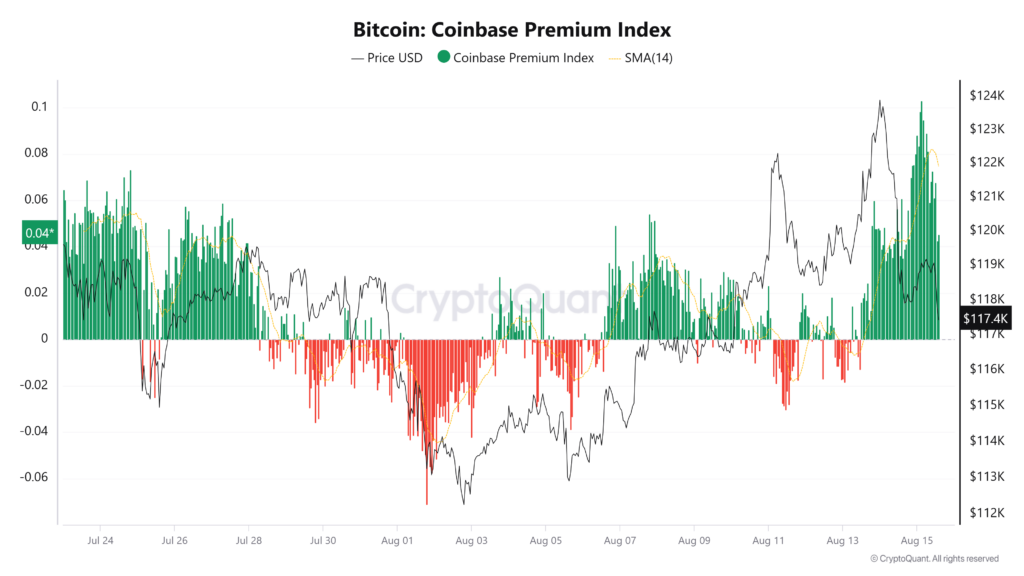 The Coinbase Premium Index reached a monthly peak on August 14.
Moreover, capitulation signals remained limited. Indeed, only 16,800 BTC were liquidated at a loss by short-term holders! This is well below the 48,000 bitcoin observed during previous corrections.
The ” Ghost Month “: when superstition weighs on Bitcoin
Beyond technical indicators, cultural seasonality plays a role. In this respect, the “Ghost Month“, which runs this year from August 23 to September 21, is seen in Asia as a period of bad omen. While this belief has no direct economic basis, its psychological impact on markets is real. Among other things, reduced risk appetite and increased profit-taking.
Historically, bitcoin has often declined during this period. Since 2017, the average drop recorded stands at 21.7%. This includes notable episodes: -39.8% in 2017 and -23% in 2021. As such, applying this pattern to the current price, an additional correction could bring BTC down to the 100,000 to 105,000 dollars range before hoping for a sustainable rebound.
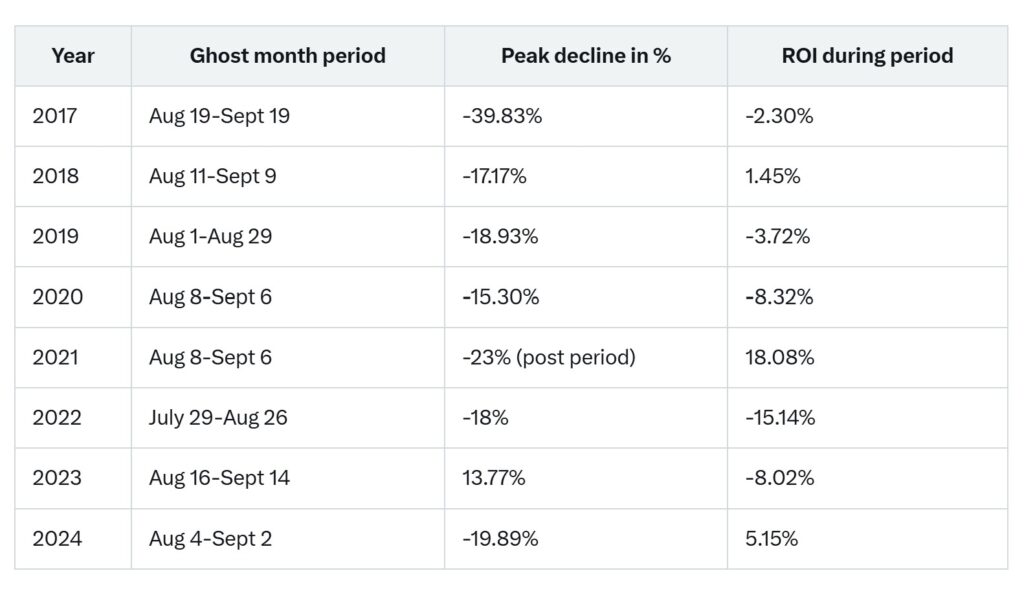 Bitcoin’s performance during previous ” Ghost Months “.
Is a return to $100,000 inevitable for BTC?
From a technical point of view, the 116,000 to 117,000 dollars zone represents a key support for bitcoin, where spot purchases and futures positions concentrate. If this base holds, the market could quickly regain an upward trajectory. Conversely, a marked retreat of BTC during the Ghost Month would reinforce the scenario of a test phase around 100,000 dollars.
In the longer term, several analysts believe that a summer correction of bitcoin due to the ” Ghost Month “ could prepare a strong bitcoin rebound in the fourth quarter. This will be supported by a recovery in institutional demand and accumulated capital flows. The central question remains whether collective psychology will yield to seasonal fear or whether fundamentals will counter this repeated cycle.
How far will the current bitcoin drop go ? Currently, BTC operates in a tension zone between signs of resilience and the threat of a seasonal correction. If the Ghost Month prolongs the decline, it may offer a long-term accumulation opportunity for investors before a possible recovery at year-end. This annual meeting of superstition and finance reminds us that collective psychology weighs as much as technical indicators on the crypto market.
Disclaimer: The content of this article solely reflects the author's opinion and does not represent the platform in any capacity. This article is not intended to serve as a reference for making investment decisions.
You may also like
How much CPO demand will Nvidia Rubin Ultra generate? Bernstein: Optical value per Pod will increase fivefold
Bernstein believes that the co-packaged optics (CPO) and fiber demand driven by Nvidia's Rubin Ultra architecture will surge significantly, with the optical content per Pod rising from $1 million to $5.4 million. This will propel the size of Nvidia's optical ecosystem market to $46.8 billion by 2028 (a 91% annual increase). Although the industry faces supply bottlenecks with InP substrates, the outlook remains positive. The institution reiterates its “outperform” rating for Lumentum, Coherent, and Ciena.

UBS Q3 implements a two-way strategy with gold options, heavily invests in technology stocks, and builds positions in SK Hynix (SKHY.US)
UBS Group (UBS.US) has submitted its Q3 holdings report (13F) as of September 30, 2026.

SpaceX (SPCX.US) reportedly attempts “de-Nvidiaization” at the rack level: developing Kessel cabinets to bypass L6 compute boards, purchasing only chips
SemiAnalysis: SpaceX has developed its own Kessel cabinet, bypassing Nvidia's L6 cards to provide more options for manufacturing its own hardware.

$3.7 billion “data center power equipment prepayments” abandoned! What did "the most active buyer of gas turbines", SoftBank, see?
In the second quarter of fiscal year 2026, SoftBank reported a net loss of $7.1 billion, primarily due to a $3.7 billion impairment charge from a $9.5 billion advance payment for power generation equipment for US data centers—of which about $2.9 billion was non-refundable and effectively lost. The CFO admitted that SoftBank placed orders before the project plan was finalized, and is now conducting a comprehensive review of its procurement strategy. "The most aggressive purchaser of gas turbines has now written off the deposit in this way."
Crypto prices
More


