
Grayscale Files to Convert Dogecoin Trust into Spot ETF, 75% Odds of Approval in 2025

Prediction markets place the odds of US approval of a Dogecoin ETF at about 75%, due to the crypto-friendly Donald Trump administration.
Grayscale has filed paperwork with the US Securities and Exchange Commission (SEC) to launch a spot Dogecoin exchange-traded fund (ETF). This move could bring one of the most well-known meme coins into mainstream investment portfolios.
The fund, set to trade on NYSE Arca under the ticker GDOG, would convert the existing Grayscale Dogecoin Trust into an ETF structure. Notably, the Trust currently holds around $2.5 million worth of assets.
Market Odds Favor a Dogecoin ETF Approval This Year
According to the Aug. 15 S-1 filing, the new ETF’s goal is to give investors direct exposure to Dogecoin’s price without requiring them to hold the asset themselves.
Grayscale Investments Sponsors, LLC and Grayscale Operating, LLC will co-sponsor the product. CSC Delaware Trust Company will act as trustee, while BNY Mellon will take on transfer agent and administrator duties.
Additionally, Coinbase and Coinbase Custody Trust Company will handle the fund’s brokerage and custody services.
But Grayscale is not alone in the race for a Dogecoin-focused fund.
Competitors Rex-Osprey and Bitwise have also submitted applications for Dogecoin ETFs, signaling growing competition to corner the meme coin investment niche.
So far, the SEC has not approved any Dogecoin ETF, reflecting its cautious stance toward altcoin-linked products. That caution stands in contrast to Europe, where the meme coin exchange-traded products have already gained traction.
Dogecoin, originally created as a joke in 2013, has grown into a top-10 digital asset with a market capitalization in the tens of billions.
Its pop-culture rise, amplified by Elon Musk and retail traders, has since evolved into significant institutional adoption. As of today, some companies now accept DOGE for payments or include it in corporate treasury strategies.
Still, risks remain. Dogecoin’s volatility and limited institutional use compared with Bitcoin and Ethereum could give the SEC pause.
However, market sentiment leans optimistic due to the current pro-crypto US government administration.
Crypto bettors on Polymarket currently assign a 75% probability that U.S. regulators will approve a DOGE ETF before year-end.
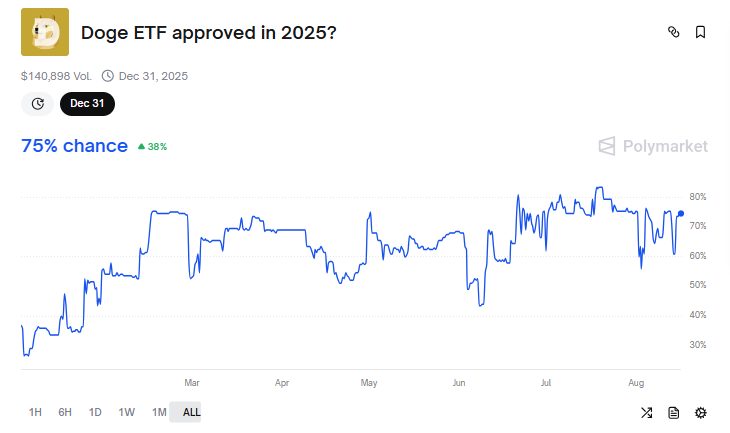 DOGE ETF Approval Odds This Year. Source: Polymarket
If approved, analysts say the product could bridge the divide between Dogecoin’s grassroots retail following and institutional capital.
Disclaimer: The content of this article solely reflects the author's opinion and does not represent the platform in any capacity. This article is not intended to serve as a reference for making investment decisions.
You may also like
How much CPO demand will Nvidia Rubin Ultra generate? Bernstein: Optical value per Pod will increase fivefold
Bernstein believes that the co-packaged optics (CPO) and fiber demand driven by Nvidia's Rubin Ultra architecture will surge significantly, with the optical content per Pod rising from $1 million to $5.4 million. This will propel the size of Nvidia's optical ecosystem market to $46.8 billion by 2028 (a 91% annual increase). Although the industry faces supply bottlenecks with InP substrates, the outlook remains positive. The institution reiterates its “outperform” rating for Lumentum, Coherent, and Ciena.

UBS Q3 implements a two-way strategy with gold options, heavily invests in technology stocks, and builds positions in SK Hynix (SKHY.US)
UBS Group (UBS.US) has submitted its Q3 holdings report (13F) as of September 30, 2026.

SpaceX (SPCX.US) reportedly attempts “de-Nvidiaization” at the rack level: developing Kessel cabinets to bypass L6 compute boards, purchasing only chips
SemiAnalysis: SpaceX has developed its own Kessel cabinet, bypassing Nvidia's L6 cards to provide more options for manufacturing its own hardware.

$3.7 billion “data center power equipment prepayments” abandoned! What did "the most active buyer of gas turbines", SoftBank, see?
In the second quarter of fiscal year 2026, SoftBank reported a net loss of $7.1 billion, primarily due to a $3.7 billion impairment charge from a $9.5 billion advance payment for power generation equipment for US data centers—of which about $2.9 billion was non-refundable and effectively lost. The CFO admitted that SoftBank placed orders before the project plan was finalized, and is now conducting a comprehensive review of its procurement strategy. "The most aggressive purchaser of gas turbines has now written off the deposit in this way."
Crypto prices
More


