
Solana hits new TVL record despite falling volume

- Solana's TVL exceeds $31 billion
- Circle accounts for 28% of the blocked value
- Trading volume down 84% since January
Following Ethereum's recent all-time high, Solana also reached a significant milestone. Data from Token Terminal indicates that Solana's total value locked (TVL) surpassed $31 billion on August 14, surpassing the previous record of $30,8 billion set in January. This growth occurs even though the SOL cryptocurrency is trading at $186—about 37% below its all-time high of $293.
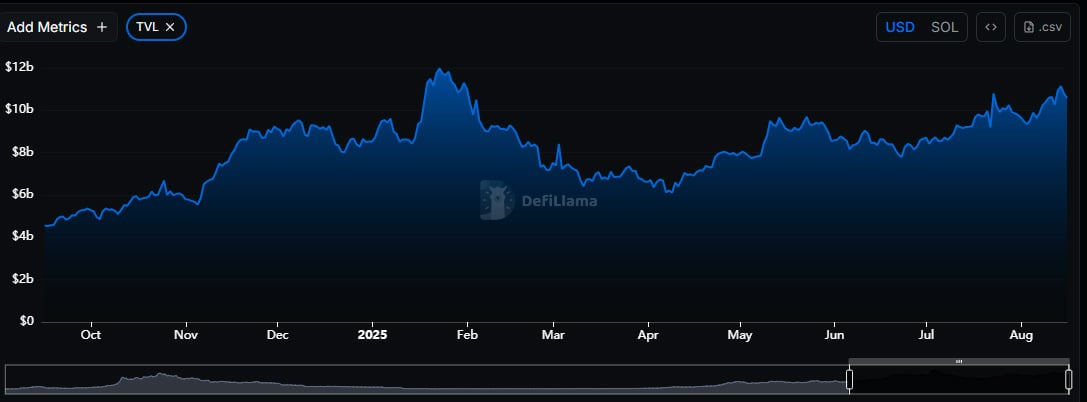
The current growth of the Solana ecosystem isn't tied to the memecoin frenzy, as it was at the beginning of the year, but rather to a more consolidated foundation. Circle, responsible for issuing USDC, is the main participant in this growth, with $8,7 billion allocated to the network, representing 28% of the total TVL. Protocols like Kamino (lending), Jupiter (DEX aggregator), and Jito (liquid staking) have a combined $10,7 billion in locked value, sustaining liquidity on the blockchain.
Despite the decline in retail interest in memecoins, institutional capital and real-world usage in DeFi protocols are keeping the ecosystem healthy. The numbers reinforce this shift: Solana's weekly trading volume fell from $103 billion in January to $16,9 billion today—an 84% drop. Cumulative fees also followed suit, falling from $530 million to $72,3 million in the same period.
Even with declining trading and revenue, funds continue to flow into decentralized applications, indicating a maturing ecosystem. The new TVL record suggests that Solana may be less dependent on speculative cycles and more anchored in real utility.
With the strengthening of established protocols and increasing liquidity, Solana now exhibits more consistent fundamentals for a potential bullish resumption. This continued growth could occur even in environments of less euphoria in the cryptocurrency market.
Disclaimer: The content of this article solely reflects the author's opinion and does not represent the platform in any capacity. This article is not intended to serve as a reference for making investment decisions.
You may also like
How much CPO demand will Nvidia Rubin Ultra generate? Bernstein: Optical value per Pod will increase fivefold
Bernstein believes that the co-packaged optics (CPO) and fiber demand driven by Nvidia's Rubin Ultra architecture will surge significantly, with the optical content per Pod rising from $1 million to $5.4 million. This will propel the size of Nvidia's optical ecosystem market to $46.8 billion by 2028 (a 91% annual increase). Although the industry faces supply bottlenecks with InP substrates, the outlook remains positive. The institution reiterates its “outperform” rating for Lumentum, Coherent, and Ciena.

UBS Q3 implements a two-way strategy with gold options, heavily invests in technology stocks, and builds positions in SK Hynix (SKHY.US)
UBS Group (UBS.US) has submitted its Q3 holdings report (13F) as of September 30, 2026.

SpaceX (SPCX.US) reportedly attempts “de-Nvidiaization” at the rack level: developing Kessel cabinets to bypass L6 compute boards, purchasing only chips
SemiAnalysis: SpaceX has developed its own Kessel cabinet, bypassing Nvidia's L6 cards to provide more options for manufacturing its own hardware.

$3.7 billion “data center power equipment prepayments” abandoned! What did "the most active buyer of gas turbines", SoftBank, see?
In the second quarter of fiscal year 2026, SoftBank reported a net loss of $7.1 billion, primarily due to a $3.7 billion impairment charge from a $9.5 billion advance payment for power generation equipment for US data centers—of which about $2.9 billion was non-refundable and effectively lost. The CFO admitted that SoftBank placed orders before the project plan was finalized, and is now conducting a comprehensive review of its procurement strategy. "The most aggressive purchaser of gas turbines has now written off the deposit in this way."
Crypto prices
More


