
Will XRP’s Next Big Cycle Begin With an ETF Approval?

The idea of market cycles has long shaped the way traders view Bitcoin and other top cryptocurrencies. Some experts believe in the four-year cycle tied to Bitcoin’s halving, which often influences the crypto market.
On the Paul Barron Podcast, Teucrium Trading’s CEO, Sal Gilbertie, was asked whether a new cycle could be forming for XRP, similar to the four-year cycle often seen with Bitcoin. He explained that while crypto cycles are not as clear as those in traditional markets, the four-year trend does hold some weight. He also pointed out that weekend trading often shows repeated patterns across different coins, which short-term traders should pay attention to.
XRP ETF on the Horizon
One of the biggest questions around XRP right now is the approval of an exchange-traded fund (ETF). Sal said that there’s a strong chance the SEC could give the green light this year. While September is a popular target, delays remain possible, but he doesn’t expect a push all the way to 2026. If approved, an XRP ETF would be big news, making it easier for traditional investors to access the token.
“I think it’ll happen this year. I don’t know about September, but I would be surprised if they push it to 2026,” he said.
Related: XRP Analysts Target $10.47 as Long-Term Bullish Cycle Persists
Banking and Swift Integration Could Be Game-Changers
According to him, two major catalysts could reshape XRP’s future: Ripple gaining a banking license and deeper involvement in cross-border payments. If Ripple becomes a regulated bank and decides to stop selling XRP in the open market, it could boost confidence and reduce supply pressure.
On the global payments front, Ripple’s blockchain solutions could challenge the Swift system. As banks begin to use XRP’s ledger for faster, cheaper transfers, they will no longer need to hold capital in multiple countries at once. This shift could free up massive amounts of liquidity, improve bank balance sheets, and fuel global economic growth.
Related: Wellgistics Health Launches XRP Ledger Payment System for 6,500+ Pharmacies
XRP Price Prediction
XRP is currently trading at $3.11. While long-term targets after a possible ETF approval are seen around $10, the short-term outlook remains uncertain. Analyst Casi Trades said that XRP dropped sharply from $3.21 to $3, but managed to hold support.
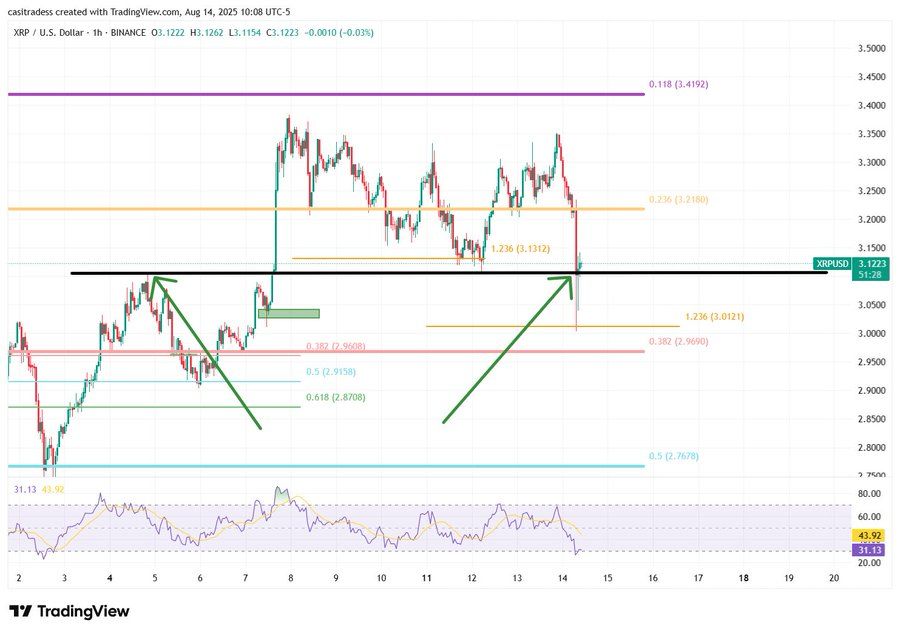
From that low, the token quickly bounced back to $3.11, regaining important retracement levels. According to the analyst, the next breakout target is near $4.70.
Disclaimer: The content of this article solely reflects the author's opinion and does not represent the platform in any capacity. This article is not intended to serve as a reference for making investment decisions.
You may also like
How much CPO demand will Nvidia Rubin Ultra generate? Bernstein: Optical value per Pod will increase fivefold
Bernstein believes that the co-packaged optics (CPO) and fiber demand driven by Nvidia's Rubin Ultra architecture will surge significantly, with the optical content per Pod rising from $1 million to $5.4 million. This will propel the size of Nvidia's optical ecosystem market to $46.8 billion by 2028 (a 91% annual increase). Although the industry faces supply bottlenecks with InP substrates, the outlook remains positive. The institution reiterates its “outperform” rating for Lumentum, Coherent, and Ciena.

UBS Q3 implements a two-way strategy with gold options, heavily invests in technology stocks, and builds positions in SK Hynix (SKHY.US)
UBS Group (UBS.US) has submitted its Q3 holdings report (13F) as of September 30, 2026.

SpaceX (SPCX.US) reportedly attempts “de-Nvidiaization” at the rack level: developing Kessel cabinets to bypass L6 compute boards, purchasing only chips
SemiAnalysis: SpaceX has developed its own Kessel cabinet, bypassing Nvidia's L6 cards to provide more options for manufacturing its own hardware.

$3.7 billion “data center power equipment prepayments” abandoned! What did "the most active buyer of gas turbines", SoftBank, see?
In the second quarter of fiscal year 2026, SoftBank reported a net loss of $7.1 billion, primarily due to a $3.7 billion impairment charge from a $9.5 billion advance payment for power generation equipment for US data centers—of which about $2.9 billion was non-refundable and effectively lost. The CFO admitted that SoftBank placed orders before the project plan was finalized, and is now conducting a comprehensive review of its procurement strategy. "The most aggressive purchaser of gas turbines has now written off the deposit in this way."
Crypto prices
More


