
Bitcoin to $144,000? BTC Faces Next Big Test at This Key Level

Bitcoin rose as high as $124,533 on Aug. 14 before taking a hit following July’s hotter-than-expected wholesale inflation data.
The July consumer price index was broadly in line with market expectations, though the core reading that excludes food and energy edged higher to 3.1%, slightly over Wall Street estimates. However, the July producer price index, which measures wholesale items, showed a surprise strong 0.9% monthly gain, the most in nearly three years.
Around the time of writing, BTC was trading down 0.77% in the last 24 hours to $117,741, following Friday's drop to a low of $116,859.
On what comes next, BTC’s average entry price for newer investors and its standard deviation bands can help to identify overheated zones.
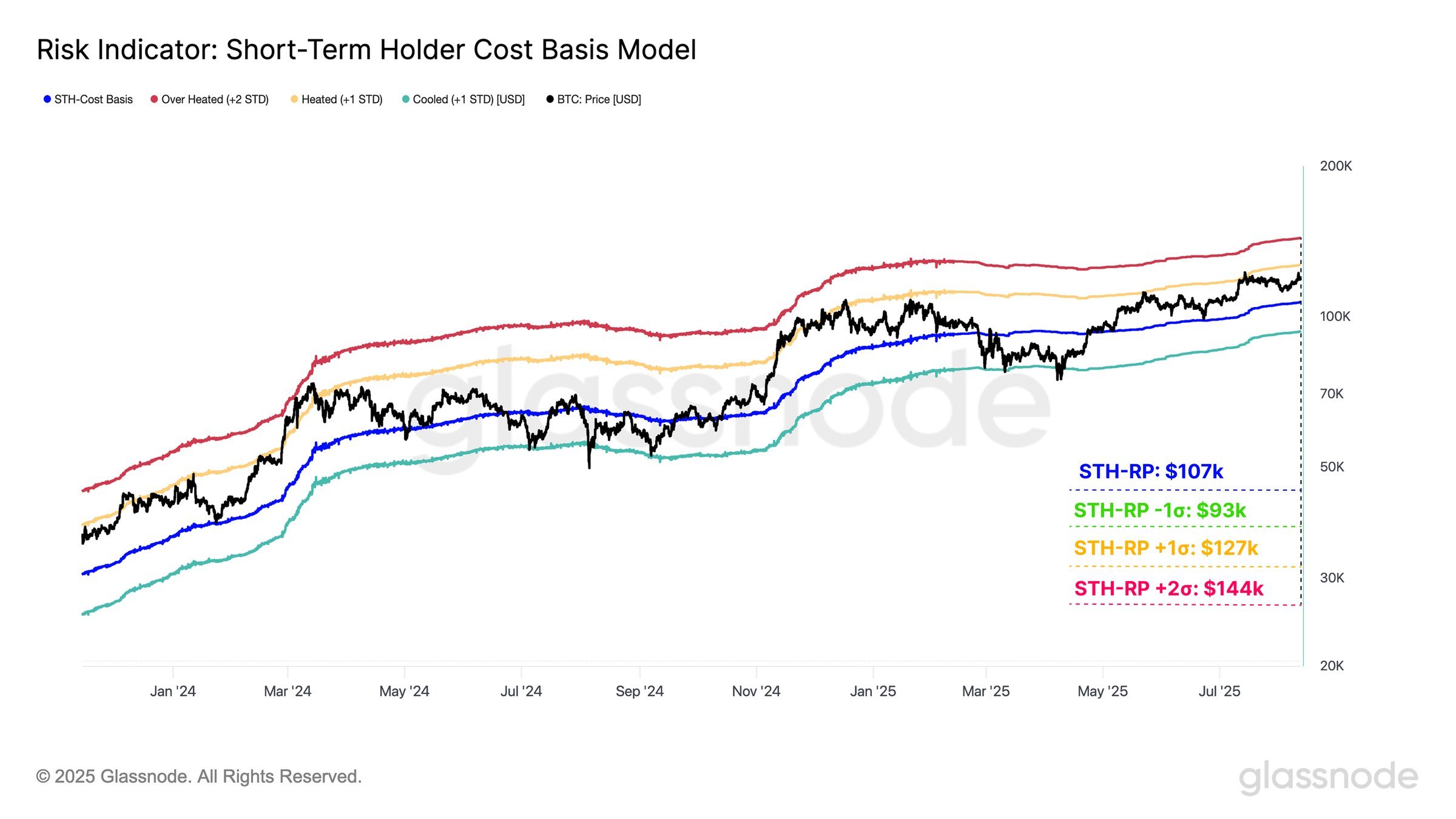
According to Glassnode data, the short-term holder realized price (STH RP) for Bitcoin (BTC) currently sits at $107,000, which represents the average on-chain acquisition price of Bitcoin (BTC).
The STH RP +1σ level is at $127,000, and it is a major key resistance for Bitcoin to surmount, with a breakout opening the path to $144,000, which coincides with the short-term holder realized price +2σ, a level where prior market tops saw increased selling pressure. Short-term holder realized price standard deviation bands +1σ and +2σ coincide with heated and overheated zones, respectively.
Bitcoin has not yet reached these levels, suggesting that the current rally might still have room to run.
Fed signals closely watched
Federal Reserve President Austan Goolsbee spoke on Friday about mixed inflation numbers, with the ongoing instability showing doubts for reduced rates.
The Fed’s annual meeting of the world’s central bankers in Jackson Hole, Wyoming, from Aug. 21-23, has historically been used for the Fed to signal policy shifts and will be watched closely by investors next week.
Markets expect the FOMC to vote to decrease the benchmark federal funds rate by a quarter percentage point in September, from 4.25% to 4.50%. However, there are concerns about what happens next, with 55% odds of another cut in October and only a 43% chance of a third move in December.
Disclaimer: The content of this article solely reflects the author's opinion and does not represent the platform in any capacity. This article is not intended to serve as a reference for making investment decisions.
You may also like
How much CPO demand will Nvidia Rubin Ultra generate? Bernstein: Optical value per Pod will increase fivefold
Bernstein believes that the co-packaged optics (CPO) and fiber demand driven by Nvidia's Rubin Ultra architecture will surge significantly, with the optical content per Pod rising from $1 million to $5.4 million. This will propel the size of Nvidia's optical ecosystem market to $46.8 billion by 2028 (a 91% annual increase). Although the industry faces supply bottlenecks with InP substrates, the outlook remains positive. The institution reiterates its “outperform” rating for Lumentum, Coherent, and Ciena.

UBS Q3 implements a two-way strategy with gold options, heavily invests in technology stocks, and builds positions in SK Hynix (SKHY.US)
UBS Group (UBS.US) has submitted its Q3 holdings report (13F) as of September 30, 2026.

SpaceX (SPCX.US) reportedly attempts “de-Nvidiaization” at the rack level: developing Kessel cabinets to bypass L6 compute boards, purchasing only chips
SemiAnalysis: SpaceX has developed its own Kessel cabinet, bypassing Nvidia's L6 cards to provide more options for manufacturing its own hardware.

$3.7 billion “data center power equipment prepayments” abandoned! What did "the most active buyer of gas turbines", SoftBank, see?
In the second quarter of fiscal year 2026, SoftBank reported a net loss of $7.1 billion, primarily due to a $3.7 billion impairment charge from a $9.5 billion advance payment for power generation equipment for US data centers—of which about $2.9 billion was non-refundable and effectively lost. The CFO admitted that SoftBank placed orders before the project plan was finalized, and is now conducting a comprehensive review of its procurement strategy. "The most aggressive purchaser of gas turbines has now written off the deposit in this way."
Crypto prices
More


