
Ethereum Holds Firm While Bitcoin Slides After PPI Data Release


- Bitcoin plunged below $118,000 after hot PPI data sparked heavy liquidations in the market.
- Ethereum stayed near $4,600 as institutional inflows boosted strength against wider volatility.
- Past cycles show altcoins gain when Bitcoin consolidates, raising hope for altseason.
A sudden wave of volatility swept across crypto markets this week. Bitcoin, fresh off a record above $124,000, tumbled below $118,000 after U.S. July Producer Price Index (PPI) data came in hotter than expected. The index rose 0.9% month-over-month and 3.3% year-over-year, fueling inflation concerns and delaying anticipated Federal Reserve easing. The shock led largest long liquidations since early August, wiping out more than $1 billion in leveraged positions.
Bitcoin Faces Sharp Pullback
Bitcoin’s surge to new highs above $124,000 was driven by optimism over September rate cuts, ETF inflows, and growing institutional adoption. Yet Thursday’s reversal to $118,000 was described as “normal” by Wave Digital Assets CEO David Siemer, who called it a recalibration in a bullish trend. He noted Bitcoin remains “firmly entrenched as the anchor of institutional crypto strategies.”
Profit-taking played a major role in the correction. Siemer explained that after the sharp rally, many short-term traders closed positions to lock in gains. The PPI data compounded selling pressure, cooling optimism for near-term rate cuts.
The correction also punished late bulls. CoinGlass reported, over $1 billion in leveraged long positions were liquidated, the largest since the late July–early August plunge when Bitcoin slipped below $112,000. That event also triggered double-digit declines across altcoins, carving out a local market bottom.
Well-followed trader Bob Loukas commented on X that the latest flush was an “I guess opening a 50x long after a 7-day 50% move was not the best idea type of shakeout.
Ethereum Retains Resilience
Ethereum displayed a contrasting performance during the shakeout. On the daily chart, ETH traded at $4,434, sitting just below the 0.786 Fibonacci retracement level at $4,454. That zone has become short-term resistance after ETH touched $4,749 earlier this week.
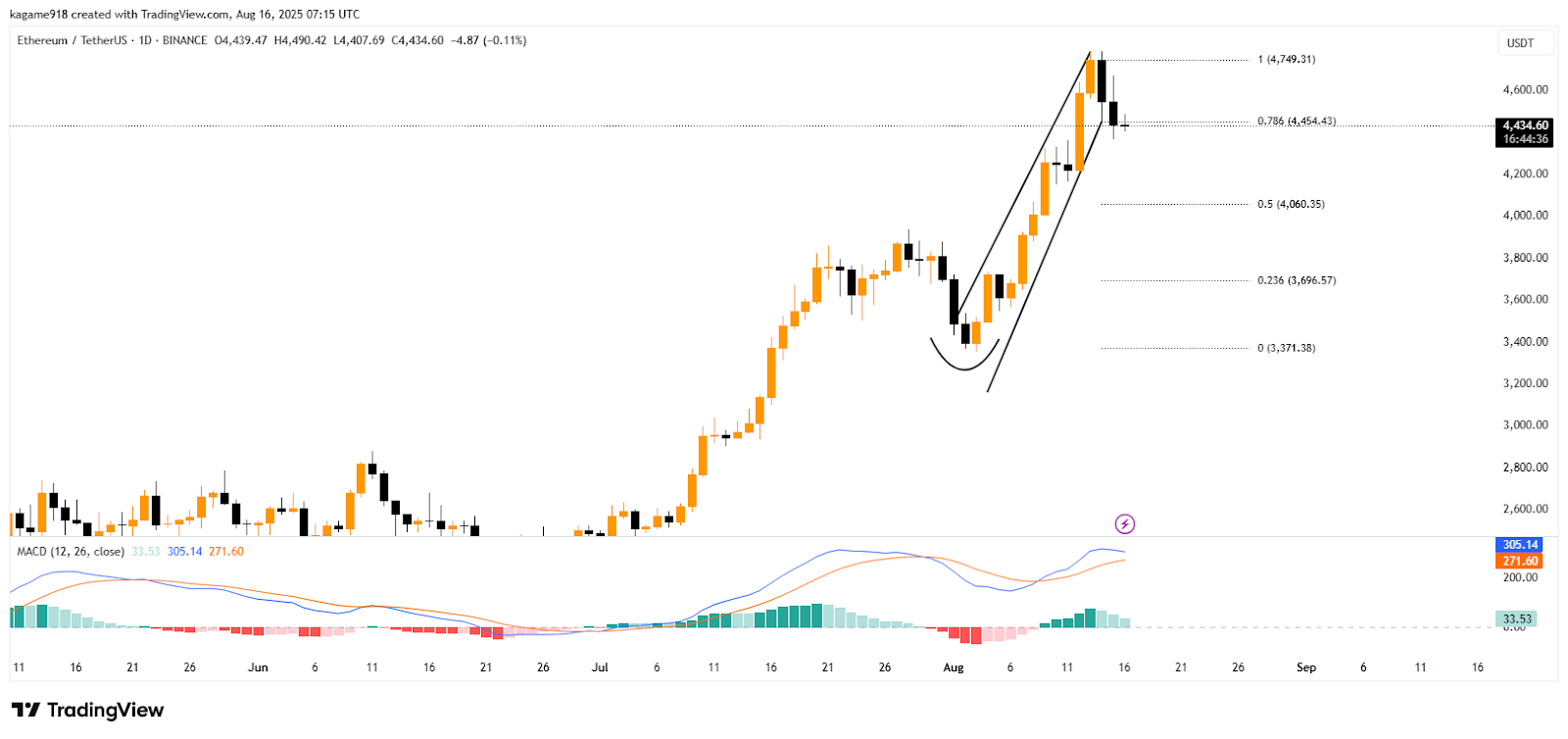
Source: TradingView
Despite slipping from a steep rising channel, Ethereum still shows resilience. Key support rests at $4,060 and is followed by $3,696, with stronger structural support near $3,371. The MACD indicator holds a positive trajectory at 33.53, as it suggests that its strength is intact.
Ethereum also outperformed Bitcoin on a weekly basis. ETH remained flat near $4,600 while BTC retreated. Over the past seven days, Ethereum gained 22%, positioning itself as the market’s top gainer during heightened volatility.
Santiment said that “the $ETH crowd hasn’t shown nearly as much bullishness despite significantly better performance over the past 3 months.”
Institutional accumulation has added fuel to this resilience. Spot Ethereum ETFs recorded $729 million in net inflows in a single day, lifting multi-billion-dollar inflows this week. Treasury companies have added 2.5 million ETH to reserves since June.
Related: ETH Treasury Firms Rival ETFs, Offer Yield and DeFi Upside
Could Altseason Be Near?
Bitcoin’s weekly chart can be called a consolidation, as it is trading at $117,476 after pulling back from $124,474. Key support rests at the 0.236 Fibonacci level near $117,057, with additional support at $102,350 and $86,424. Resistance remains capped around $130,192. The MACD reading of 775.70 indicates bullish momentum remains despite cooling price action.
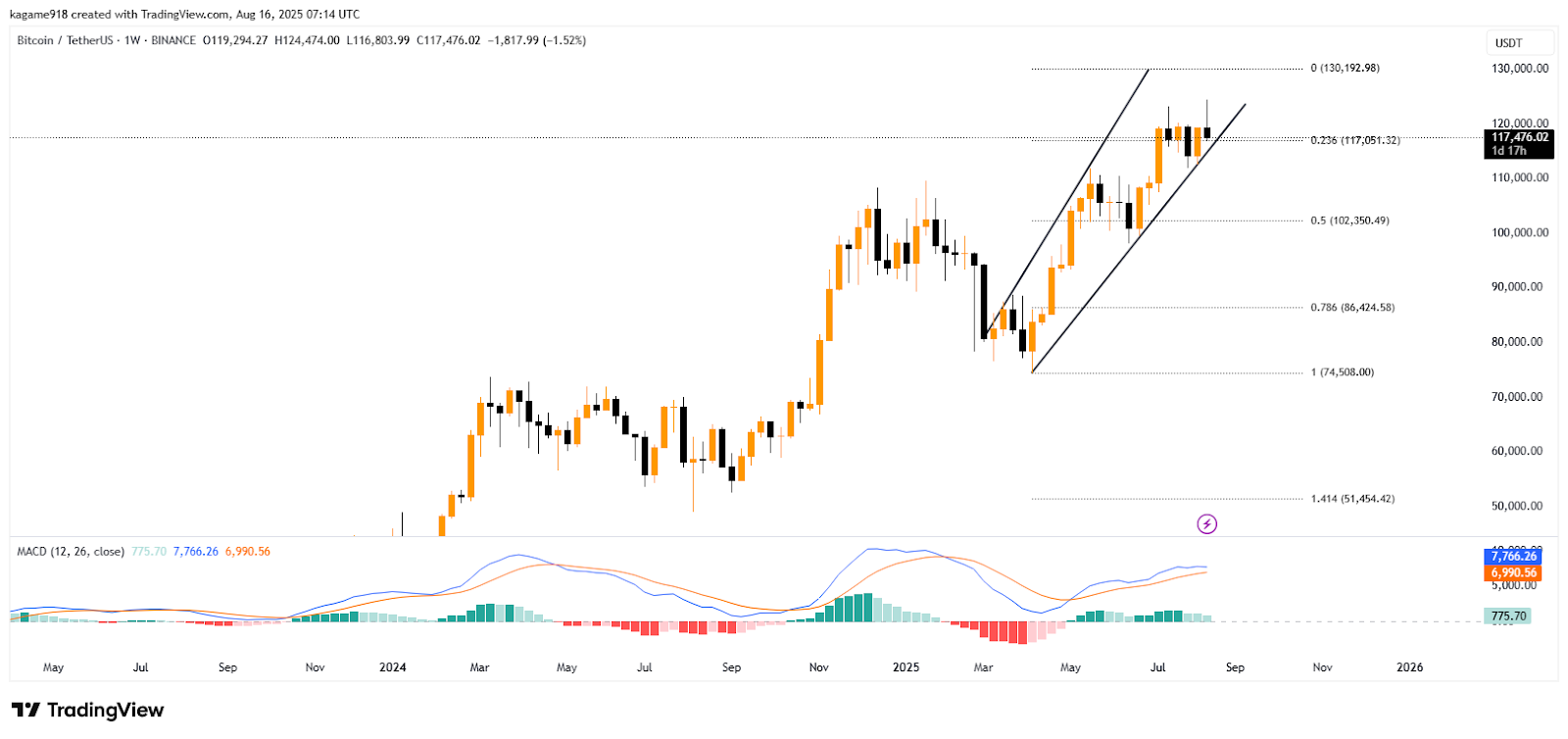
Source: TradingView
On the other hand, Ethereum’s stability is being tested by macro factors. The hot July PPI triggered validator exits exceeding 727,000 ETH, worth over $3.2 billion, and a 5% intraday price dip. Still, ETH has maintained strong support levels.
The analysis conducted by Block Scholes reveals that on previous cycles, altcoins jumped when Bitcoin was at its peak. Investors then rotated profits into Ethereum and other tokens as the BTC consolidated. The same can be seen today as Bitcoin consolidates against macro headwinds and Ethereum gathers inflows.
The post Ethereum Holds Firm While Bitcoin Slides After PPI Data Release appeared first on Cryptotale.
Disclaimer: The content of this article solely reflects the author's opinion and does not represent the platform in any capacity. This article is not intended to serve as a reference for making investment decisions.
You may also like
How much CPO demand will Nvidia Rubin Ultra generate? Bernstein: Optical value per Pod will increase fivefold
Bernstein believes that the co-packaged optics (CPO) and fiber demand driven by Nvidia's Rubin Ultra architecture will surge significantly, with the optical content per Pod rising from $1 million to $5.4 million. This will propel the size of Nvidia's optical ecosystem market to $46.8 billion by 2028 (a 91% annual increase). Although the industry faces supply bottlenecks with InP substrates, the outlook remains positive. The institution reiterates its “outperform” rating for Lumentum, Coherent, and Ciena.
UBS Q3 implements a two-way strategy with gold options, heavily invests in technology stocks, and builds positions in SK Hynix (SKHY.US)
UBS Group (UBS.US) has submitted its Q3 holdings report (13F) as of September 30, 2026.

SpaceX (SPCX.US) reportedly attempts “de-Nvidiaization” at the rack level: developing Kessel cabinets to bypass L6 compute boards, purchasing only chips
SemiAnalysis: SpaceX has developed its own Kessel cabinet, bypassing Nvidia's L6 cards to provide more options for manufacturing its own hardware.

$3.7 billion “data center power equipment prepayments” abandoned! What did "the most active buyer of gas turbines", SoftBank, see?
In the second quarter of fiscal year 2026, SoftBank reported a net loss of $7.1 billion, primarily due to a $3.7 billion impairment charge from a $9.5 billion advance payment for power generation equipment for US data centers—of which about $2.9 billion was non-refundable and effectively lost. The CFO admitted that SoftBank placed orders before the project plan was finalized, and is now conducting a comprehensive review of its procurement strategy. "The most aggressive purchaser of gas turbines has now written off the deposit in this way."
Crypto prices
More


