
Friday charts: Investor’s crystal ball, cloudy with a chance of FOMO

This is a segment from The Breakdown newsletter. To read more editions, subscribe.
“100% of the information you have about any business reflects the past, and 100% of the value of that business depends on the future.”
— Bill Miller
Are markets still forward-looking?
A core tenet of investing theory is that asset prices are driven by the market’s best (and sometimes worst) guesses about the future.
This is why stocks are valued on forward earnings multiples, not trailing ones. And bonds are priced on what the economy is expected to do, not what it’s already done.
It doesn’t feel like that’s what’s happening just now.
This week’s data showed inflation ticking back up again, and every week’s data shows the federal deficit exploding. But Treasury yields are flat on the week and down on the year.
Meanwhile, the US economy seems headed into recession, but stocks keep making new highs.
There are two possible explanations.
One is offered by valuation expert Aswath Damodaran, who thinks the market has given up on being a “predicting machine.”
After years of forecasters missing the mark, he says, the market has shifted into “reactive” mode, where he expects it will stay “until we figure out a better predictive mechanism.”
In other words, investors are living in the moment and not worrying about tomorrow.
The second possible explanation is the opposite: that the stock market is still in prediction mode; it’s simply predicting that things will be good.
That may seem hard to square with the constant drumbeat of worrying headlines: a weak jobs market, the president at war with the Fed, a politicized Bureau of Labor Statistics.
But the market might be looking through all that and seeing its favorite thing:easy money.
The FOMC is expected to start cutting interest rates at its next meeting and might be bullied by the president into cutting more, and faster, than it probably should.
And a federal court may be on the verge of repealing the president’s tariffs, at the cost of higher deficits and the benefit of higher earnings.
Lower interest rates, bigger budget deficits and higher earnings is a surefire recipe for higher stocks.
But investors may be even more forward-looking than that.
With the stock market valuations nearing all-time highs, it’s easy to think investors must be blind to the risks we see in the headlines every day.
But recent research suggests investors don’t think in terms of risk, as textbooks assume, but in terms of fear: “Fear provides an alternative explanation for the magnitude of the excess return realized [by stocks] historically.”
Could anything be more fear-inducing than the AI boom?
Chief AI doomer Eliezer Yudkowsky, for example, warns that artificial general intelligence could lead to human extinction in as little as two years. On a longer timeline, he generously gives us a “shred of a chance” to survive.
For investors, though, the truly existential risk is in missing out.
That may turn out to be less hyperbolic than it sounds because even reasonable people can fear that superintelligent AIs (should they choose to let us live) might take all the jobs.
If so, the only way to make money will be from investments — and you’ll need to make those investments before the AIs take over, which could be any time now.
Personally, I think there will always be plenty for humans to do, so I’m not as pessimistic as that.
But record-high stocks might be a prediction that I should be.
Let’s check the charts.
There’s more money:

M2 money supply is growing again, thanks to increased bank lending and deficit spending (I think). There should be a lot more of both to come. The FT writes that the AI boom has created “a race among private capital providers to offer more and larger loans” to build data centers.
The capex race:
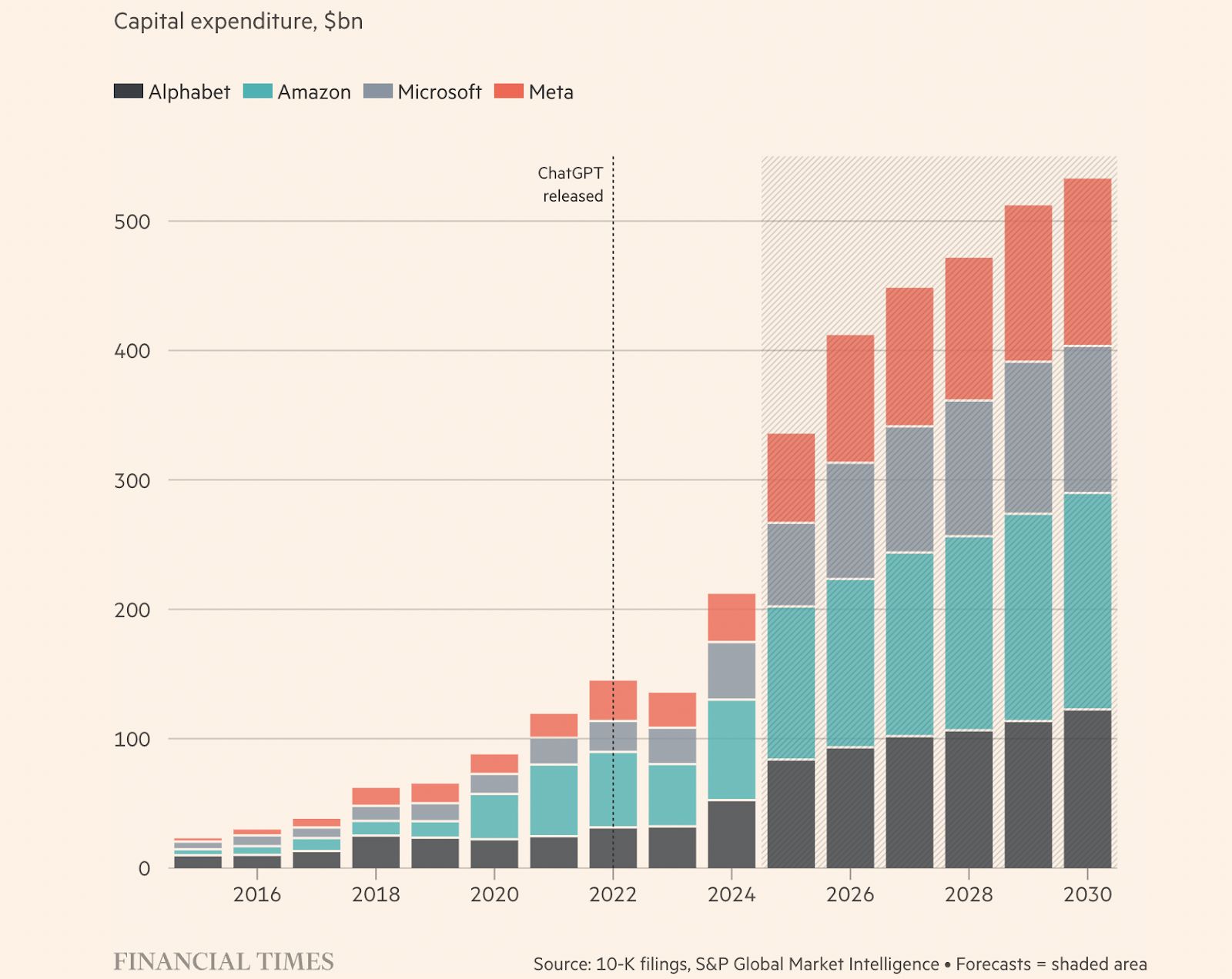
ChatGPT fired the starting gun and the race seems to be just getting going. The big four hyperscalers are expected to spend $350 billion on data centers in 2025, and another $400 billion in 2026.
Cash flows won’t cover it:

Morgan Stanley forecasts that the hyperscalers will spend $2.9 trillion on data centers over just four years, and that their cash flow will cover less than half of it.
Don’t forget the little guys:

Based on the surging number of new businesses, Torsten Slok says “the US remains the most dynamic economy in the world.” Thanks to AI, some of these might soon be one-person unicorns (i.e., $1 billion companies with a single employee).
Transitory?

Producer prices were sharply higher in July, suggesting that companies are starting to pass the cost of tariffs through to consumers. Economists at Goldman Sachs estimate that consumers absorbed just 22% of tariff costs through June, with businesses absorbing the other two-thirds (through lower margins). Goldman expects those numbers to flip-flop by October, with consumers bearing two-thirds of tariff costs.
What tariffs?

Brad Setser notes China’s trade surplus in goods (exports minus imports) continues to rise despite the trade war with its largest customer.
Time to renegotiate the rent:

Data from the Cleveland Fed shows an unprecedented collapse in the cost of renting, as measured by new rental agreements. Jeff Weniger speculates it’s the result of non-citizen residents “self-deporting.”
End of an era?

The rate of wage growth for low-income workers has dropped below the rate for high-income workers for the first time in 10 years. “The era of big raises for low-paid workers is over,” according to the Wall Street Journal. If so, it was an excellent run.
FOMO valuations:

27.2% of stocks in the S&P 100 trade at a P/E of at least 50. Just one trades 10x.
All-time greatest FOMO?

At nearly 100x next year’s sales, The Economist says Palantir might be the most overvalued stock of all time.
Disclaimer: The content of this article solely reflects the author's opinion and does not represent the platform in any capacity. This article is not intended to serve as a reference for making investment decisions.
You may also like
How much CPO demand will Nvidia Rubin Ultra generate? Bernstein: Optical value per Pod will increase fivefold
Bernstein believes that the co-packaged optics (CPO) and fiber demand driven by Nvidia's Rubin Ultra architecture will surge significantly, with the optical content per Pod rising from $1 million to $5.4 million. This will propel the size of Nvidia's optical ecosystem market to $46.8 billion by 2028 (a 91% annual increase). Although the industry faces supply bottlenecks with InP substrates, the outlook remains positive. The institution reiterates its “outperform” rating for Lumentum, Coherent, and Ciena.

UBS Q3 implements a two-way strategy with gold options, heavily invests in technology stocks, and builds positions in SK Hynix (SKHY.US)
UBS Group (UBS.US) has submitted its Q3 holdings report (13F) as of September 30, 2026.

SpaceX (SPCX.US) reportedly attempts “de-Nvidiaization” at the rack level: developing Kessel cabinets to bypass L6 compute boards, purchasing only chips
SemiAnalysis: SpaceX has developed its own Kessel cabinet, bypassing Nvidia's L6 cards to provide more options for manufacturing its own hardware.

$3.7 billion “data center power equipment prepayments” abandoned! What did "the most active buyer of gas turbines", SoftBank, see?
In the second quarter of fiscal year 2026, SoftBank reported a net loss of $7.1 billion, primarily due to a $3.7 billion impairment charge from a $9.5 billion advance payment for power generation equipment for US data centers—of which about $2.9 billion was non-refundable and effectively lost. The CFO admitted that SoftBank placed orders before the project plan was finalized, and is now conducting a comprehensive review of its procurement strategy. "The most aggressive purchaser of gas turbines has now written off the deposit in this way."
Crypto prices
More


