
TRON’s Futures Map Says “Not Overheated” — Could Another Rally Be Coming?

TRON’s market momentum has eased after a recent rally that pushed its price above $0.365, with the asset now trading at $0.355, representing a 1.76% drop over the past 24 hours.
This consolidation follows a steady climb in recent weeks that saw the network’s transaction activity and derivatives data draw increased analyst attention.
According to CryptoQuant contributor Burak Kesmeci, the current TRX futures market remains in a neutral position, suggesting that the asset may still have room to advance before approaching a local top.
Futures Market Indicators and Historical Context
Kesmeci’s analysis centers on the TRON Futures Volume Bubble Map, a metric used to gauge periods of overheating in the futures market. Historically, this tool has flagged heightened risk when red-toned “bubbles” appear, marking moments of excessive speculative activity. The last notable instance occurred in early December 2024, when TRX rose from $0.26 to $0.45 before hitting a local peak.

At present, Kesmeci notes that the indicator has not entered the high-risk zone, meaning TRX has not yet reached levels of speculative saturation. This, in theory, leaves space for further price increases if current market trends persist.
Futures market analysis like this often helps traders differentiate between rallies supported by organic demand and those driven primarily by leveraged speculation. The neutral reading suggests that current TRX movements could be supported by genuine buying interest rather than excessive short-term leverage.
A balanced outlook, however, would also consider that futures market conditions can shift quickly. If trading volume or open interest begins to rise sharply alongside price, the risk of a pullback could grow. For now, the neutral futures environment combined with moderate spot market activity provides a base for potential incremental gains.
TRON On-Chain Data Reveals Exchange-Linked Transfer Spike
In a separate observation, CryptoQuant analyst CryptoOnchain highlighted unusual network activity on July 19, 2025, when more than 3.426 billion TRX, valued at roughly $1.11 billion, moved across the blockchain in a single day.
A closer breakdown of these transactions indicates that this surge was not the result of organic user demand but was instead tied to operational movements between a small group of large wallets.
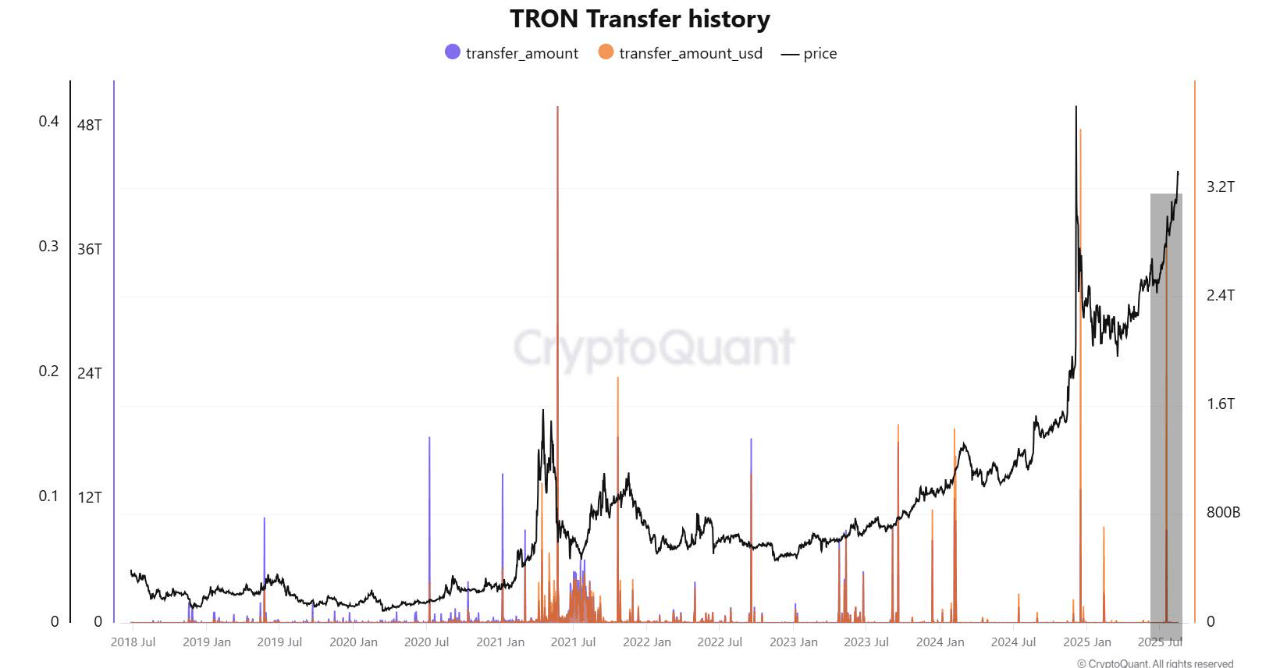
The data shows that two back-and-forth transfers of 612 million TRX each between two addresses accounted for around 36% of that day’s total value, fitting the pattern of a hot-to-cold wallet rebalance often associated with exchanges.
Additional chains of transfers, including fixed-denomination movements of between 3 million and 7.5 million TRX, also align with common exchange deposit and withdrawal processing.
While over 85% of the day’s total transfer volume was traced to this interconnected wallet cluster, both Arkham and Tronscan list no official ownership labels for the addresses.
Nevertheless, the mirrored transaction flows and their structured nature strongly point toward centralized custody, likely by an exchange or large service provider.
Compared with a similar event in June 2023, the July 19 spike occurred within a broader trend of increasing transactions per second (TPS) and total transaction volume in 2025.
This suggests that while the event itself was operational, TRON’s underlying network activity continues to expand. CryptoOnchain cautions that such operational spikes should be distinguished from genuine adoption surges to avoid overestimating organic growth.
Featured image created with DALL-E, Chart from TradingView
Disclaimer: The content of this article solely reflects the author's opinion and does not represent the platform in any capacity. This article is not intended to serve as a reference for making investment decisions.
You may also like
How much CPO demand will Nvidia Rubin Ultra generate? Bernstein: Optical value per Pod will increase fivefold
Bernstein believes that the co-packaged optics (CPO) and fiber demand driven by Nvidia's Rubin Ultra architecture will surge significantly, with the optical content per Pod rising from $1 million to $5.4 million. This will propel the size of Nvidia's optical ecosystem market to $46.8 billion by 2028 (a 91% annual increase). Although the industry faces supply bottlenecks with InP substrates, the outlook remains positive. The institution reiterates its “outperform” rating for Lumentum, Coherent, and Ciena.

UBS Q3 implements a two-way strategy with gold options, heavily invests in technology stocks, and builds positions in SK Hynix (SKHY.US)
UBS Group (UBS.US) has submitted its Q3 holdings report (13F) as of September 30, 2026.

SpaceX (SPCX.US) reportedly attempts “de-Nvidiaization” at the rack level: developing Kessel cabinets to bypass L6 compute boards, purchasing only chips
SemiAnalysis: SpaceX has developed its own Kessel cabinet, bypassing Nvidia's L6 cards to provide more options for manufacturing its own hardware.

$3.7 billion “data center power equipment prepayments” abandoned! What did "the most active buyer of gas turbines", SoftBank, see?
In the second quarter of fiscal year 2026, SoftBank reported a net loss of $7.1 billion, primarily due to a $3.7 billion impairment charge from a $9.5 billion advance payment for power generation equipment for US data centers—of which about $2.9 billion was non-refundable and effectively lost. The CFO admitted that SoftBank placed orders before the project plan was finalized, and is now conducting a comprehensive review of its procurement strategy. "The most aggressive purchaser of gas turbines has now written off the deposit in this way."
Crypto prices
More


