
Trump Sons’ $1.5B WLFI Deal Shakes Up Wall Street

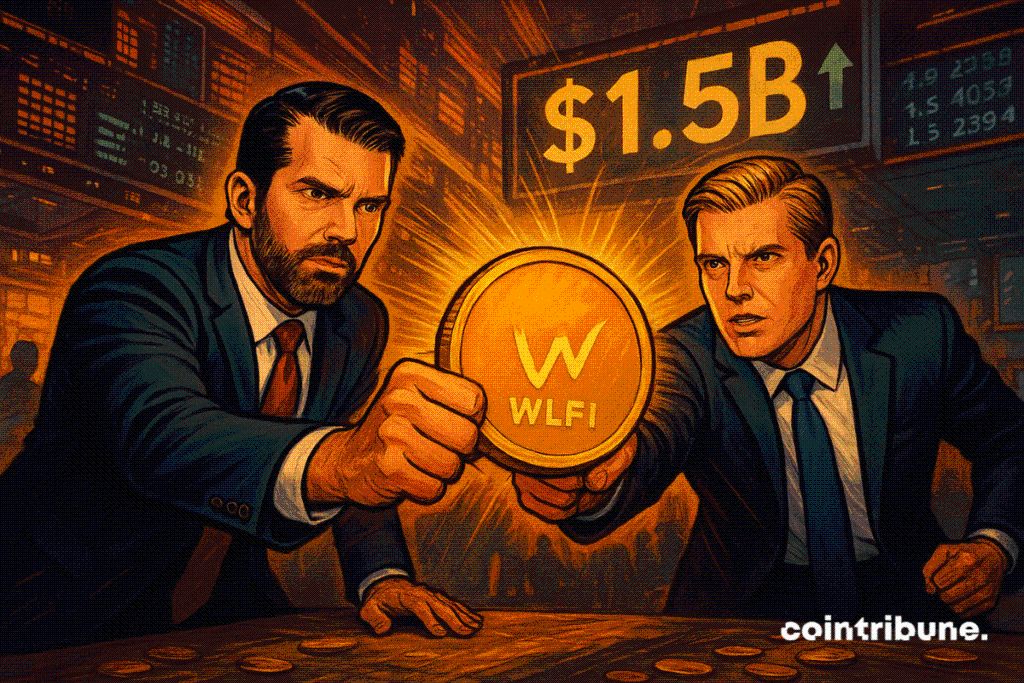
World Liberty Financial (WLFI), the crypto venture co-founded by Eric Trump and Donald Trump Jr., has taken a major leap into the spotlight. On Wednesday, the brothers joined a Nasdaq bell-ringing ceremony in Times Square, celebrating a $1.5 billion token arrangement that could push their firm into the upper ranks of decentralized finance.
In Brief
- WLFI token deal pushes Trump-backed World Liberty Financial into DeFi spotlight.
- ALT5 Sigma’s market cap jumps after securing 7.5% stake in unlisted WLFI token.
- Analysts warn WLFI strategy mirrors risky speculative trends seen before 2008.
Strategic Bet on WLFI
The move marks a bold pivot from conventional corporate crypto strategies, steering away from established digital assets toward the company’s own WLFI token , a project not yet trading on centralized exchanges.
The deal centers on Las Vegas-based ALT5 Sigma Corp., a relatively small fintech and biotech player until now. According to a Bloomberg report, before the announcement, ALT5’s market value was under $150 million .
Following the disclosure, it surged to nearly $850 million. Under the agreement, ALT5 will acquire 7.5% of WLFI’s total token supply, positioning itself as a major holder in a yet-to-be-listed asset.
Supporters say the Trump sons’ deal could integrate crypto with traditional markets, meeting rising investor demand for crossover opportunities. Eric Trump framed the plan as a bridge between Wall Street and blockchain-based finance.
The strategy mirrors Michael Saylor’s 2020 move, when MicroStrategy (now Strategy) added Bitcoin to its corporate balance sheet.
Investor Caution and Market Questions
However, not all investors are convinced. Some have expressed concern about creating a public treasury for an unlisted token. Morten Christensen, an existing investor, acknowledged the concept could draw attention but described it as highly unconventional. Critics like Lex Sokolin of Generative Ventures question the decision to use a public vehicle for such a new asset, warning it could be designed to create buying pressure.
Despite skepticism, the structure is legally feasible under current U.S. policy. The SEC has indicated most tokens are not securities, giving firms more flexibility in designing treasury strategies. Besides market exposure, such arrangements can carry tax benefits, allowing companies to defer capital gains until asset sales.
Speculation and Broader Trends
Deals involving younger tokens are becoming more common. Alliance Global Partners, which worked on the WLFI structure, recently arranged a similar transaction for Mill City Ventures III to accumulate the SUI token.
Some analysts, including Austin Campbell of Zero Knowledge Consulting, see parallels between today’s surge in speculative token investments and pre-2008 financial exuberance . They caution that these models depend heavily on continuous price appreciation to remain viable.
Disclaimer: The content of this article solely reflects the author's opinion and does not represent the platform in any capacity. This article is not intended to serve as a reference for making investment decisions.
You may also like
How much CPO demand will Nvidia Rubin Ultra generate? Bernstein: Optical value per Pod will increase fivefold
Bernstein believes that the co-packaged optics (CPO) and fiber demand driven by Nvidia's Rubin Ultra architecture will surge significantly, with the optical content per Pod rising from $1 million to $5.4 million. This will propel the size of Nvidia's optical ecosystem market to $46.8 billion by 2028 (a 91% annual increase). Although the industry faces supply bottlenecks with InP substrates, the outlook remains positive. The institution reiterates its “outperform” rating for Lumentum, Coherent, and Ciena.

UBS Q3 implements a two-way strategy with gold options, heavily invests in technology stocks, and builds positions in SK Hynix (SKHY.US)
UBS Group (UBS.US) has submitted its Q3 holdings report (13F) as of September 30, 2026.

SpaceX (SPCX.US) reportedly attempts “de-Nvidiaization” at the rack level: developing Kessel cabinets to bypass L6 compute boards, purchasing only chips
SemiAnalysis: SpaceX has developed its own Kessel cabinet, bypassing Nvidia's L6 cards to provide more options for manufacturing its own hardware.

$3.7 billion “data center power equipment prepayments” abandoned! What did "the most active buyer of gas turbines", SoftBank, see?
In the second quarter of fiscal year 2026, SoftBank reported a net loss of $7.1 billion, primarily due to a $3.7 billion impairment charge from a $9.5 billion advance payment for power generation equipment for US data centers—of which about $2.9 billion was non-refundable and effectively lost. The CFO admitted that SoftBank placed orders before the project plan was finalized, and is now conducting a comprehensive review of its procurement strategy. "The most aggressive purchaser of gas turbines has now written off the deposit in this way."
Crypto prices
More


