
98% of Ethereum Supply Hits Profit: Warning Signal Flashes

Over 98% of the circulating Ethereum supply is now in a profitable state, reaching a two-year high and signaling a heightened risk of a price correction as investors may look to cash in on their gains. Not-Seen Profit Level in Two Years According to on-chain data platform Glassnode, its “Percent Supply in Profit” metric for … <a href="https://beincrypto.com/98-of-ethereum-supply-hits-profit-warning-signal-flashes/">Continued</a>
Over 98% of the circulating Ethereum supply is now in a profitable state, reaching a two-year high and signaling a heightened risk of a price correction as investors may look to cash in on their gains.
Not-Seen Profit Level in Two Years
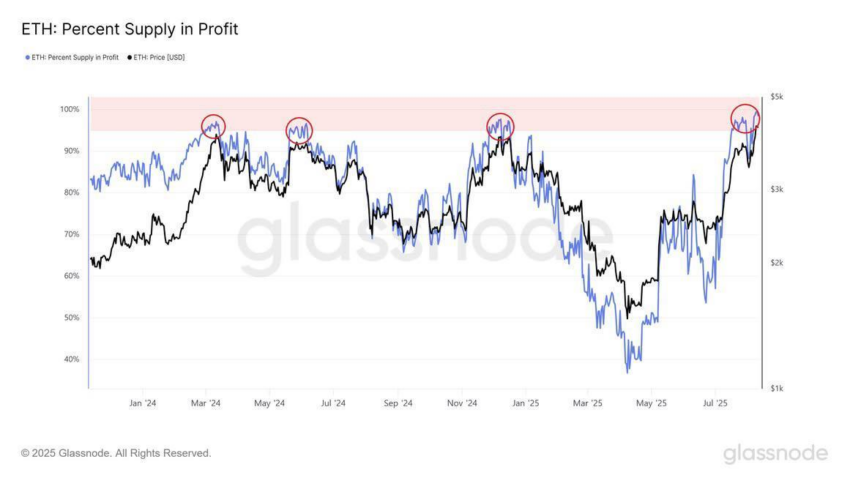
According to on-chain data platform Glassnode, its “Percent Supply in Profit” metric for ETH surpassed 98% on Thursday, a level not seen in the last two years. This key market sentiment indicator measures the percentage of coins trading above their previous blockchain transaction prices. Analysts classify coins as ‘in profit’ when current prices exceed last transaction prices, and ‘in loss’ when below.
 Source:
Glassnode
Historically, readings above 95% suggest the market becomes overheated and approaches a local top. Most investors hold unrealized gains, creating strong incentives to sell and realize profits. Conversely, readings below 50% often indicate market bottoms, where widespread losses reduce selling pressure and create buying opportunities.
Statistics from the past two years underscore the potential for a pullback. The metric has crossed the 95% threshold on four separate occasions. Of the three previous instances, two triggered price corrections exceeding 10%, with the most recent pullback slashing prices by over 40%.
Watch for Indicator Drops if ETH Corrects
The current ETH rally was significantly fueled by concentrated buying from Digital Asset Treasury (DAT) companies that began in May. A substantial correction could occur if these major holders decide to take profits en masse, possibly triggered by shifting macro-economic conditions.
Analysts suggest that the “Percent Supply in Profit” indicator should be watched closely if a downturn materializes. A sharp drop in the metric coinciding with a steep price decline has historically served as a reliable signal that the market has formed a short-term bottom.
Disclaimer: The content of this article solely reflects the author's opinion and does not represent the platform in any capacity. This article is not intended to serve as a reference for making investment decisions.
You may also like
How much CPO demand will Nvidia Rubin Ultra generate? Bernstein: Optical value per Pod will increase fivefold
Bernstein believes that the co-packaged optics (CPO) and fiber demand driven by Nvidia's Rubin Ultra architecture will surge significantly, with the optical content per Pod rising from $1 million to $5.4 million. This will propel the size of Nvidia's optical ecosystem market to $46.8 billion by 2028 (a 91% annual increase). Although the industry faces supply bottlenecks with InP substrates, the outlook remains positive. The institution reiterates its “outperform” rating for Lumentum, Coherent, and Ciena.

UBS Q3 implements a two-way strategy with gold options, heavily invests in technology stocks, and builds positions in SK Hynix (SKHY.US)
UBS Group (UBS.US) has submitted its Q3 holdings report (13F) as of September 30, 2026.

SpaceX (SPCX.US) reportedly attempts “de-Nvidiaization” at the rack level: developing Kessel cabinets to bypass L6 compute boards, purchasing only chips
SemiAnalysis: SpaceX has developed its own Kessel cabinet, bypassing Nvidia's L6 cards to provide more options for manufacturing its own hardware.

$3.7 billion “data center power equipment prepayments” abandoned! What did "the most active buyer of gas turbines", SoftBank, see?
In the second quarter of fiscal year 2026, SoftBank reported a net loss of $7.1 billion, primarily due to a $3.7 billion impairment charge from a $9.5 billion advance payment for power generation equipment for US data centers—of which about $2.9 billion was non-refundable and effectively lost. The CFO admitted that SoftBank placed orders before the project plan was finalized, and is now conducting a comprehensive review of its procurement strategy. "The most aggressive purchaser of gas turbines has now written off the deposit in this way."
Crypto prices
More


