
Google Play to Enforce Licensing Rules for Crypto Wallet Providers in US, EU and Beyond

Google Play is tightening oversight on cryptocurrency wallet providers, with a new policy requiring licensing and compliance with “industry standards” in more than 15 jurisdictions — including the United States and European Union.
Google Play is tightening oversight on cryptocurrency wallet providers, with a new policy requiring licensing and compliance with “industry standards” in more than 15 jurisdictions — including the United States and European Union.
The updated rules , which take effect on October 29, will not apply to non-custodial wallets.
Under the revised framework, developers operating in the US must register with local regulators as either a money services business or a money transmitter. EU-based providers will need to secure registration as a crypto-asset service provider (CASP).
In the US, firms registered with the Financial Crimes Enforcement Network (FinCEN) are subject to strict obligations, such as implementing a written Anti-Money Laundering (AML) program. These requirements could pave the way for expanded Know Your Customer (KYC) checks and other compliance measures across the industry.
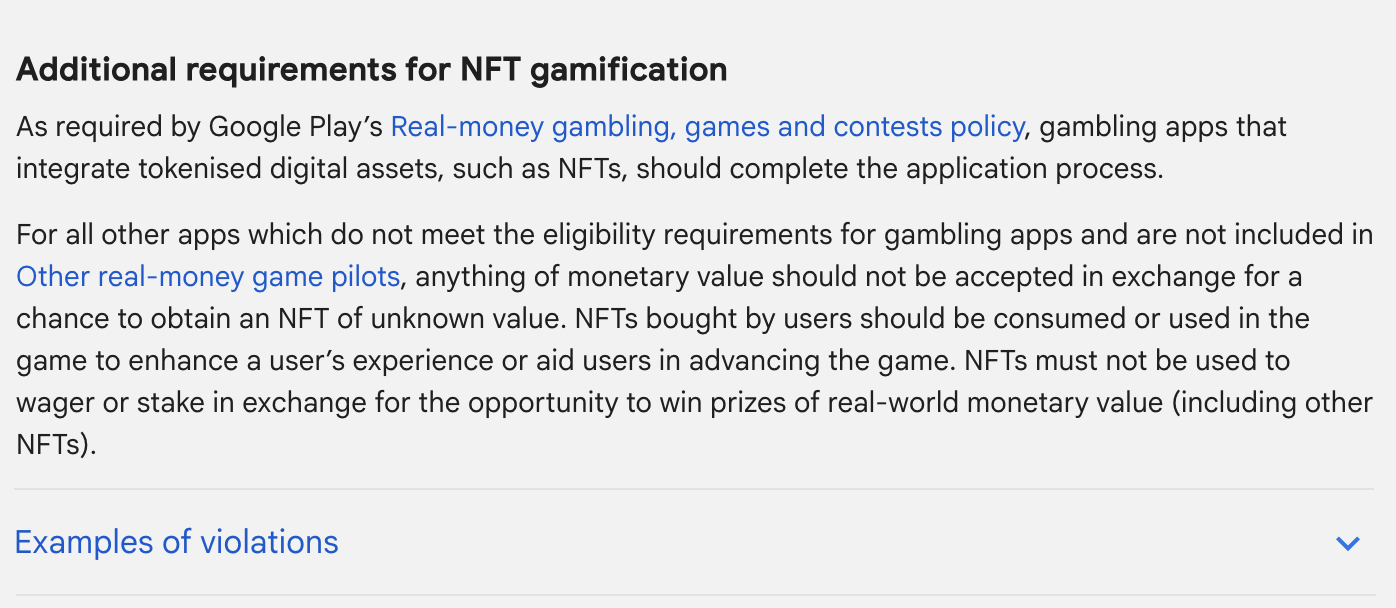 Source:
Google
Responding to criticism from the crypto community, Google clarified via X that non-custodial wallets remain outside the scope of its Cryptocurrency Exchanges and Software Wallets Policy. The company added that it is updating its Help Center to reflect this exemption.
Google Play’s relationship with the crypto sector has been turbulent. In 2018, it banned crypto mining apps; in 2020, it removed the Bitcoin Blast game and delisted crypto news apps from outlets like Cointelegraph and Coindesk without explanation. The platform also barred eight so-called “deceptive” crypto apps in 2021, accusing them of tricking users into paying for a fraudulent cloud service.
In 2023, Google shifted course slightly, allowing non-fungible token (NFT) games under certain conditions, including mandatory disclosure of NFT features, a ban on gambling mechanics, and the removal of “loot box” systems that deliver random rewards.
According to Google Play’s blockchain content guidelines, four categories of applications currently face heightened scrutiny: cryptocurrency exchanges and software wallets, crypto wallets, tokenized digital asset distribution platforms, and NFT gamification apps.
Notably, Google uncovers new malware ‘LOSTKEYS’ used by russian-backed coldriver group in sophisticated attacks targeting high-profile Western individuals and organizations.
Disclaimer: The content of this article solely reflects the author's opinion and does not represent the platform in any capacity. This article is not intended to serve as a reference for making investment decisions.
You may also like
How much CPO demand will Nvidia Rubin Ultra generate? Bernstein: Optical value per Pod will increase fivefold
Bernstein believes that the co-packaged optics (CPO) and fiber demand driven by Nvidia's Rubin Ultra architecture will surge significantly, with the optical content per Pod rising from $1 million to $5.4 million. This will propel the size of Nvidia's optical ecosystem market to $46.8 billion by 2028 (a 91% annual increase). Although the industry faces supply bottlenecks with InP substrates, the outlook remains positive. The institution reiterates its “outperform” rating for Lumentum, Coherent, and Ciena.

UBS Q3 implements a two-way strategy with gold options, heavily invests in technology stocks, and builds positions in SK Hynix (SKHY.US)
UBS Group (UBS.US) has submitted its Q3 holdings report (13F) as of September 30, 2026.

SpaceX (SPCX.US) reportedly attempts “de-Nvidiaization” at the rack level: developing Kessel cabinets to bypass L6 compute boards, purchasing only chips
SemiAnalysis: SpaceX has developed its own Kessel cabinet, bypassing Nvidia's L6 cards to provide more options for manufacturing its own hardware.

$3.7 billion “data center power equipment prepayments” abandoned! What did "the most active buyer of gas turbines", SoftBank, see?
In the second quarter of fiscal year 2026, SoftBank reported a net loss of $7.1 billion, primarily due to a $3.7 billion impairment charge from a $9.5 billion advance payment for power generation equipment for US data centers—of which about $2.9 billion was non-refundable and effectively lost. The CFO admitted that SoftBank placed orders before the project plan was finalized, and is now conducting a comprehensive review of its procurement strategy. "The most aggressive purchaser of gas turbines has now written off the deposit in this way."
Crypto prices
More


