
Bitcoin’s New Bullish Nature: Long Climb Without Sharp Surges

Bitcoin's new bull market features sustained growth with fewer explosive rallies, driven by institutional investments and Bitcoin ETFs, marking a shift from past speculative cycles.
According to a new analysis, the character of the current crypto bull market has changed. Institutional participation is paving the way for a longer, more sustained period of growth at the expense of the explosive gains seen in past cycles.
On-chain data analyst ‘Yonsei_dent’ of CryptoQuant argued Wednesday that key metrics show the market is maturing. He pointed to the Net Unrealized Profit/Loss (NUPL) indicator, explaining that it shifts toward “longer, more sustainable cycles” that may feature fewer sharp, short-term rallies that defined previous bull runs.
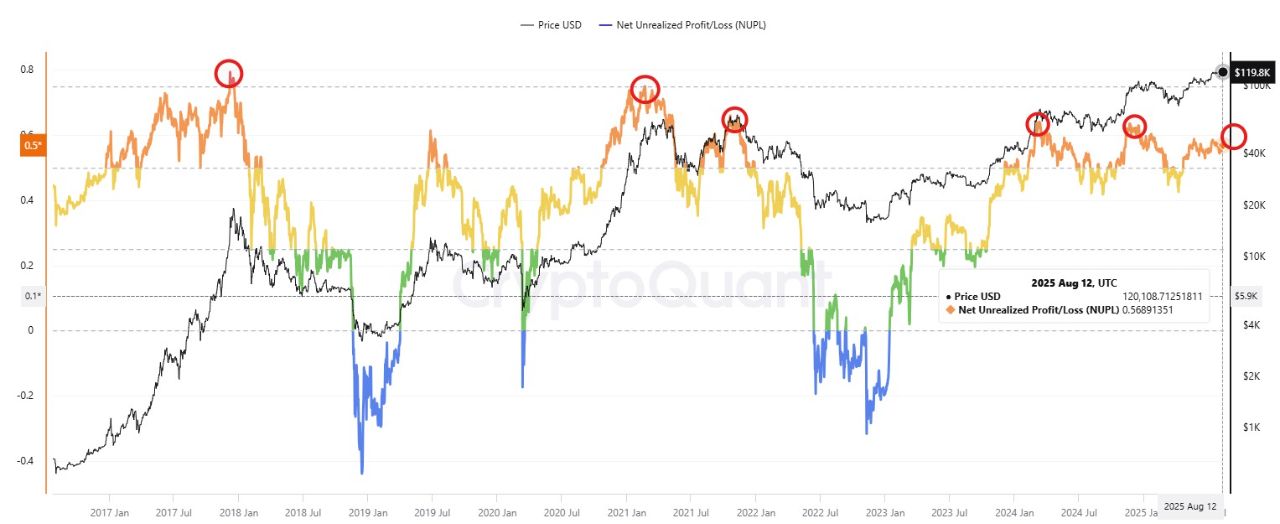 USD/NUPL chart. Source: Yonsei_dent
Institutional Investors Transformed the Market Nature
The NUPL metric essentially gauges the market’s overall profitability. When it’s high, many investors hold significant unrealized profits, which increases the temptation to sell and take profits.
“Historically, NUPL peaks have been a remarkably accurate signal for market cycle tops. The 2017 cycle had one massive peak. The 2021 cycle had two. In the current cycle, NUPL appears to be attempting a third peak. What we’re seeing now is new.”
Yonsei_dent attributes this fundamental shift to the influx of institutional capital, particularly through the successful US-based spot Bitcoin ETFs. This new source of demand is more consistent and less speculative than the retail-driven frenzy of past cycles.
“The ETFs have been a game-changer,” the analyst noted. “They bring a stabilizing force and immense liquidity.”
This new stability, however, comes at a price. While the market is larger and less volatile, the analysis shows that the percentage gains during each successive rally in this cycle have gradually decreased.
“The era of frenzied, 100x rallies in a short period might be behind us. The data suggests we are entering a new paradigm. Bull markets may last longer and be built on a more solid foundation, but investors should adjust their expectations for the kind of sharp, overheated gains we saw in the past.”
Disclaimer: The content of this article solely reflects the author's opinion and does not represent the platform in any capacity. This article is not intended to serve as a reference for making investment decisions.
You may also like
How much CPO demand will Nvidia Rubin Ultra generate? Bernstein: Optical value per Pod will increase fivefold
Bernstein believes that the co-packaged optics (CPO) and fiber demand driven by Nvidia's Rubin Ultra architecture will surge significantly, with the optical content per Pod rising from $1 million to $5.4 million. This will propel the size of Nvidia's optical ecosystem market to $46.8 billion by 2028 (a 91% annual increase). Although the industry faces supply bottlenecks with InP substrates, the outlook remains positive. The institution reiterates its “outperform” rating for Lumentum, Coherent, and Ciena.

UBS Q3 implements a two-way strategy with gold options, heavily invests in technology stocks, and builds positions in SK Hynix (SKHY.US)
UBS Group (UBS.US) has submitted its Q3 holdings report (13F) as of September 30, 2026.

SpaceX (SPCX.US) reportedly attempts “de-Nvidiaization” at the rack level: developing Kessel cabinets to bypass L6 compute boards, purchasing only chips
SemiAnalysis: SpaceX has developed its own Kessel cabinet, bypassing Nvidia's L6 cards to provide more options for manufacturing its own hardware.

$3.7 billion “data center power equipment prepayments” abandoned! What did "the most active buyer of gas turbines", SoftBank, see?
In the second quarter of fiscal year 2026, SoftBank reported a net loss of $7.1 billion, primarily due to a $3.7 billion impairment charge from a $9.5 billion advance payment for power generation equipment for US data centers—of which about $2.9 billion was non-refundable and effectively lost. The CFO admitted that SoftBank placed orders before the project plan was finalized, and is now conducting a comprehensive review of its procurement strategy. "The most aggressive purchaser of gas turbines has now written off the deposit in this way."
Crypto prices
More


