
The ETF + 401(k) Combination Ready to Transform Ethereum

Ethereum has just reached a decisive milestone. In a single day, August 11, inflows into its ETFs exceeded one billion dollars, a clear sign of institutional confidence. At the same time, an executive order signed by Donald Trump opens the American 401(k) plans — a pillar of retirement savings in the United States — to cryptocurrencies. Two events that, combined, could sustainably reshape the dynamics of the crypto market.

In Brief
- Ethereum ETFs record a net inflow record of 1 billion dollars in one day.
- American 401(k) plans are now allowed to include cryptos and private equity.
- The ETF + 401(k) combination could trigger a massive and lasting inflow of capital into Ethereum.
1 Billion in 24h: The Ethereum ETF Breaks All Records
Ethereum ETFs recorded more than 1 billion dollars in net inflows on August 11, a historic record for the asset. BlackRock, with its ETHA product, captured 640 million dollars, while Fidelity, through FETH, attracted 277 million.
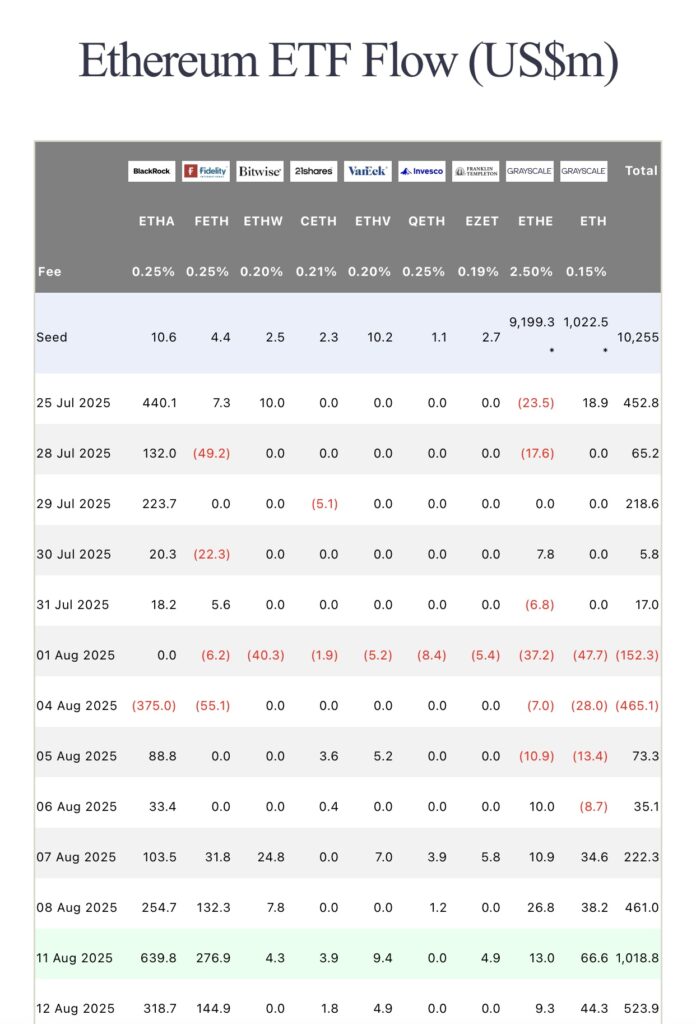 Inflows into Ethereum ETFs on August 11.
This enthusiasm for ETH is explained by several macroeconomic factors. US inflation stands at 2.8% year-over-year, strengthening expectations of Fed rate cuts. Investors are returning to risky assets, including cryptos, pushing Ethereum toward the 4,600 dollar zone, with bullish momentum in the short and medium term.
American 401(k) Plans Open Their Doors to Cryptos
The Trump administration has reached a milestone by allowing cryptos and private equity in 401(k) plans by repealing a directive dating from 2021. This change opens access to digital assets to millions of Americans via tax-advantaged accounts, a potentially colossal lever for long-term adoption.
This measure could replicate the impact that gold ETFs had in the 2000s, when the SPDR Gold Trust facilitated gold exposure for institutional and retail investors.
ETF + 401(k): The Duo That Could Transform Ethereum
The arrival of Ethereum ETFs strengthens the asset’s legitimacy with institutional investors. At the same time, opening 401(k) plans to crypto creates an unprecedented retail investment channel. This dual dynamic is amplified by cash strategies of companies like BitMine Immersion Technologies, which now holds 1.15 million ETH.
This mix of institutional flows, corporate accumulation, and retirement savings could inject tens or even hundreds of billions into the Ethereum ecosystem. As Ryan Lee, chief analyst at Bitget, points out:
This combination will strengthen the role of cryptocurrencies as an alternative to traditional financial investments, paving the way for sustainable capital inflows in the coming months.
Despite this optimism, several points of caution remain:
- Ethereum remains a highly volatile asset, susceptible to sharp corrections.
- Integration into 401(k) plans raises questions about liquidity and risk management for retirement portfolios.
- The SEC and Congress may still clarify the regulatory framework, notably regarding eligibility criteria for crypto assets in retirement accounts.
Bullish signals are multiplying for Ethereum . The combination of institutional adoption through ETFs and massive retail opening via 401(k) plans could be the catalyst for a structural bull cycle for Ethereum. If the trend is confirmed, this year could be retrospectively seen as the moment when ETH transitioned from an innovative asset to a cornerstone of global financial allocation.
Disclaimer: The content of this article solely reflects the author's opinion and does not represent the platform in any capacity. This article is not intended to serve as a reference for making investment decisions.
You may also like
How much CPO demand will Nvidia Rubin Ultra generate? Bernstein: Optical value per Pod will increase fivefold
Bernstein believes that the co-packaged optics (CPO) and fiber demand driven by Nvidia's Rubin Ultra architecture will surge significantly, with the optical content per Pod rising from $1 million to $5.4 million. This will propel the size of Nvidia's optical ecosystem market to $46.8 billion by 2028 (a 91% annual increase). Although the industry faces supply bottlenecks with InP substrates, the outlook remains positive. The institution reiterates its “outperform” rating for Lumentum, Coherent, and Ciena.

UBS Q3 implements a two-way strategy with gold options, heavily invests in technology stocks, and builds positions in SK Hynix (SKHY.US)
UBS Group (UBS.US) has submitted its Q3 holdings report (13F) as of September 30, 2026.

SpaceX (SPCX.US) reportedly attempts “de-Nvidiaization” at the rack level: developing Kessel cabinets to bypass L6 compute boards, purchasing only chips
SemiAnalysis: SpaceX has developed its own Kessel cabinet, bypassing Nvidia's L6 cards to provide more options for manufacturing its own hardware.

$3.7 billion “data center power equipment prepayments” abandoned! What did "the most active buyer of gas turbines", SoftBank, see?
In the second quarter of fiscal year 2026, SoftBank reported a net loss of $7.1 billion, primarily due to a $3.7 billion impairment charge from a $9.5 billion advance payment for power generation equipment for US data centers—of which about $2.9 billion was non-refundable and effectively lost. The CFO admitted that SoftBank placed orders before the project plan was finalized, and is now conducting a comprehensive review of its procurement strategy. "The most aggressive purchaser of gas turbines has now written off the deposit in this way."
Crypto prices
More


