
Machine learning algorithm predicts Ethereum price on August 31, 2025

Ethereum (ETH) could be on the verge of smashing its all-time high this month, with advanced AI models forecasting prices above $5,000 by August 31, 2025.
Finbold’s AI price prediction tool powered by machine learning models GPT-5, Claude 3.5 Sonnet, and Grok 3 Vision, alongside a suite of technical indicators including MACD, RSI, stochastic oscillators, and both the 50-day and 200-day moving averages, now places Ethereum’s average projected price at $5,067.
That represents an 8.42% upside from the current market level of $4,696.5.
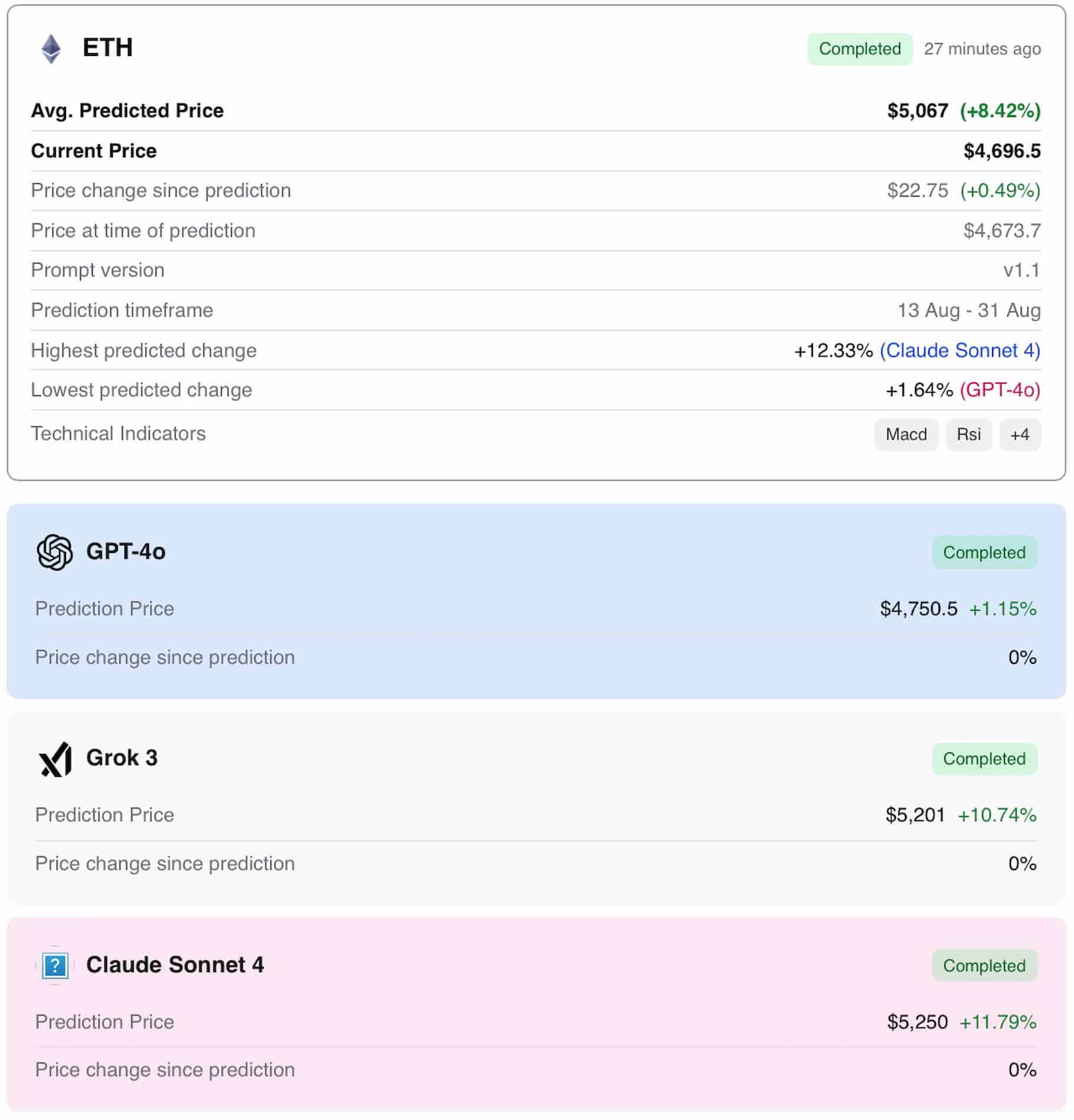
Each of the models shows strong conviction that Ethereum will maintain its bullish momentum. Claude 3.5 Sonnet emerges as the most optimistic, projecting a price of $5,250, a 12.33% gain that would mark a clear move into uncharted territory.
Grok 3 Vision forecasts $5,201, implying a 10.74% increase and signaling that the uptrend could extend well beyond the psychological $5,000 threshold. Even the more conservative GPT-5 (GPT-4o variant) anticipates a climb to $4,750, which would still keep ETH comfortably above recent support levels.
ETH sees massive institutional inflow
The bullish projection comes as Ethereum’s rally accelerates on the back of record ETF inflows. On August 11 alone, Ethereum ETFs saw $1 billion in net inflows, led by BlackRock ($640 million), Fidelity ($270 million), and Grayscale ($80 million), according to Farside Investors. Over August 11–12, inflows topped $1.5 billion.
Arkham Intelligence data shows BlackRock’s wallet activity spiking, with multiple high-value ETH transfers from Coinbase Prime. Institutional appetite is growing, even as retail traders have been selling into strength; dynamic Santiment notes have historically preceded further upside.
Adding fuel to the rally, 180 Life Sciences Corp. a crypto-focused firm backed by Palantir co-founder Peter Thiel, recently disclosed holdings of 82,186 ETH (worth $349 million at $4,600), alongside a 250% surge in its share price.
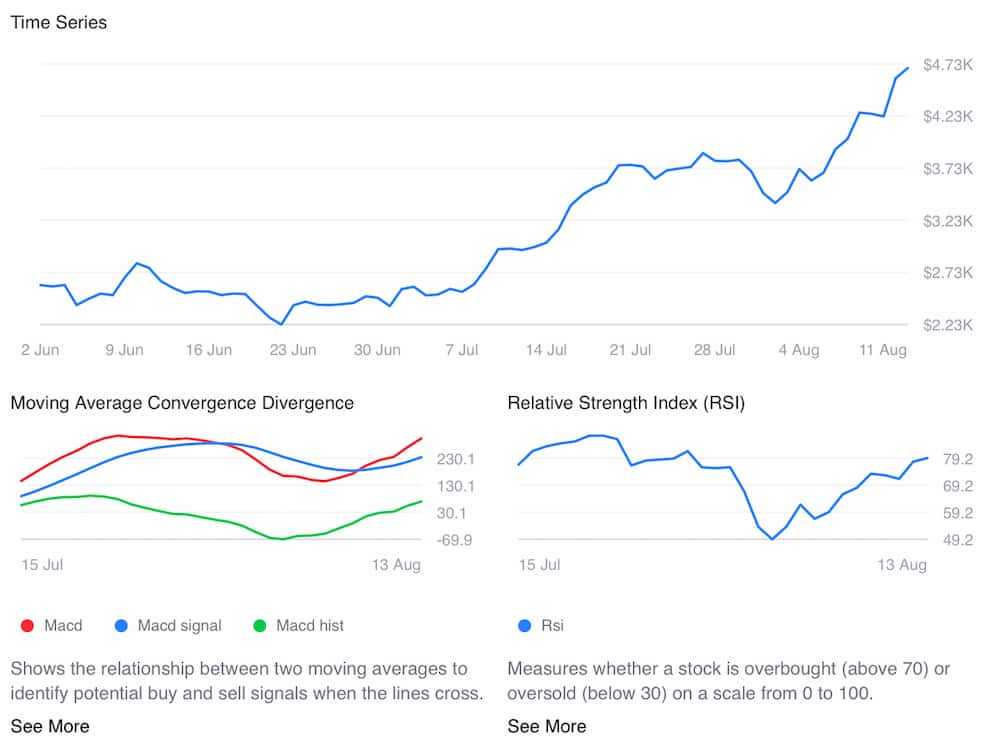
With ETH currently trading near $4,700, just 6.4% below its November 2021 peak of $4,891 momentum indicators are flashing bullish. RSI sits above 79, suggesting strong buying pressure, while MACD remains in positive territory.
If AI projections hold, Ethereum could not only reclaim but decisively break its all-time high before the end of August, setting the stage for potential price discovery heading into Q4.
Disclaimer: The content of this article solely reflects the author's opinion and does not represent the platform in any capacity. This article is not intended to serve as a reference for making investment decisions.
You may also like
How much CPO demand will Nvidia Rubin Ultra generate? Bernstein: Optical value per Pod will increase fivefold
Bernstein believes that the co-packaged optics (CPO) and fiber demand driven by Nvidia's Rubin Ultra architecture will surge significantly, with the optical content per Pod rising from $1 million to $5.4 million. This will propel the size of Nvidia's optical ecosystem market to $46.8 billion by 2028 (a 91% annual increase). Although the industry faces supply bottlenecks with InP substrates, the outlook remains positive. The institution reiterates its “outperform” rating for Lumentum, Coherent, and Ciena.

UBS Q3 implements a two-way strategy with gold options, heavily invests in technology stocks, and builds positions in SK Hynix (SKHY.US)
UBS Group (UBS.US) has submitted its Q3 holdings report (13F) as of September 30, 2026.

SpaceX (SPCX.US) reportedly attempts “de-Nvidiaization” at the rack level: developing Kessel cabinets to bypass L6 compute boards, purchasing only chips
SemiAnalysis: SpaceX has developed its own Kessel cabinet, bypassing Nvidia's L6 cards to provide more options for manufacturing its own hardware.

$3.7 billion “data center power equipment prepayments” abandoned! What did "the most active buyer of gas turbines", SoftBank, see?
In the second quarter of fiscal year 2026, SoftBank reported a net loss of $7.1 billion, primarily due to a $3.7 billion impairment charge from a $9.5 billion advance payment for power generation equipment for US data centers—of which about $2.9 billion was non-refundable and effectively lost. The CFO admitted that SoftBank placed orders before the project plan was finalized, and is now conducting a comprehensive review of its procurement strategy. "The most aggressive purchaser of gas turbines has now written off the deposit in this way."
Crypto prices
More


