
Elon Musk Accuses App Store of Favoring ChatGPT

Elon Musk restarts hostilities against Apple, accusing it of marginalizing Grok and X in the App Store to the benefit of ChatGPT. Behind this apparent quarrel, a broader showdown is at play around AI, competition, and platform control. The line between legitimate curation and anti-competitive practices is blurrier than ever.
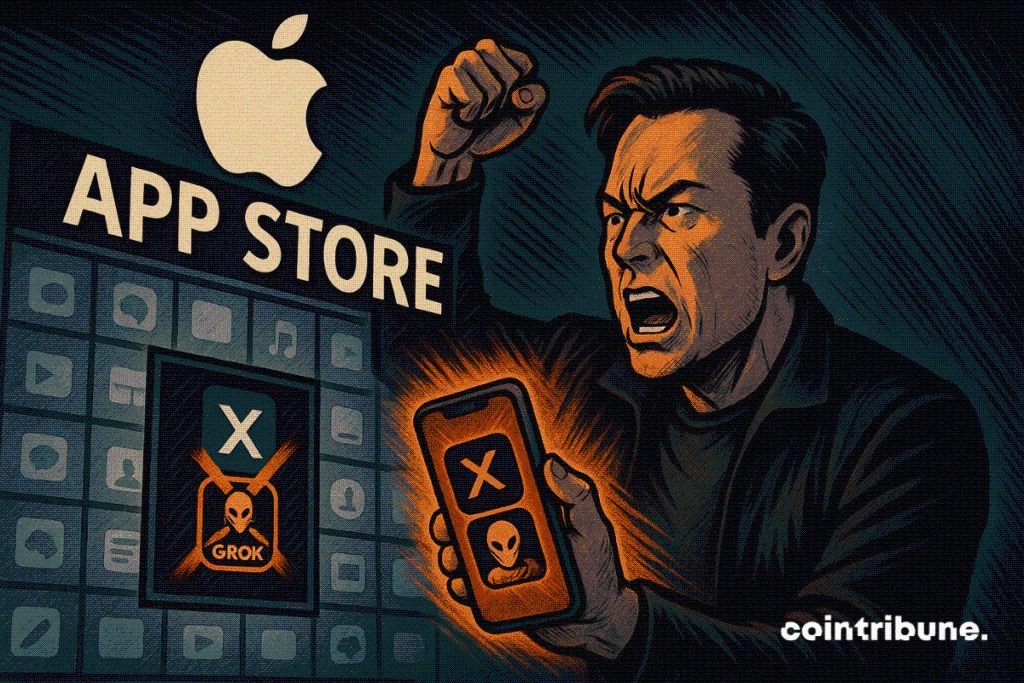
In Brief
- Elon Musk accuses Apple of deliberately excluding Grok and X from its “Must Have” section despite their strong rankings.
- This controversy is part of a broader antitrust battle against Apple’s dominance over the App Store.
- Legal experts see it as a crucial test between curation rights and anti-competitive practices.
A direct accusation against Apple’s policy
Monday, Elon Musk rekindled tensions with Apple by directly attacking its curation methods on the App Store.
The head of X publicly challenged Cupertino firm’s promotion strategy, pointing out the absence of its own services in the prestigious “Must Have” section.
“Hey Apple App Store, why do you refuse to put either X or Grok in your ‘Must Have’ section when X is the #1 news app in the world and Grok is #5 among all apps?” Musk called out on his platform.
Then, with a touch of irony, he added: “Are you playing politics? What gives? Inquiring minds want to know.“
These statements reflect the escalation of a conflict between two technological giants with divergent interests. Musk accuses Apple of favoring OpenAI’s ChatGPT at the expense of its own solutions. For him, this choice reveals a structural bias that would distort competition in a key sector: artificial intelligence.
Behind this clash lies a major strategic issue: visibility on iOS. The “Must Have” section acts as a premium showcase, able to boost an app towards millions of downloads and directly influence its adoption by the general public.
Musk believes that the exclusion of X and Grok, despite their performance, illustrates Apple’s abusive use of its dominant position, a matter already at the heart of numerous international antitrust investigations.
A conflict with major antitrust stakes
This controversy arises as Apple is already under close scrutiny by US and European authorities, who are investigating the App Store’s dominance and its rules imposed on developers, notably the commissions charged.
For Andrew Rossow, a specialized lawyer and CEO of AR Media Consulting, the legal issue is subtle:
The key is with distinguishing between legitimate editorial curation (which platforms generally have the right to exercise) and anti-competitive conduct that harms the competitive process.
Courts will have to assess the consistency of Apple’s policies, their business motivations, and their overall impact on the market. He reminds that antitrust law protects competition, not individual competitors. Musk will therefore have to prove that the difficulties of X and Grok stem directly from Apple’s practices, and not from internal shortcomings.
Some observers adopt a firmer tone. Himanshu Tyagi, professor at the Indian Institute of Science, speaks of “pure censorship”: if favoritism influences content selection, it could distort competition in AI by limiting access to potentially better products.
This battle is part of a larger fight for control of the tech market. After the allocation of 29 billion dollars in shares to keep him at the head of Tesla, Musk seems determined to defend his interests on all fronts.
For Jesse Glass, a researcher at DecideAI, the slowdown of progress on large language models makes distribution control even more strategic.
Musk’s attack on Apple thus goes beyond a simple commercial quarrel: it strikes at the heart of power in AI. If this case leads to legal action, it could redefine the rules of the game between platforms, developers, and regulators. In this war for visibility, Apple’s next decision could weigh far more than a simple editorial choice.
Disclaimer: The content of this article solely reflects the author's opinion and does not represent the platform in any capacity. This article is not intended to serve as a reference for making investment decisions.
You may also like
How much CPO demand will Nvidia Rubin Ultra generate? Bernstein: Optical value per Pod will increase fivefold
Bernstein believes that the co-packaged optics (CPO) and fiber demand driven by Nvidia's Rubin Ultra architecture will surge significantly, with the optical content per Pod rising from $1 million to $5.4 million. This will propel the size of Nvidia's optical ecosystem market to $46.8 billion by 2028 (a 91% annual increase). Although the industry faces supply bottlenecks with InP substrates, the outlook remains positive. The institution reiterates its “outperform” rating for Lumentum, Coherent, and Ciena.

UBS Q3 implements a two-way strategy with gold options, heavily invests in technology stocks, and builds positions in SK Hynix (SKHY.US)
UBS Group (UBS.US) has submitted its Q3 holdings report (13F) as of September 30, 2026.

SpaceX (SPCX.US) reportedly attempts “de-Nvidiaization” at the rack level: developing Kessel cabinets to bypass L6 compute boards, purchasing only chips
SemiAnalysis: SpaceX has developed its own Kessel cabinet, bypassing Nvidia's L6 cards to provide more options for manufacturing its own hardware.

$3.7 billion “data center power equipment prepayments” abandoned! What did "the most active buyer of gas turbines", SoftBank, see?
In the second quarter of fiscal year 2026, SoftBank reported a net loss of $7.1 billion, primarily due to a $3.7 billion impairment charge from a $9.5 billion advance payment for power generation equipment for US data centers—of which about $2.9 billion was non-refundable and effectively lost. The CFO admitted that SoftBank placed orders before the project plan was finalized, and is now conducting a comprehensive review of its procurement strategy. "The most aggressive purchaser of gas turbines has now written off the deposit in this way."
Crypto prices
More


