
SHIB burn rate soars as single wallet removes 85m tokens from supply

A single large address burned 85,795,990 Shiba Inu tokens, causing a major spike in the daily burn rate.
- Shiba Inu saw a dramatic spike in daily burn rate.
- One whale was behind the large daily spike, burning 85 million SHIB.
- Still, the transaction is even the biggest burn in the last two weeks.
Burn rates remain a keydriver of Shiba Inu’s (SHIB) medium- to long-term performance. On Wednesday, August 13, SHIB’s daily burn rate surged 48,247.45%, with almost 88 million tokens burned in the past 24 hours. This coincided with a 6% daily gain in SHIB’s price.
The spike in the burn rate was largely driven by a single whale wallet, which alone burned 85,795,990 SHIB tokens, according to data from Shibburn. Still, the transaction was not the biggest burn that Shiba Inu saw recently.
The latest large burn occurred on July 29, with 18 million SHIB tokens burned. What is more, just one day prior, one whale burned 600 million SHIB tokens, representing by far the biggest burn in the past 30 days.
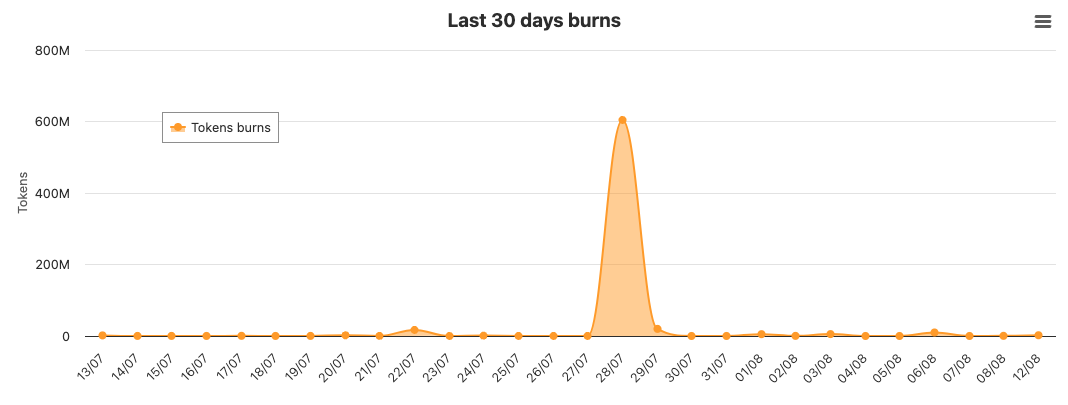 Shiba Inu burn rate in the last 30 days | Source: Shiba Burn Tracker
Shiba Inu price moves sideways despite token burn
Interestingly, despite the major late-July burn, SHIB’s price moved in the opposite direction. Between July 28 and August 2, the token fell from $0.000014 to a monthly low of $0.000011. It has since recovered to $0.00001386.
This drop coincided with Bitcoin’s fall from above $119,000 to a monthly low of $122,321 in a few days. What is more, Shiba Inu’s recovery in the last seven days also coincided with Bitcoin’s (BTC) recovery.
While token burns are important for Shiba Inu’s long-term outlook, they rarely drive prices higher in the short term. Instead, SHIB’s day-to-day price action remains closely tied to broader crypto market sentiment, particularly Bitcoin’s performance.
Disclaimer: The content of this article solely reflects the author's opinion and does not represent the platform in any capacity. This article is not intended to serve as a reference for making investment decisions.
You may also like
How much CPO demand will Nvidia Rubin Ultra generate? Bernstein: Optical value per Pod will increase fivefold
Bernstein believes that the co-packaged optics (CPO) and fiber demand driven by Nvidia's Rubin Ultra architecture will surge significantly, with the optical content per Pod rising from $1 million to $5.4 million. This will propel the size of Nvidia's optical ecosystem market to $46.8 billion by 2028 (a 91% annual increase). Although the industry faces supply bottlenecks with InP substrates, the outlook remains positive. The institution reiterates its “outperform” rating for Lumentum, Coherent, and Ciena.

UBS Q3 implements a two-way strategy with gold options, heavily invests in technology stocks, and builds positions in SK Hynix (SKHY.US)
UBS Group (UBS.US) has submitted its Q3 holdings report (13F) as of September 30, 2026.

SpaceX (SPCX.US) reportedly attempts “de-Nvidiaization” at the rack level: developing Kessel cabinets to bypass L6 compute boards, purchasing only chips
SemiAnalysis: SpaceX has developed its own Kessel cabinet, bypassing Nvidia's L6 cards to provide more options for manufacturing its own hardware.

$3.7 billion “data center power equipment prepayments” abandoned! What did "the most active buyer of gas turbines", SoftBank, see?
In the second quarter of fiscal year 2026, SoftBank reported a net loss of $7.1 billion, primarily due to a $3.7 billion impairment charge from a $9.5 billion advance payment for power generation equipment for US data centers—of which about $2.9 billion was non-refundable and effectively lost. The CFO admitted that SoftBank placed orders before the project plan was finalized, and is now conducting a comprehensive review of its procurement strategy. "The most aggressive purchaser of gas turbines has now written off the deposit in this way."
Crypto prices
More


