
How SUI (SUI) Benefits From the Launch of Grayscale’s Two New Products

Grayscale’s DeepBook and Walrus Trusts could accelerate Sui blockchain adoption, driving institutional confidence and attracting more developers and users to the ecosystem, increasing network activity.
The Sui (SUI) blockchain has seen a substantial increase in user engagement and adoption, and this momentum could gain further traction.
Grayscale recently launched two new single-asset investment trusts, which could contribute to the growth of the Sui network.
Sui Blockchain Grows Stronger with Grayscale’s New Investment Trusts
On August 12, Grayscale, a leading digital asset investment platform, announced the launch of the Grayscale DeepBook Trust and Grayscale Walrus Trust. These trusts operate similarly to Grayscale’s other single-asset investment products.
Thus, they are exclusively invested in the DEEP and WAL tokens, respectively, offering investors direct access to these tokens. The firm revealed that the trusts are now available for daily subscription to eligible individual and institutional accredited investors.
But how does this benefit Sui? Well, DeepBook and Walrus are two core protocols within Sui’s ecosystem. The former is a decentralized central limit order book (CLOB). It serves as the liquidity backbone for Sui’s decentralized finance (DeFi) applications.
Walrus is a decentralized storage platform built on the Sui blockchain. It provides a system for developers to store and manage large data files, such as videos, images, and PDFs, in a resilient, scalable, and programmable manner. Notably, Walrus is chain-agnostic and capable of handling data from any blockchain, making it a versatile tool.
“DeepBook and Walrus provide infrastructure designed for high-performance on-chain liquidity and data, helping power the next wave of scalable, real-world blockchain applications,” Rayhaneh Sharif-Askary, Head of Product & Research at Grayscale, noted.
Since they’re built on the Sui blockchain, the launch of these trusts will benefit the ecosystem in several ways. Grayscale’s involvement brings heightened visibility to Sui’s ecosystem, leading to heightened appeal. The trusts also signal institutional confidence in Sui’s infrastructure, boosting legitimacy.
Furthermore, this may attract more developers and users. As they join the Sui network, the ecosystem benefits from the network effect, where each new participant adds value to the others, accelerating growth.
“We believe these two product launches are a seminal moment in the journey of the Sui ecosystem. With Grayscale DeepBook Trust and Grayscale Walrus Trust, investors will now have direct exposure to two core protocols within the Sui ecosystem,” Adeniyi Abiodun, Co-Founder and CPO at Mysten Labs, said.
Lastly, the trusts could likely drive increased transaction volume on the Sui blockchain, uplifting network activity. Meanwhile, these positive catalysts come amid a broader trend of growth and development within the ecosystem.
Artemis data showed that the daily active addresses on Sui have reached a new all-time high. This growth in active addresses highlights the increasing interest in the blockchain.
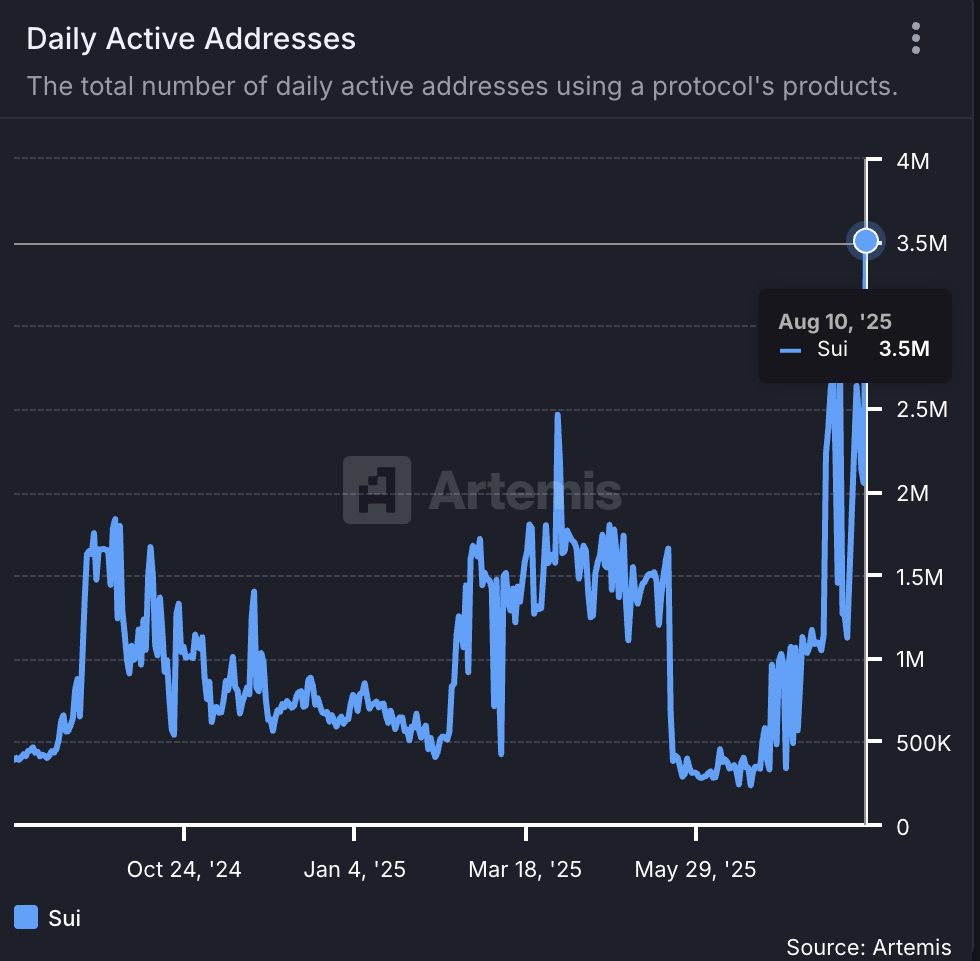 Sui Daily Active Addresses. Source:
Moreover, the surge in SUI code commits in 2025 further reinforces this momentum, reflecting strong developer activity and a commitment to continuous improvement.
Disclaimer: The content of this article solely reflects the author's opinion and does not represent the platform in any capacity. This article is not intended to serve as a reference for making investment decisions.
You may also like
How much CPO demand will Nvidia Rubin Ultra generate? Bernstein: Optical value per Pod will increase fivefold
Bernstein believes that the co-packaged optics (CPO) and fiber demand driven by Nvidia's Rubin Ultra architecture will surge significantly, with the optical content per Pod rising from $1 million to $5.4 million. This will propel the size of Nvidia's optical ecosystem market to $46.8 billion by 2028 (a 91% annual increase). Although the industry faces supply bottlenecks with InP substrates, the outlook remains positive. The institution reiterates its “outperform” rating for Lumentum, Coherent, and Ciena.

UBS Q3 implements a two-way strategy with gold options, heavily invests in technology stocks, and builds positions in SK Hynix (SKHY.US)
UBS Group (UBS.US) has submitted its Q3 holdings report (13F) as of September 30, 2026.

SpaceX (SPCX.US) reportedly attempts “de-Nvidiaization” at the rack level: developing Kessel cabinets to bypass L6 compute boards, purchasing only chips
SemiAnalysis: SpaceX has developed its own Kessel cabinet, bypassing Nvidia's L6 cards to provide more options for manufacturing its own hardware.

$3.7 billion “data center power equipment prepayments” abandoned! What did "the most active buyer of gas turbines", SoftBank, see?
In the second quarter of fiscal year 2026, SoftBank reported a net loss of $7.1 billion, primarily due to a $3.7 billion impairment charge from a $9.5 billion advance payment for power generation equipment for US data centers—of which about $2.9 billion was non-refundable and effectively lost. The CFO admitted that SoftBank placed orders before the project plan was finalized, and is now conducting a comprehensive review of its procurement strategy. "The most aggressive purchaser of gas turbines has now written off the deposit in this way."
Crypto prices
More


