
Whales Sniff Opportunity as FARTCOIN Rockets 26% in a Day

FARTCOIN jumps 26%, fueled by whale and smart wallet accumulation, with bullish momentum eyeing $1.74.
Solana-based meme token FARTCOIN has emerged as today’s top-performing crypto, surging 26% in the past 24 hours. The meme coin trades at $1.06 at press time, with daily trading volume soaring past $650 million.
On-chain data reveals strengthening buy-side pressure, suggesting the token’s rally could extend in the near term.
208 Million Reasons Whales Could Keep FARTCOIN’s Rally Alive
Beyond the boost from improving broader market sentiment over the past 24 hours, data from Nansen indicates that the activity of the largest holders has partly fueled FARTCOIN’s double-digit surge.
According to the on-chain data provider, whale wallets with FARTCOIN holdings valued above $1 million have increased their token supply by 2% in the last day.
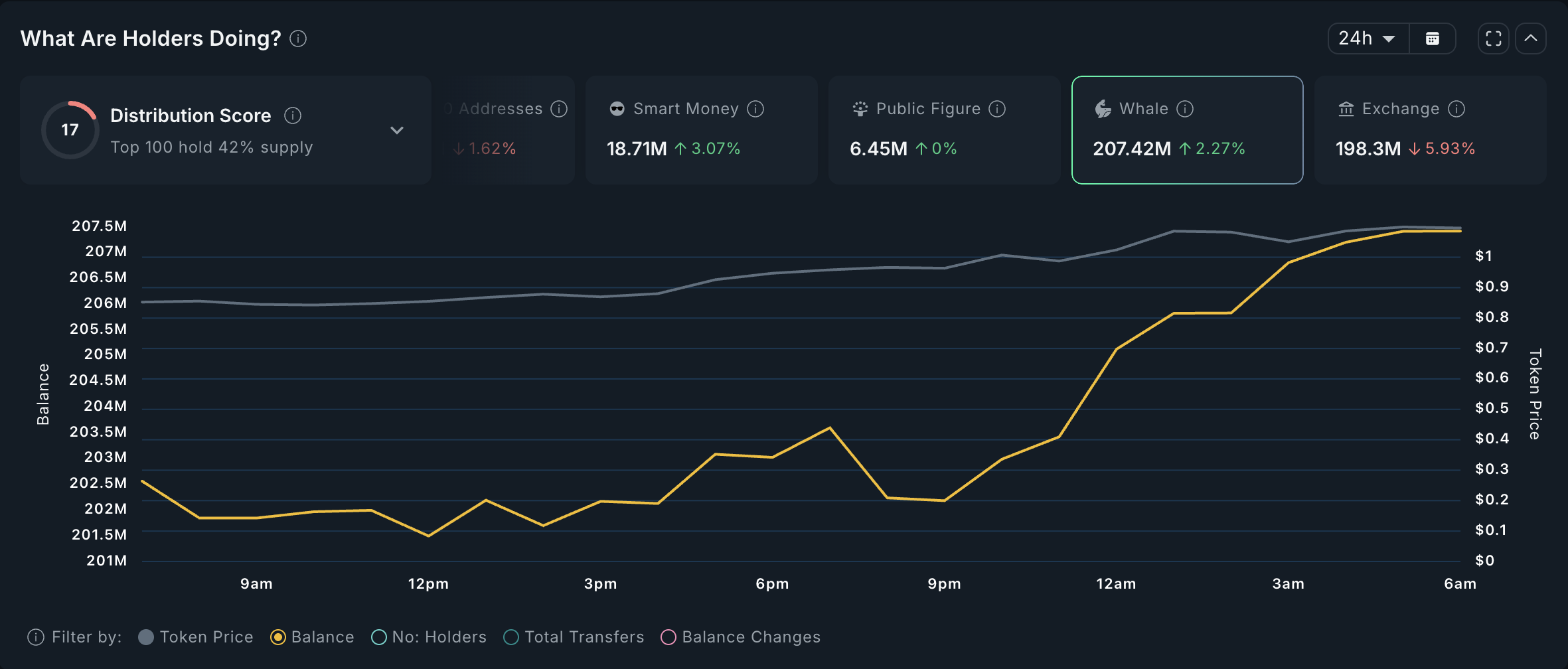 FARTCOIN Whale Activity. Source:
Nansen
This uptick in whale accumulation has strengthened the market’s bullish bias and could drive further gains if buying activity persists. As of this writing, this investor cohort controls 207.42 million FARTCOIN tokens.
Further, smart money — addresses that have historically demonstrated profitable or highly skilled trading behavior — have also increased their FARTCOIN holdings over the past day.
According to Nansen’s data, their supply has grown by 3% in the same period, and this group now holds 19 million FARTCOIN tokens, signaling heightened interest from seasoned market participants.
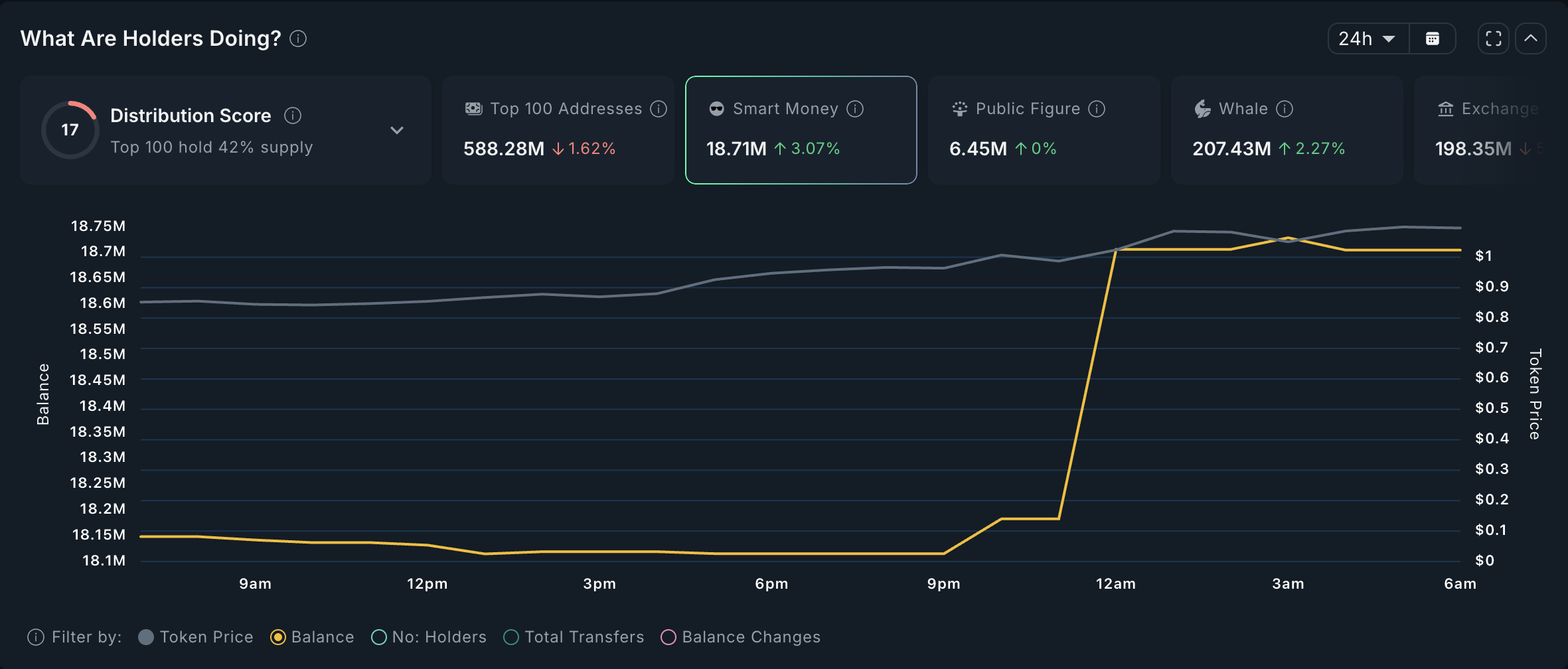 FARTCOIN Smart Money. Source:
Nansen
This uptick in demand from seasoned investors could drive deeper retail participation, as traders often take whale and smart money activity as a bullish signal.
If retail inflows into the FARTCOIN spot markets grow in response, it could add further momentum to the meme coin’s short-term upward rally.
FARTCOIN Price Setup Looks Ripe for a Breakout, but Risks Remain
On the daily chart, the setup of FARTCOIN’s Moving Average Convergence Divergence (MACD) indicator supports this bullish outlook. As of this writing, the token’s MACD line (blue) rests above the signal line (orange).
Also, its green histogram bars have grown in size over the past two trading sessions, signaling bullish momentum is climbing.
The MACD indicator identifies trends and momentum in its price movement. It helps traders spot potential buy or sell signals through crossovers between the MACD and signal lines.
As with FARTCOIN, when the MACD line rests above the signal line, it signals strengthening buying pressure and falling sell-side strength. If this persists, FARTCOIN’s price could break above $1.74.
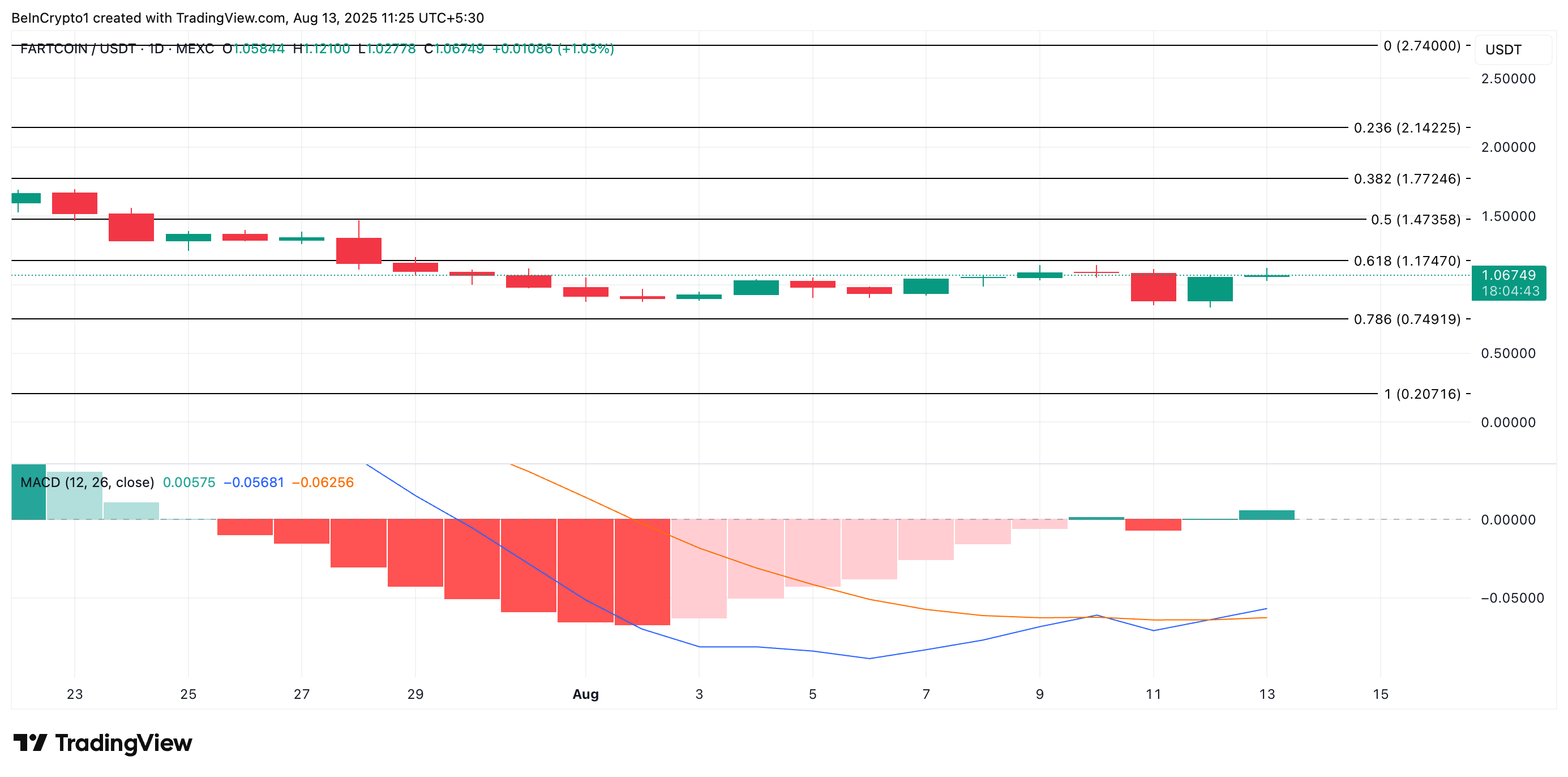 FARTCOIN Price Analysis. Source:
TradingView
On the other hand, if demand falls, the meme coin’s price could lose recent gains and drop to $0.74.
Disclaimer: The content of this article solely reflects the author's opinion and does not represent the platform in any capacity. This article is not intended to serve as a reference for making investment decisions.
You may also like
How much CPO demand will Nvidia Rubin Ultra generate? Bernstein: Optical value per Pod will increase fivefold
Bernstein believes that the co-packaged optics (CPO) and fiber demand driven by Nvidia's Rubin Ultra architecture will surge significantly, with the optical content per Pod rising from $1 million to $5.4 million. This will propel the size of Nvidia's optical ecosystem market to $46.8 billion by 2028 (a 91% annual increase). Although the industry faces supply bottlenecks with InP substrates, the outlook remains positive. The institution reiterates its “outperform” rating for Lumentum, Coherent, and Ciena.
UBS Q3 implements a two-way strategy with gold options, heavily invests in technology stocks, and builds positions in SK Hynix (SKHY.US)
UBS Group (UBS.US) has submitted its Q3 holdings report (13F) as of September 30, 2026.
SpaceX (SPCX.US) reportedly attempts “de-Nvidiaization” at the rack level: developing Kessel cabinets to bypass L6 compute boards, purchasing only chips
SemiAnalysis: SpaceX has developed its own Kessel cabinet, bypassing Nvidia's L6 cards to provide more options for manufacturing its own hardware.
$3.7 billion “data center power equipment prepayments” abandoned! What did "the most active buyer of gas turbines", SoftBank, see?
In the second quarter of fiscal year 2026, SoftBank reported a net loss of $7.1 billion, primarily due to a $3.7 billion impairment charge from a $9.5 billion advance payment for power generation equipment for US data centers—of which about $2.9 billion was non-refundable and effectively lost. The CFO admitted that SoftBank placed orders before the project plan was finalized, and is now conducting a comprehensive review of its procurement strategy. "The most aggressive purchaser of gas turbines has now written off the deposit in this way."
Crypto prices
More


