
Solana’s Struggles Intensify: Why Are Whales Dumping Millions in SOL?

Solana whales are offloading millions in SOL, triggering concerns as the price struggles 40% below its all-time high. However, recent developments show signs of growing mainstream adoption.
Major cryptocurrency whales are offloading their Solana (SOL) holdings, triggering growing concerns within the market.
This surge in selling activity comes amid Solana’s underwhelming performance, as the altcoin continues to lag behind the broader global cryptocurrency market.
Solana’s Price Struggles as Whales Dump Millions in SOL
In a recent post on X (formerly Twitter), blockchain analytics firm Lookonchain reported that three whale wallets moved over 226,000 SOL to exchanges in recent hours. The offloading of the stack valued at approximately $40 million signals potential profit-taking or a shift in strategy among large investors.
Lookonchain highlighted that CMJiHu deposited 96,996 SOL worth around $17.45 million to exchanges. Additionally, 5PjMxa deposited 91,890 SOL valued at nearly $15.98 million to Kraken. Lastly, HiN7sS transferred 37,658 SOL worth 6.73 million to Binance, realizing a profit of $1.63 million.
The pattern of sell-offs isn’t new. Over the weekend, Galaxy Digital moved 224,000 SOL valued at $41.12 million to Binance and Coinbase. Additionally, BeInCrypto reported last week that the digital asset financial services firm unstaked 250,000 SOL, valued at around $40.7 million.
The firm then transferred it to Binance. Similarly, another whale has been unstaking significant portions of their Solana holdings. The selling pressure coincides with a lack of investor enthusiasm, as evidenced by the performance of the REX Osprey Solana exchange-traded fund.
According to data from Farside Investors, the ETF recorded zero net flows for most of August’s trading sessions, with only one day of a positive flow.
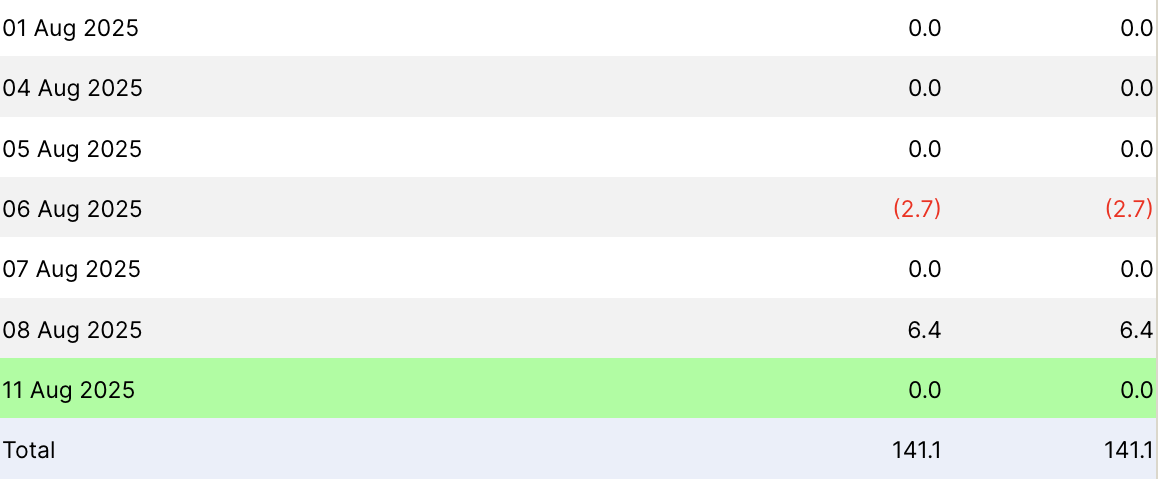 REX Osprey Solana ETF Performance. Source:
At the same time, SOL’s price performance has been lackluster. BeInCrypto Markets data revealed that the altcoin has struggled to approach its record highs, still remaining 40% below the all-time high (ATH).
In contrast, other cryptocurrencies such as ETH have experienced significant rallies, with the latest uptrend pushing its price to levels not seen since 2021. Furthermore, SOL has slipped 5.49% over the past day. At press time, it was trading at $175.64.
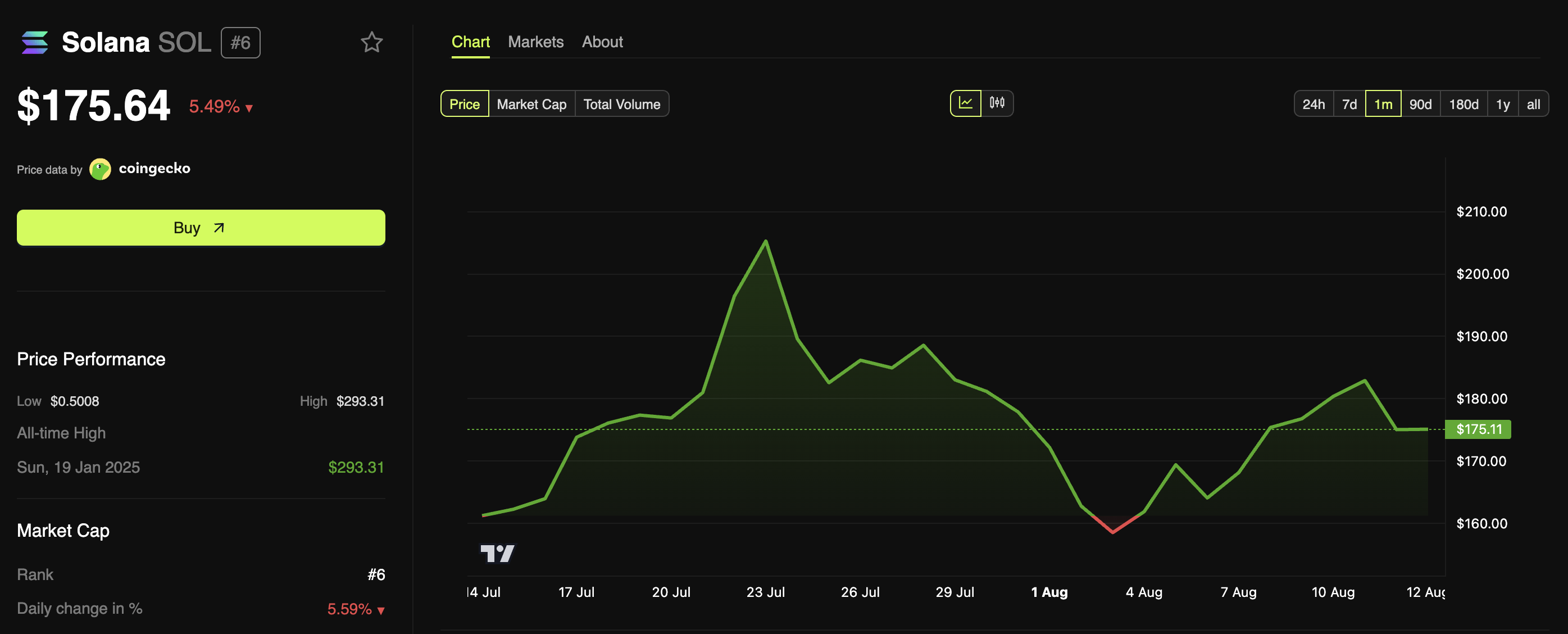 Solana (SOL) Price Performance. Source:
Positive Shifts for Solana as Whales Continue Offloading
Nonetheless, not all is bad for Solana. Some positive developments have emerged. For instance, OSL HK, a regulated cryptocurrency exchange, has announced that it will offer Solana trading to retail investors.
“We are pleased to announce that OSL HK will become the first exchange in Hong Kong to support Solana (SOL) retail trading,” the announcement said.
Additionally, Jeff Bezos’ Blue Origin has begun accepting SOL, alongside Bitcoin (BTC), Ethereum, Tether (USDT), and USDC (USDC) for spaceflight bookings, signaling growing mainstream adoption.
“Crypto is now a $4 trillion asset class, and the sky is the limit when it comes to its potential in the current payments ecosystem. We believe crypto and stablecoins are going to become an increasingly popular way for consumers to pay, particularly for high-end purchases, as both the consumer and merchant benefit financially from these transactions,” Alex Wilson, Head of Crypto at Shift4, stated.
The Solana ecosystem also saw a milestone with its meme token graduation rate surpassing 3%, reflecting increased activity.
Either the Solana trenches are back, or some serious crime is taking place. pic.twitter.com/yZxXLnPLjg
— Googly(@0xG00gly) August 11, 2025
While these developments show promise for Solana’s broader adoption, the ongoing whale sell-offs highlight the uncertainty surrounding the asset. It remains to be seen whether the whales will continue offloading their holdings or shift strategies, which will likely impact the token’s future trajectory.
Disclaimer: The content of this article solely reflects the author's opinion and does not represent the platform in any capacity. This article is not intended to serve as a reference for making investment decisions.
You may also like
How much CPO demand will Nvidia Rubin Ultra generate? Bernstein: Optical value per Pod will increase fivefold
Bernstein believes that the co-packaged optics (CPO) and fiber demand driven by Nvidia's Rubin Ultra architecture will surge significantly, with the optical content per Pod rising from $1 million to $5.4 million. This will propel the size of Nvidia's optical ecosystem market to $46.8 billion by 2028 (a 91% annual increase). Although the industry faces supply bottlenecks with InP substrates, the outlook remains positive. The institution reiterates its “outperform” rating for Lumentum, Coherent, and Ciena.
UBS Q3 implements a two-way strategy with gold options, heavily invests in technology stocks, and builds positions in SK Hynix (SKHY.US)
UBS Group (UBS.US) has submitted its Q3 holdings report (13F) as of September 30, 2026.
SpaceX (SPCX.US) reportedly attempts “de-Nvidiaization” at the rack level: developing Kessel cabinets to bypass L6 compute boards, purchasing only chips
SemiAnalysis: SpaceX has developed its own Kessel cabinet, bypassing Nvidia's L6 cards to provide more options for manufacturing its own hardware.

$3.7 billion “data center power equipment prepayments” abandoned! What did "the most active buyer of gas turbines", SoftBank, see?
In the second quarter of fiscal year 2026, SoftBank reported a net loss of $7.1 billion, primarily due to a $3.7 billion impairment charge from a $9.5 billion advance payment for power generation equipment for US data centers—of which about $2.9 billion was non-refundable and effectively lost. The CFO admitted that SoftBank placed orders before the project plan was finalized, and is now conducting a comprehensive review of its procurement strategy. "The most aggressive purchaser of gas turbines has now written off the deposit in this way."
Crypto prices
More


