
$120K and Rising: What On-Chain Data Says About Bitcoin’s Next Move

Bitcoin has continued its upward momentum over the past week, reclaiming price levels close to its all-time high. At the time of writing, the cryptocurrency is trading above $120,000, only a short distance from the record of more than $123,000.
Over the last seven days, the asset has posted a gain of approximately 5.1%, placing it among the stronger performers in the digital asset market.
Amid the price movement, on-chain data from the TRON network’s USDT transfers is offering insights into current market behavior. CryptoQuant contributor Amr Taha analyzed TRC-20 USDT transaction flows and identified patterns that may serve as potential indicators of Bitcoin price shifts.
By categorizing transactions into six size groups, ranging from retail trades of $100 to large “super whale” transfers exceeding $10 million, the analysis aims to distinguish between everyday market activity and institutional-scale transactions.
Large USDT Transfers as a Market Signal
Taha’s research notes that when transactions exceeding $10 million in USDT on the TRON network surpass $5 billion in a single day, this often coincides with significant profit-taking in Bitcoin.
Such activity typically involves converting BTC into USDT, followed by transferring the stablecoins to private wallets, reducing buying pressure in the spot market.
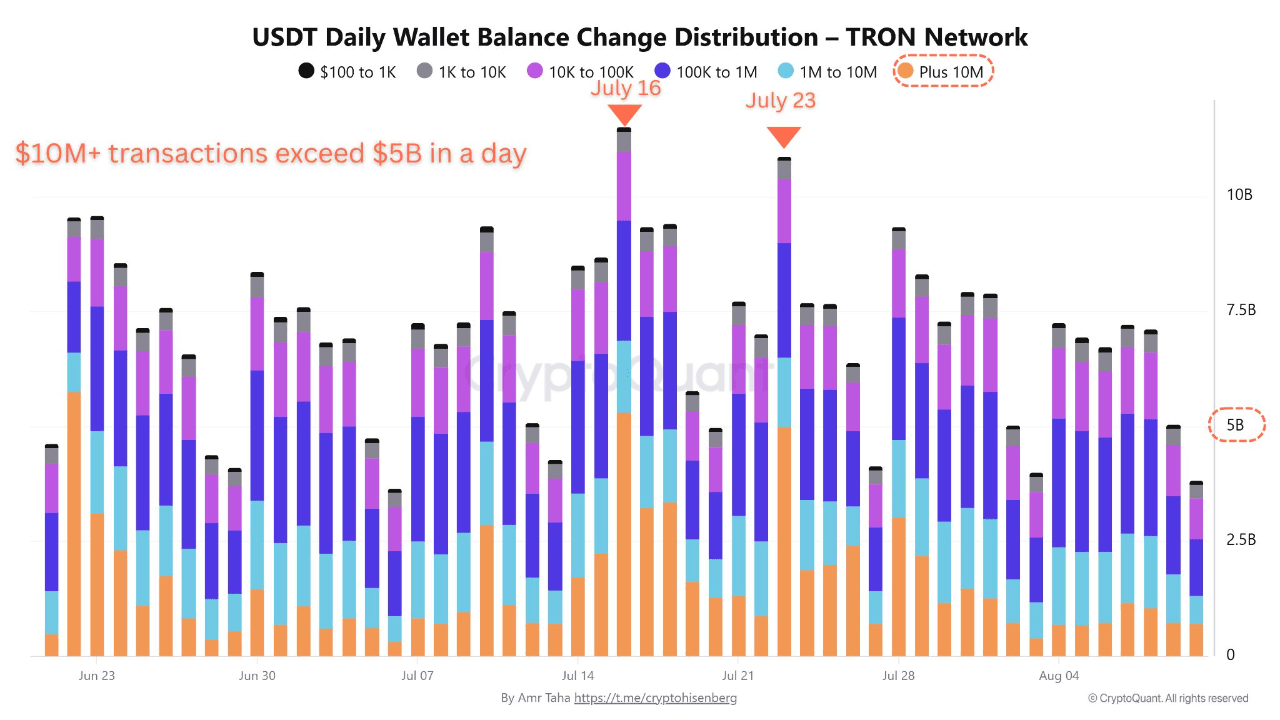
Past examples include July 16, when $10M+ USDT transfers reached $5.2 billion, followed by a 4.5% decline in BTC, and July 23, when $5.8 billion in similar transfers preceded a 3.8% drop within 48 hours.
Current data, however, shows a lack of such large-scale transactions, suggesting that major holders are not actively selling into stablecoins at present. This absence of substantial whale outflows may indicate that large investors are maintaining positions rather than exiting the market.
Bitcoin Shifting Market Participation and Potential Breakout Scenarios
A separate analysis from CryptoQuant’s ShayanMarkets examined the average executed order size in Bitcoin futures markets, providing another perspective on participation trends.
This metric, which divides total traded volume by the number of executed orders, helps identify whether activity is being driven by retail participants or larger, institutional traders.
Data from late 2024 and early 2025 showed periods of whale dominance, which coincided with strong rallies. In contrast, recent weeks have seen a rise in smaller, retail-sized orders, while whale-driven trades have diminished.
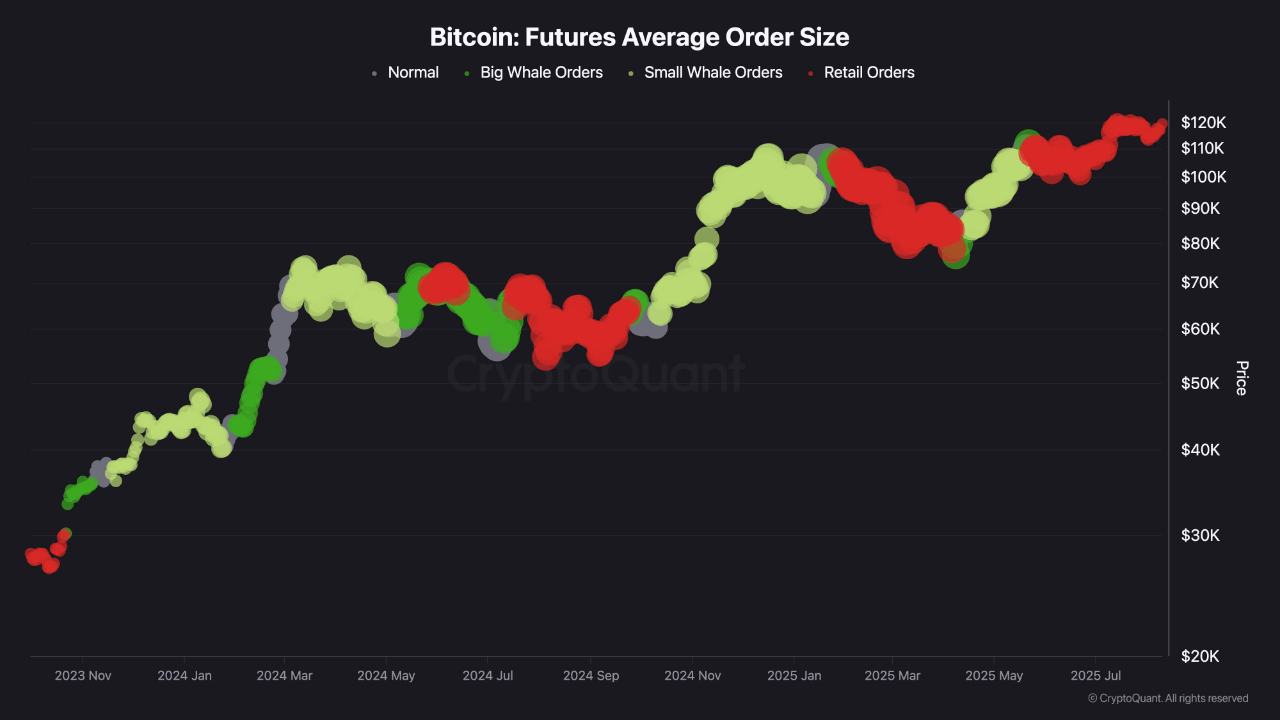
This shift suggests that large-scale buyers may be holding positions acquired at lower price levels or waiting for new market conditions before re-entering with significant volume.
Historically, extended whale dominance near market highs has often been associated with distribution phases, where large holders take profits.
The current absence of such behavior leaves open the possibility of a bullish breakout above Bitcoin’s previous all-time high, provided that renewed selling pressure from large investors does not emerge in the near term.

Featured image created with DALL-E, Chart from TradingView
Disclaimer: The content of this article solely reflects the author's opinion and does not represent the platform in any capacity. This article is not intended to serve as a reference for making investment decisions.
You may also like
How much CPO demand will Nvidia Rubin Ultra generate? Bernstein: Optical value per Pod will increase fivefold
Bernstein believes that the co-packaged optics (CPO) and fiber demand driven by Nvidia's Rubin Ultra architecture will surge significantly, with the optical content per Pod rising from $1 million to $5.4 million. This will propel the size of Nvidia's optical ecosystem market to $46.8 billion by 2028 (a 91% annual increase). Although the industry faces supply bottlenecks with InP substrates, the outlook remains positive. The institution reiterates its “outperform” rating for Lumentum, Coherent, and Ciena.

UBS Q3 implements a two-way strategy with gold options, heavily invests in technology stocks, and builds positions in SK Hynix (SKHY.US)
UBS Group (UBS.US) has submitted its Q3 holdings report (13F) as of September 30, 2026.

SpaceX (SPCX.US) reportedly attempts “de-Nvidiaization” at the rack level: developing Kessel cabinets to bypass L6 compute boards, purchasing only chips
SemiAnalysis: SpaceX has developed its own Kessel cabinet, bypassing Nvidia's L6 cards to provide more options for manufacturing its own hardware.

$3.7 billion “data center power equipment prepayments” abandoned! What did "the most active buyer of gas turbines", SoftBank, see?
In the second quarter of fiscal year 2026, SoftBank reported a net loss of $7.1 billion, primarily due to a $3.7 billion impairment charge from a $9.5 billion advance payment for power generation equipment for US data centers—of which about $2.9 billion was non-refundable and effectively lost. The CFO admitted that SoftBank placed orders before the project plan was finalized, and is now conducting a comprehensive review of its procurement strategy. "The most aggressive purchaser of gas turbines has now written off the deposit in this way."
Crypto prices
More


