
Global Crypto ETPs Attract $572M Inflows, Led by Bitcoin and Ethereum Products

Global crypto exchange-traded products (ETPs) recorded $572 million in inflows during the trading week ending Friday, according to data from European digital asset manager CoinShares.
Global crypto exchange-traded products (ETPs) recorded $572 million in inflows during the trading week ending Friday, according to data from European digital asset manager CoinShares.
The strong demand comes amid improving market sentiment and growing institutional participation in digital assets .
Bitcoin-backed investment products remained the primary beneficiary, securing $520 million in net inflows for the week. The flagship cryptocurrency’s market dominance and its role as the most accessible institutional gateway into crypto continued to attract asset managers.
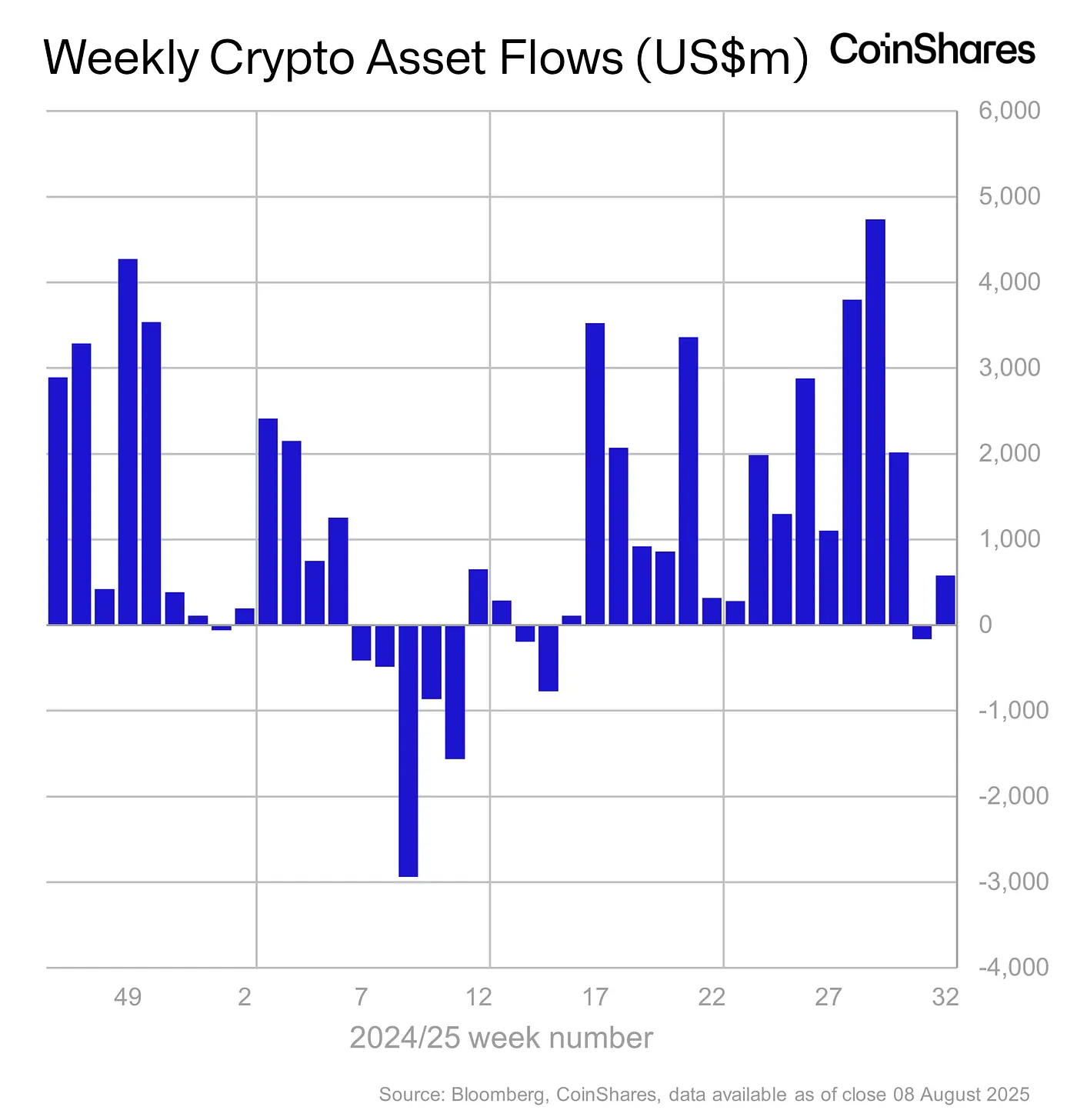 Source
:
CoinShares
Ethereum products also saw renewed interest, pulling in $21 million in inflows. The second-largest cryptocurrency has been buoyed by optimism surrounding the potential approval and launch of spot Ethereum ETFs in the United States, as well as broader adoption of its blockchain for stablecoin settlements and tokenized assets.
Other altcoin-linked ETPs recorded mixed performance. Solana products drew $8 million in inflows, reflecting sustained interest from investors seeking exposure to high-throughput blockchains. Meanwhile, multi-asset ETPs saw net outflows, suggesting some investors are consolidating positions into top-tier digital assets.
The inflows mark the fourth consecutive week of positive net investments into crypto ETPs, signaling a shift in institutional appetite after months of cautious positioning. CoinShares analysts attributed the momentum to falling interest rates expectations, weakening U.S. dollar strength, and growing clarity on regulatory pathways for crypto-based financial products in key markets.
Trading volumes in crypto ETPs surged to $2.3 billion for the week, well above the year-to-date weekly average. Analysts say this uptick underscores a resurgence in market activity, with asset managers and professional traders positioning ahead of potential catalysts in the coming months.
CoinShares noted that while market volatility remains a factor, the steady inflows suggest that institutional investors are increasingly treating digital assets as a core component of diversified portfolios.
Despite recent price volatility in Bitcoin and Ether, institutional appetite appears to be strengthening, with digital assets increasingly seen as a strategic component of diversified portfolios.
Disclaimer: The content of this article solely reflects the author's opinion and does not represent the platform in any capacity. This article is not intended to serve as a reference for making investment decisions.
You may also like
How much CPO demand will Nvidia Rubin Ultra generate? Bernstein: Optical value per Pod will increase fivefold
Bernstein believes that the co-packaged optics (CPO) and fiber demand driven by Nvidia's Rubin Ultra architecture will surge significantly, with the optical content per Pod rising from $1 million to $5.4 million. This will propel the size of Nvidia's optical ecosystem market to $46.8 billion by 2028 (a 91% annual increase). Although the industry faces supply bottlenecks with InP substrates, the outlook remains positive. The institution reiterates its “outperform” rating for Lumentum, Coherent, and Ciena.

UBS Q3 implements a two-way strategy with gold options, heavily invests in technology stocks, and builds positions in SK Hynix (SKHY.US)
UBS Group (UBS.US) has submitted its Q3 holdings report (13F) as of September 30, 2026.

SpaceX (SPCX.US) reportedly attempts “de-Nvidiaization” at the rack level: developing Kessel cabinets to bypass L6 compute boards, purchasing only chips
SemiAnalysis: SpaceX has developed its own Kessel cabinet, bypassing Nvidia's L6 cards to provide more options for manufacturing its own hardware.

$3.7 billion “data center power equipment prepayments” abandoned! What did "the most active buyer of gas turbines", SoftBank, see?
In the second quarter of fiscal year 2026, SoftBank reported a net loss of $7.1 billion, primarily due to a $3.7 billion impairment charge from a $9.5 billion advance payment for power generation equipment for US data centers—of which about $2.9 billion was non-refundable and effectively lost. The CFO admitted that SoftBank placed orders before the project plan was finalized, and is now conducting a comprehensive review of its procurement strategy. "The most aggressive purchaser of gas turbines has now written off the deposit in this way."
Crypto prices
More


