
GENIUS ban won’t stop institutions from seeking stablecoin yield — ex-Standard Chartered exec

The landmark US GENIUS Act could serve as a major catalyst for stablecoin adoption both domestically and abroad. But rather than simply boosting demand for dollar-backed digital currencies, it may unintentionally push capital into the tokenization market as investors seek yield on their holdings.
That was one of the key takeaways from a recent interview with Will Beeson, a former Standard Chartered executive and now founder and CEO of Uniform Labs, a developer of institutional liquidity solutions for tokenized financial markets.
A central provision of the GENIUS Act is its blanket ban on yield-bearing stablecoins, which prevents holders from earning interest on their digital dollar balances. According to Beeson, this restriction will accelerate the flow of capital into tokenized real-world assets (RWAs).
“With yield-bearing stablecoins off the table, institutions need a compliant way to earn yield while staying liquid,” Beeson told Cointelegraph. “Capital is already shifting.”
He noted that trillions of dollars in non-interest-bearing stablecoins are poised to enter digital finance. “Institutional holders aren’t going to sit on idle, depreciating assets. They’ll demand yield — and infrastructure that makes accessing it [...] compliant,” he said, adding:
“The next phase isn’t about holding idle stablecoins. It’s about programmatic access to risk-free yield, and the ability to move between cash and high-quality assets at will.”
Beeson’s view is shared by Aptos Labs’ Solomon Tesfaye, who told Cointelegraph that the GENIUS Act will benefit tokenization as much as it does stablecoins.
To meet this need, Beeson’s Uniform Labs is building Multiliquid, an institutional liquidity layer for tokenized markets that enables programmable, real-time conversion between tokenized assets, such as US Treasurys and money market funds, and stablecoins.
Multiliquid’s open-architecture design allows compliant issuers to integrate without commercial agreements.
While declining to name partners, Beeson confirmed that Uniform Labs is “working with a number of leading institutions, fintechs, and stablecoin issuers” ahead of its production launch later this year.
Before launching Uniform Labs, Beeson served as chief product officer at Libeara, a tokenization platform incubated by Standard Chartered’s SC Ventures.
Related: Tokenized money market funds emerge as Wall Street’s answer to stablecoins
Tokenization surge to broaden beyond private credit, government bonds
Although the GENIUS Act gives newfound legitimacy to stablecoins — and to digital currencies more broadly — “the next phase of digital assets is focused on asset tokenization,” wrote Sandra Waliczek, a member of the World Economic Forum’s blockchain and digital asset division.
Waliczek highlighted tokenization’s potential to level the investing playing field for asset classes like real estate and private equity, which have historically been restricted to wealthier investors.
“Tokenization changes this by enabling asset fractionalization, breaking assets into smaller, more affordable units,” she wrote.
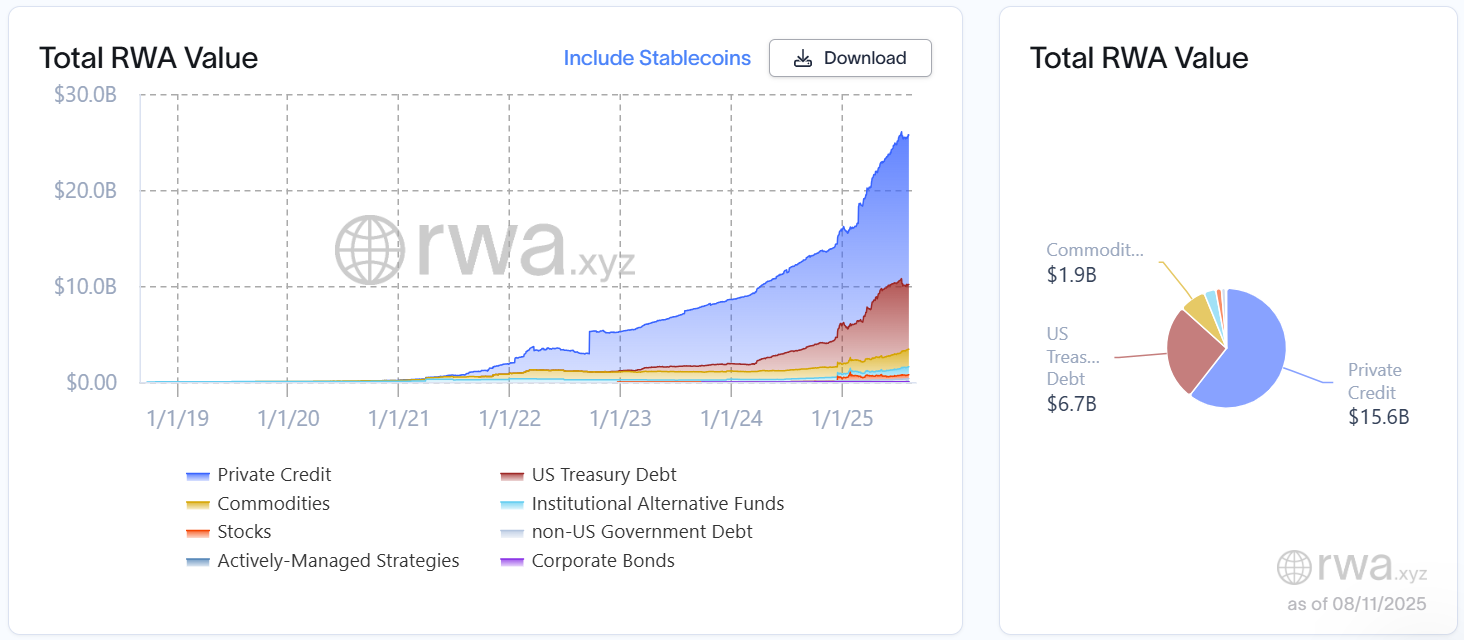
So far, the nearly $26 billion tokenization market has largely centered on private credit and government bonds. But as Beeson noted, the disruption will extend far beyond those segments, encompassing “corporate bonds, credit and credit funds, commodities, equities, real estate funds, private equity funds, and ultimately private equity and real estate assets themselves.”
Related: GENIUS Act scrutinized for stablecoin yield ban as TradFi tokenization gains steam
Disclaimer: The content of this article solely reflects the author's opinion and does not represent the platform in any capacity. This article is not intended to serve as a reference for making investment decisions.
You may also like
How much CPO demand will Nvidia Rubin Ultra generate? Bernstein: Optical value per Pod will increase fivefold
Bernstein believes that the co-packaged optics (CPO) and fiber demand driven by Nvidia's Rubin Ultra architecture will surge significantly, with the optical content per Pod rising from $1 million to $5.4 million. This will propel the size of Nvidia's optical ecosystem market to $46.8 billion by 2028 (a 91% annual increase). Although the industry faces supply bottlenecks with InP substrates, the outlook remains positive. The institution reiterates its “outperform” rating for Lumentum, Coherent, and Ciena.

UBS Q3 implements a two-way strategy with gold options, heavily invests in technology stocks, and builds positions in SK Hynix (SKHY.US)
UBS Group (UBS.US) has submitted its Q3 holdings report (13F) as of September 30, 2026.

SpaceX (SPCX.US) reportedly attempts “de-Nvidiaization” at the rack level: developing Kessel cabinets to bypass L6 compute boards, purchasing only chips
SemiAnalysis: SpaceX has developed its own Kessel cabinet, bypassing Nvidia's L6 cards to provide more options for manufacturing its own hardware.

$3.7 billion “data center power equipment prepayments” abandoned! What did "the most active buyer of gas turbines", SoftBank, see?
In the second quarter of fiscal year 2026, SoftBank reported a net loss of $7.1 billion, primarily due to a $3.7 billion impairment charge from a $9.5 billion advance payment for power generation equipment for US data centers—of which about $2.9 billion was non-refundable and effectively lost. The CFO admitted that SoftBank placed orders before the project plan was finalized, and is now conducting a comprehensive review of its procurement strategy. "The most aggressive purchaser of gas turbines has now written off the deposit in this way."
Crypto prices
More


