
Institutions grab 1.03m Ethereum worth $4.17b, ETH price breaks $4,000

More than 1.035 million Ethereum worth $4.167 billion have been accumulated by unknown whales and institutions over the past month.
- Whales, institutions amass 1.035 million Ethereum worth $4.17 billion in one month.
- Average ETH buy price $3,546 as price surges from $2,600 to $4,170.
- Analysts warn of overextension, advise ETH ecosystem plays instead.
According to analyst Ember CN, the massive buying spree coincided with ETH’s price surge from $2,600 to over $4,000, which is a 45% gain since July 10 and a 19.6% gain over the last seven days.
The institutional accumulation occurred through exchanges and institutional trading platforms and buyers paidan average price of approximately $3,546 per Ethereum ( ETH ).
Ember CN suggested most addresses belong to institutions or U.S. public companies building Ethereum reserves, excluding known addresses like SBET.
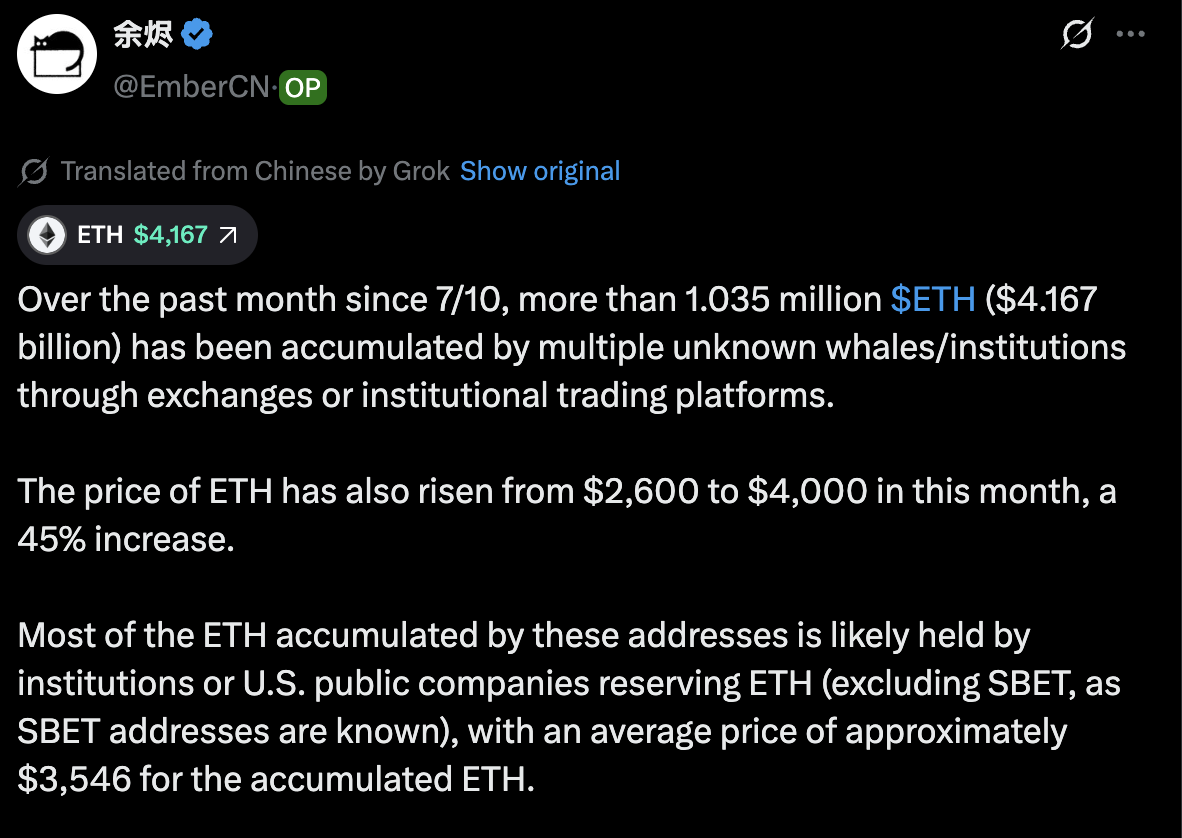 X post by analyst EmberCN
Binance moves ETH as price breaks $4,000
Arkham Intelligence data shows Binance hot wallets transferred thousands of ETH to market maker Wintermute within hours of the price surge.
The transactions began with flows of 250 to 500 ETH per transfer before escalating to larger movements including single transactions exceeding 1,800 ETH.
The Wintermute transfers suggest institutional demand need better execution to avoid market impact. Market makers handle large orders by breaking them into smaller transactions or providing liquidity during volatile periods.
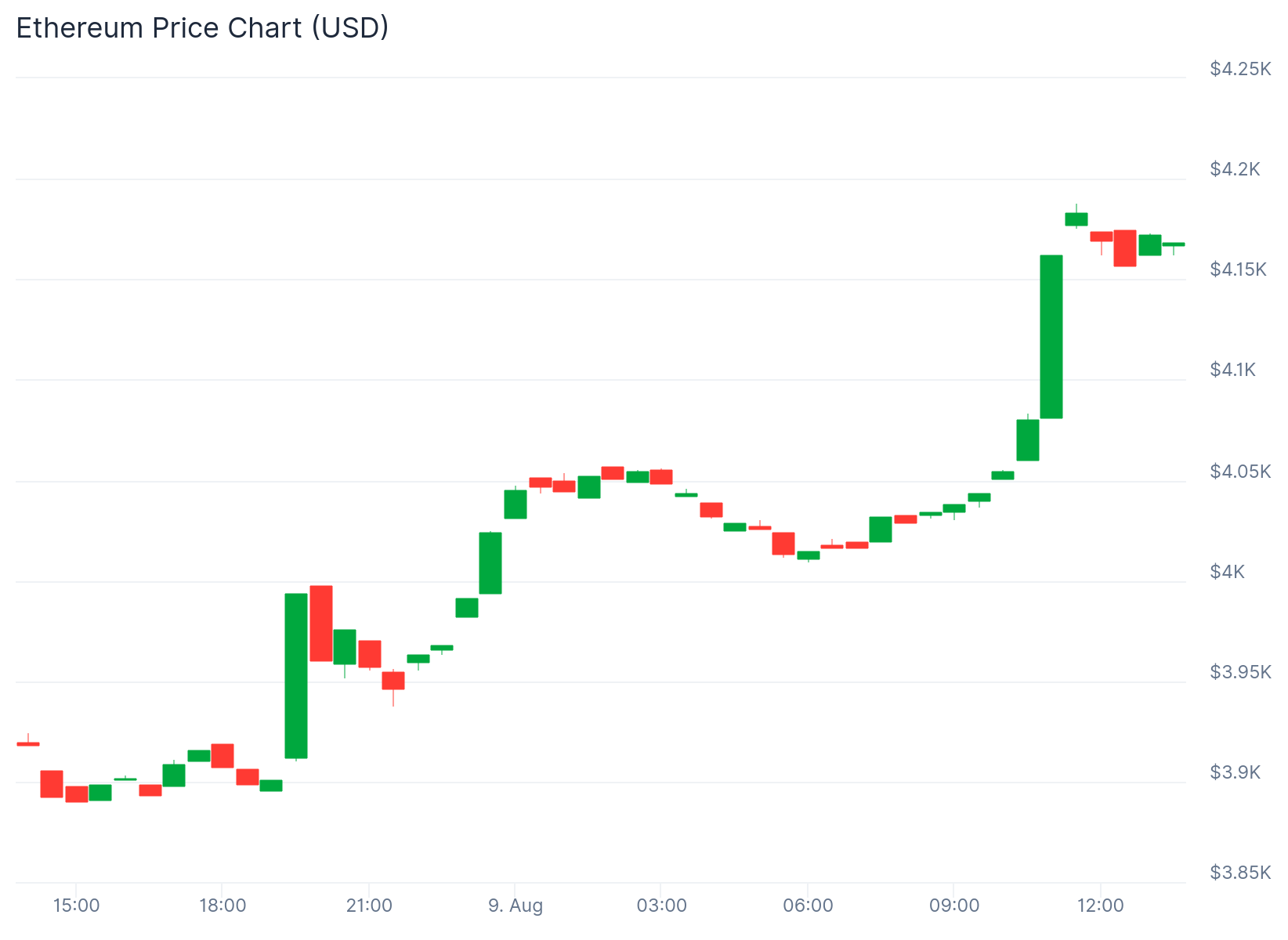 Ethereum 24-H price chart: CoinGecko
Ethereum’s 24-hour gain of 6.6% pushed the price to $4,170, approaching the previous all-time high near $4,800. The 30-day performance of nearly 50% shows sustained institutional buying pressure across multiple time frames.
Technical analysts warn of overextension
Analyst Michaël van de Poppe cautioned against buying ETH at current levels. He also described the move as “wild” and noting that prices have “swept the high.”
Poppe suggested the setup could lead to “a big breakout towards ATHs” but recommended allocating funds within the Ethereum ecosystem instead.
“It’s a little too risky to be buying $ETH at these highs,” van de Poppe posted. “I think it’s wiser to allocate funds within the $ETH ecosystem as it should yield a higher return.”
The analyst’s recommendation shows a common strategy of buying ecosystem tokens that may outperform ETH during rallies while maintaining exposure to Ethereum’s growth.
The $4.17 billion accumulation period coincides with increased institutional cryptocurrency adoption.
U.S. public companies have increasingly adopted cryptocurrency treasury strategies, with Ethereum becoming a secondary choice after Bitcoin for corporate holdings.
Disclaimer: The content of this article solely reflects the author's opinion and does not represent the platform in any capacity. This article is not intended to serve as a reference for making investment decisions.
You may also like
How much CPO demand will Nvidia Rubin Ultra generate? Bernstein: Optical value per Pod will increase fivefold
Bernstein believes that the co-packaged optics (CPO) and fiber demand driven by Nvidia's Rubin Ultra architecture will surge significantly, with the optical content per Pod rising from $1 million to $5.4 million. This will propel the size of Nvidia's optical ecosystem market to $46.8 billion by 2028 (a 91% annual increase). Although the industry faces supply bottlenecks with InP substrates, the outlook remains positive. The institution reiterates its “outperform” rating for Lumentum, Coherent, and Ciena.

UBS Q3 implements a two-way strategy with gold options, heavily invests in technology stocks, and builds positions in SK Hynix (SKHY.US)
UBS Group (UBS.US) has submitted its Q3 holdings report (13F) as of September 30, 2026.

SpaceX (SPCX.US) reportedly attempts “de-Nvidiaization” at the rack level: developing Kessel cabinets to bypass L6 compute boards, purchasing only chips
SemiAnalysis: SpaceX has developed its own Kessel cabinet, bypassing Nvidia's L6 cards to provide more options for manufacturing its own hardware.

$3.7 billion “data center power equipment prepayments” abandoned! What did "the most active buyer of gas turbines", SoftBank, see?
In the second quarter of fiscal year 2026, SoftBank reported a net loss of $7.1 billion, primarily due to a $3.7 billion impairment charge from a $9.5 billion advance payment for power generation equipment for US data centers—of which about $2.9 billion was non-refundable and effectively lost. The CFO admitted that SoftBank placed orders before the project plan was finalized, and is now conducting a comprehensive review of its procurement strategy. "The most aggressive purchaser of gas turbines has now written off the deposit in this way."
Crypto prices
More


