
Ethereum Treasury Companies Are a Better Buy Than US Spot Ether ETFs, Standard Chartered Says

Why Ethereum Treasury Holdings Beat Spot ETFs, According to Standard Chartered
Geoffrey Kendrick, head of digital assets research at London-based Standard Chartered Bank, delivered a nugget of alpha that many may have missed last week, ether treasury companies are probably a better buy than spot ether ETFs. The reason, which may be obvious to some, is that spot ETH funds don’t currently offer staking rewards, but treasury companies do.
Kendrick and his team published a research note last Tuesday, showing how ether treasury companies such as Sharplink , have purchased the cryptocurrency at double the rate of spot ETFs. In a follow-up note yesterday, Kendrick said that since June, both treasury firms and ETFs each bought roughly 1.6% of all ether in circulation.
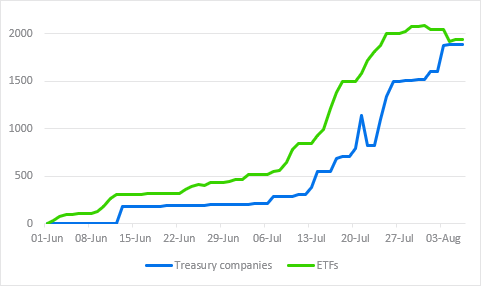
( ETH holding companies and ETFs are neck-and-neck when it comes to amount of ETHbought since June / Standard Chartered Research)
And now, given the already rapid pace of acquisition shown by treasury entities, the additional benefit of compounded staking rewards, and the fact that holding companies face fewer regulatory hurdles than ether ETFs, Kendrick and team see ETH treasury firms as having more growth potential than their fund counterparts or even their bitcoin treasury cousins.
“We think ETH treasury companies have even more growth potential than BTC ones from a regulatory arbitrage perspective,” Kendrick and team explain. “We think they may eventually end up owning 10% of all ETH , a 10x increase from current holdings.”
The team also expects ether treasury companies to help buoy the cryptocurrency past the $4,000 threshold. Ether, which floundered in the first quarter of 2025, reached its all-time high of $4,891.70 nearly four years ago in November 2021. The digital asset was trading at $3,816.40 at the time of reporting, up 3.81% over 24 hours, according to Coinmarketcap.
“If the flows can continue, ETH may be able to break above the key USD 4,000 level (our current end-2025 forecast),” Kendrick and team said.
Disclaimer: The content of this article solely reflects the author's opinion and does not represent the platform in any capacity. This article is not intended to serve as a reference for making investment decisions.
You may also like
How much CPO demand will Nvidia Rubin Ultra generate? Bernstein: Optical value per Pod will increase fivefold
Bernstein believes that the co-packaged optics (CPO) and fiber demand driven by Nvidia's Rubin Ultra architecture will surge significantly, with the optical content per Pod rising from $1 million to $5.4 million. This will propel the size of Nvidia's optical ecosystem market to $46.8 billion by 2028 (a 91% annual increase). Although the industry faces supply bottlenecks with InP substrates, the outlook remains positive. The institution reiterates its “outperform” rating for Lumentum, Coherent, and Ciena.

UBS Q3 implements a two-way strategy with gold options, heavily invests in technology stocks, and builds positions in SK Hynix (SKHY.US)
UBS Group (UBS.US) has submitted its Q3 holdings report (13F) as of September 30, 2026.

SpaceX (SPCX.US) reportedly attempts “de-Nvidiaization” at the rack level: developing Kessel cabinets to bypass L6 compute boards, purchasing only chips
SemiAnalysis: SpaceX has developed its own Kessel cabinet, bypassing Nvidia's L6 cards to provide more options for manufacturing its own hardware.

$3.7 billion “data center power equipment prepayments” abandoned! What did "the most active buyer of gas turbines", SoftBank, see?
In the second quarter of fiscal year 2026, SoftBank reported a net loss of $7.1 billion, primarily due to a $3.7 billion impairment charge from a $9.5 billion advance payment for power generation equipment for US data centers—of which about $2.9 billion was non-refundable and effectively lost. The CFO admitted that SoftBank placed orders before the project plan was finalized, and is now conducting a comprehensive review of its procurement strategy. "The most aggressive purchaser of gas turbines has now written off the deposit in this way."
Crypto prices
More


