
Ethereum’s $4,000 Breakout is Just a Matter of Time: 3 Signals Hint the Wait’s Almost Over

Ethereum price is inching toward $4,000, and this time, it might finally break through. With short-term buyers returning, SOPR falling, and resistance fading, the charts and on-chain metrics point to a breakout that’s just a matter of time.
Ethereum is up nearly 3% in the last 24 hours, and the weekly loss has been trimmed to just 3.5%. With price now closing in on the psychological $4,000 level again, both technicals and on-chain metrics are showing signs that the breakout might not be far away.
Three signals in particular are connecting well.
Short-Term Holders Are Accumulating Again
A reliable way to gauge upcoming momentum is to track the wallet activity of short-term holders. These are addresses that have held Ethereum between 1 and 3 months, often linked to fresh accumulation. According to HODL wave data, the percentage of these addresses has risen sharply from 9.57% to 11.93% in just under a month, showing renewed buying activity.
For token TA and market updates: Want more token insights like this? Sign up for Editor Harsh Notariya’s Daily Crypto Newsletter.
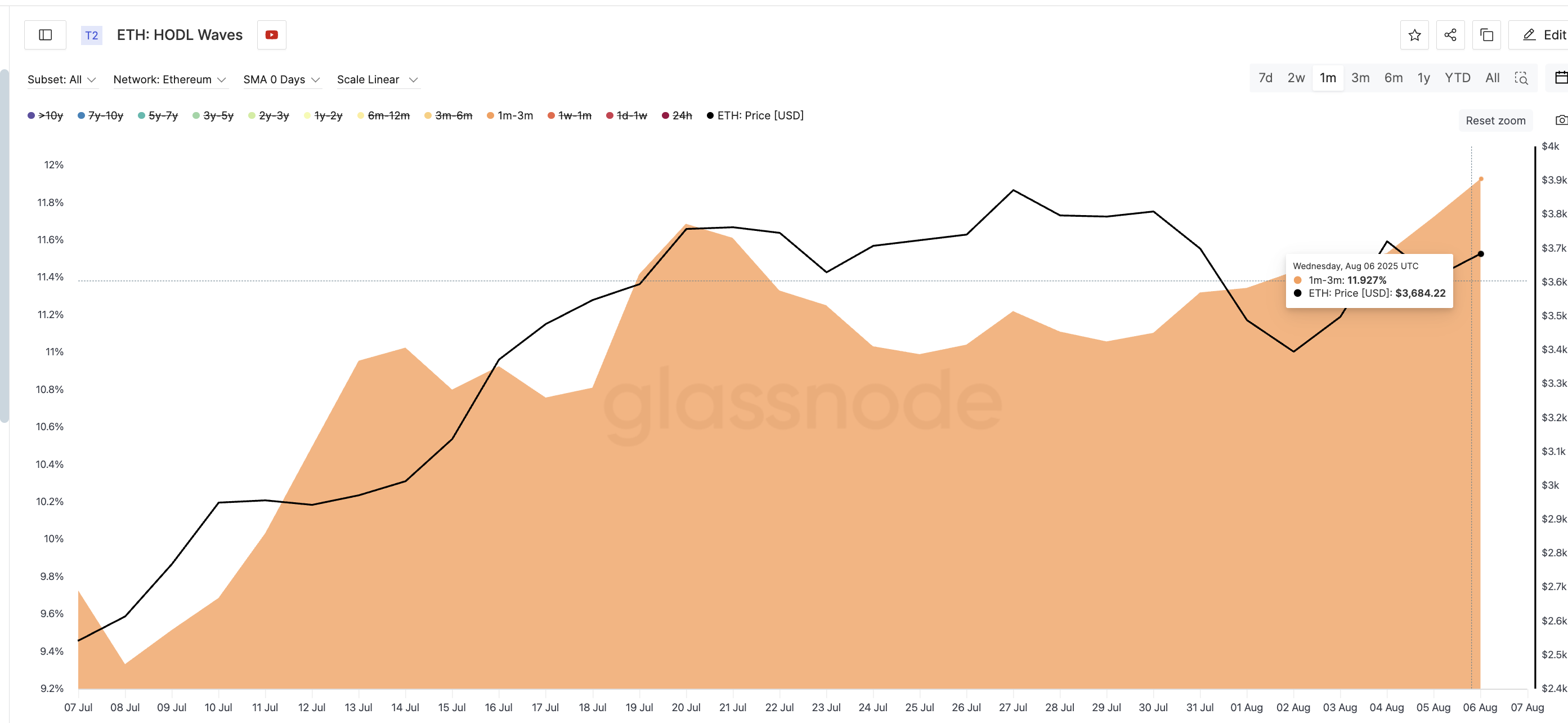 Ethereum HODL waves:
Glassnode
These holders often enter during consolidation and play a role in initiating breakouts.
HODL Waves show the percentage of Ethereum supply held over different durations. The 1–3-month cohort is especially important for identifying accumulation during transitional phases.
SOPR Suggests Sellers Are Losing Steam
Supporting this buying activity is the behavior of the SOPR metric, or Spent Output Profit Ratio. This indicator tracks whether coins being sold are in profit. A declining SOPR, while price remains steady or climbs, often signals that profit-taking has slowed.
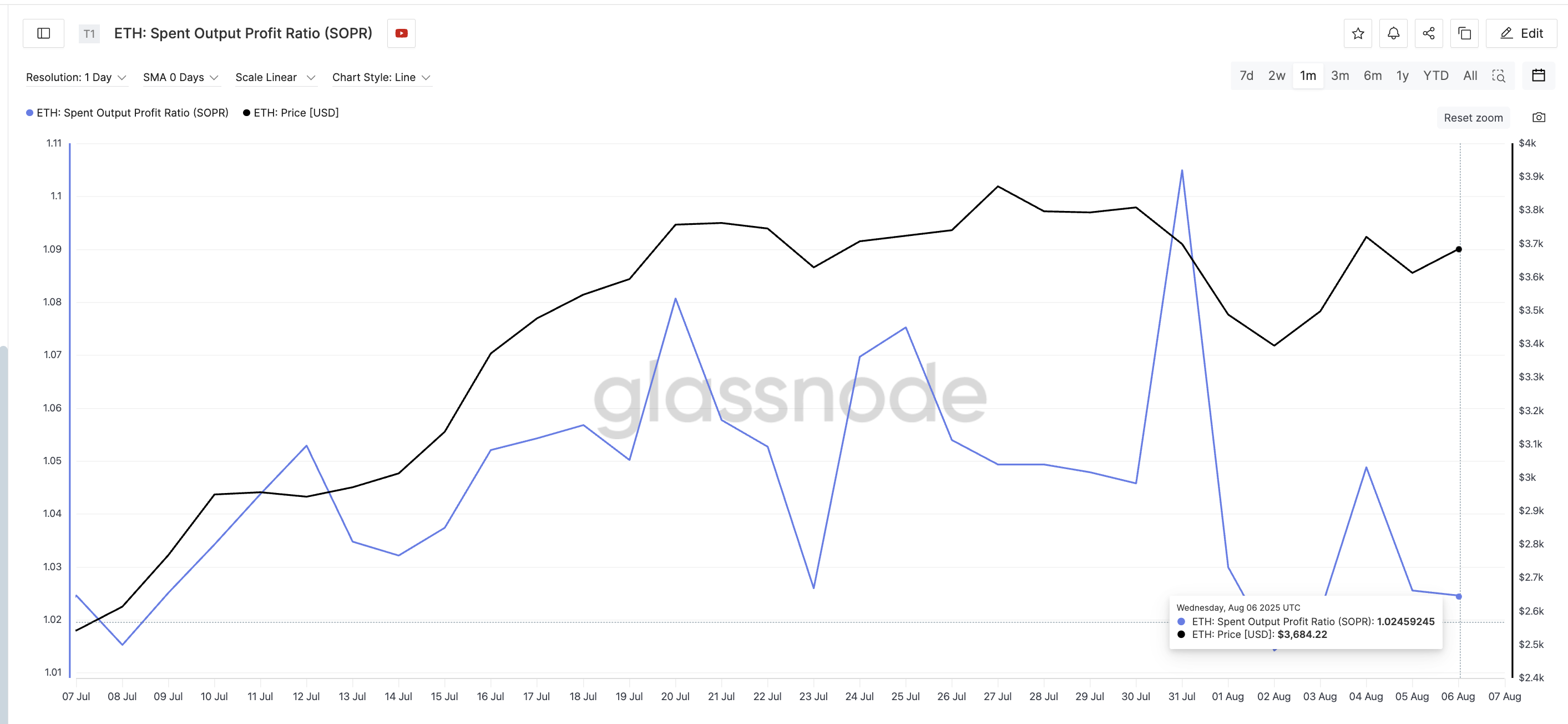 SOPR Ethereum:
Glassnode
That’s exactly what’s happening now. SOPR has dropped, even as Ethereum’s price has pushed slightly higher. The last time this happened, late July, ETH gained momentum soon after. It’s a typical bottom formation pattern. If this behavior continues, it adds strength to the idea that $4,000 is within reach.
SOPR helps measure market conviction. When sellers aren’t taking profits despite price gains, it suggests growing confidence in further upside.
Resistance Is Thinning as Buyers Step In; Good For the Ethereum Price Action?
On-chain data from IntoTheBlock’s Global In/Out of the Money model shows that the current resistance zone is weak. Only 11.95 million addresses sit just above Ethereum’s current price of $3,720. That means fewer holders are in a position to sell at breakeven, lowering the chances of heavy resistance between here and the $3,937 level.
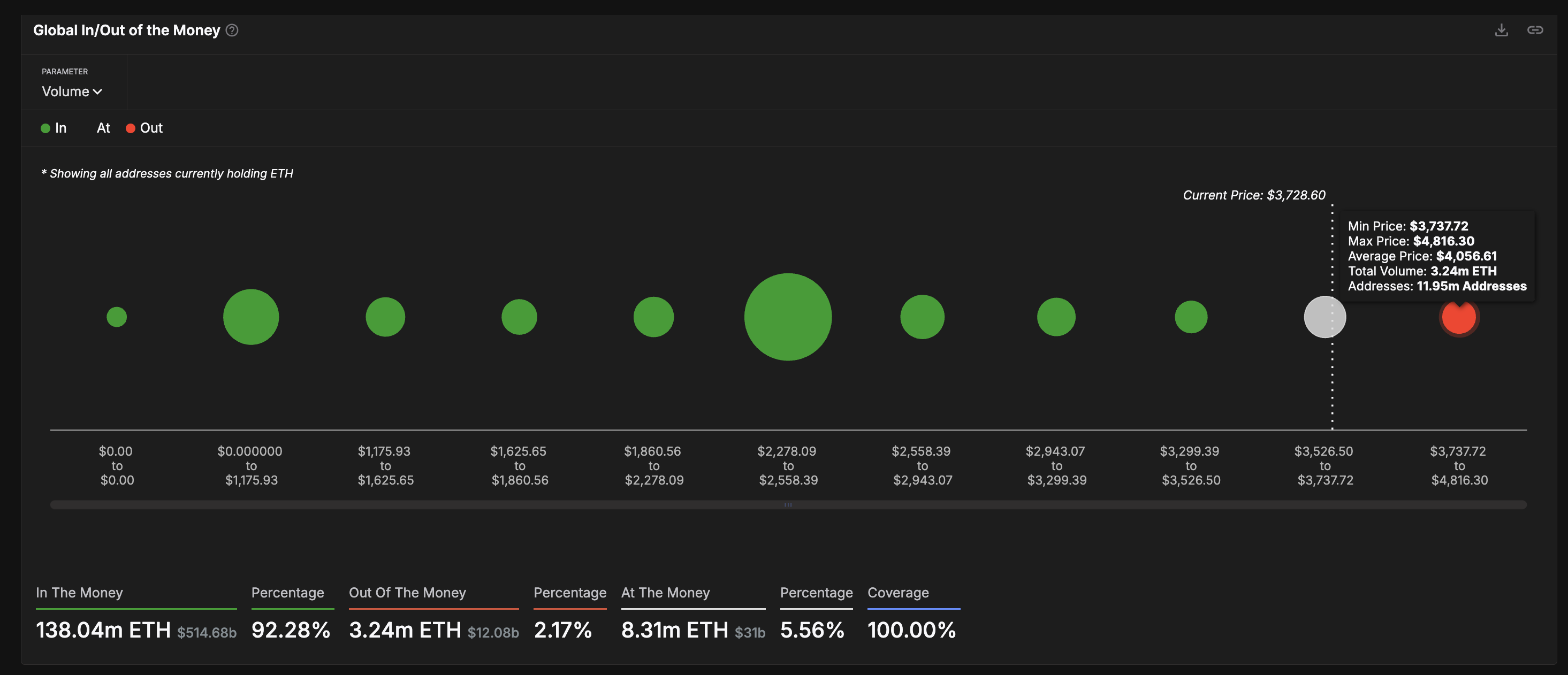 Ethereum price and sell walls:
IntoTheBlock
This level; $3,937, is critical according to the weekly price chart. In past cycles, Ethereum got rejected near $4,100; March 2024 and twice in December 2024. But this time, ETH price hasn’t tested $4,000 yet, despite holding above $3,300 since June. This makes a retest of the $4,000 mark long overdue.
Note: A weekly chart is used to cut out the range-bound movement; something ETH has been stuck with for a while now.
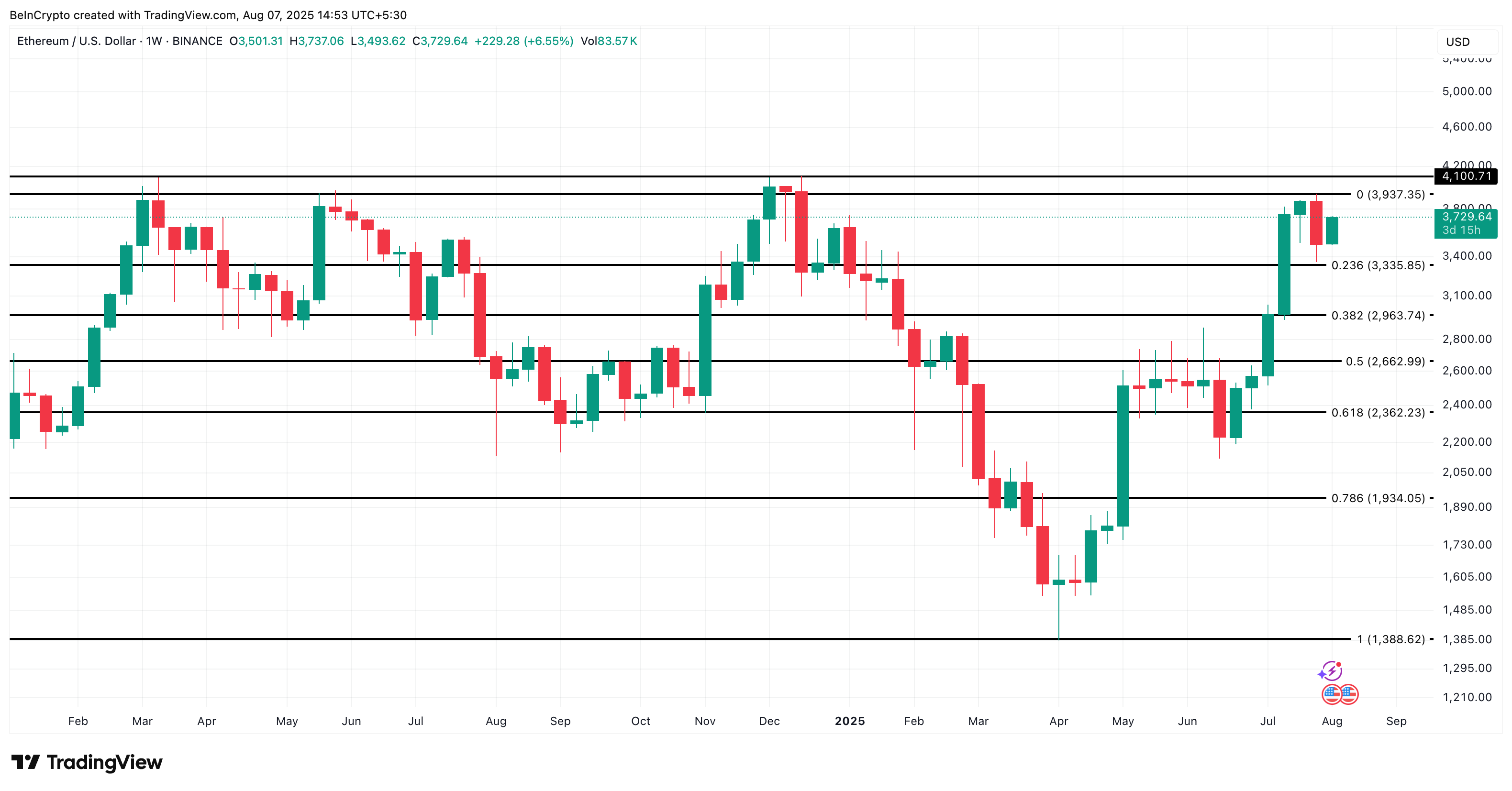 Ethereum price analysis:
TradingView
If Ethereum convincingly clears $3,937, the lack of sell pressure above makes a rally past $4,000 increasingly likely. However, if the sell pressure increases with SOPR dipping in line with price corrections or if the short-term buyers flip into the sellers, $3,335 would be a key level to watch.
A breach under that, more so on a larger timeframe, can turn the structure bearish, invalidating the current hypothesis.
Disclaimer: The content of this article solely reflects the author's opinion and does not represent the platform in any capacity. This article is not intended to serve as a reference for making investment decisions.
You may also like
How much CPO demand will Nvidia Rubin Ultra generate? Bernstein: Optical value per Pod will increase fivefold
Bernstein believes that the co-packaged optics (CPO) and fiber demand driven by Nvidia's Rubin Ultra architecture will surge significantly, with the optical content per Pod rising from $1 million to $5.4 million. This will propel the size of Nvidia's optical ecosystem market to $46.8 billion by 2028 (a 91% annual increase). Although the industry faces supply bottlenecks with InP substrates, the outlook remains positive. The institution reiterates its “outperform” rating for Lumentum, Coherent, and Ciena.

UBS Q3 implements a two-way strategy with gold options, heavily invests in technology stocks, and builds positions in SK Hynix (SKHY.US)
UBS Group (UBS.US) has submitted its Q3 holdings report (13F) as of September 30, 2026.

SpaceX (SPCX.US) reportedly attempts “de-Nvidiaization” at the rack level: developing Kessel cabinets to bypass L6 compute boards, purchasing only chips
SemiAnalysis: SpaceX has developed its own Kessel cabinet, bypassing Nvidia's L6 cards to provide more options for manufacturing its own hardware.

$3.7 billion “data center power equipment prepayments” abandoned! What did "the most active buyer of gas turbines", SoftBank, see?
In the second quarter of fiscal year 2026, SoftBank reported a net loss of $7.1 billion, primarily due to a $3.7 billion impairment charge from a $9.5 billion advance payment for power generation equipment for US data centers—of which about $2.9 billion was non-refundable and effectively lost. The CFO admitted that SoftBank placed orders before the project plan was finalized, and is now conducting a comprehensive review of its procurement strategy. "The most aggressive purchaser of gas turbines has now written off the deposit in this way."
Crypto prices
More


