
BIG Chainlink News: $1M Reserve Launched

Chainlink just dropped a game-changing update: it's building a reserve funded by real revenue —both onchain and offchain. With over $1 million in LINK already stacked, the market just got a reason to pay attention. Is this the fuel LINK price needs to break past $20 again?
Chainlink News: What Is the Chainlink Reserve and Why It Matters?
Chainlink just rolled out a strategic LINK reserve , aimed at long-term sustainability. It’s not just a marketing term. The Chainlink reserve is already backed by over $1 million worth of LINK, accumulated through both onchain service fees and offchain enterprise payments. Think Swift, Mastercard, UBS — not just your typical DeFi projects.
This isn’t a short-term liquidity pool or a rainy-day fund. Chainlink says it won’t touch the reserve for years. The goal is to funnel institutional adoption and revenue into LINK accumulation, strengthening its token economy without relying on inflationary emissions.
The model is smart. Enterprises can pay in stablecoins or fiat, and Chainlink will programmatically convert that revenue into LINK via DEXs. Over time, as adoption grows, this could create consistent buy pressure on LINK from real revenue.
Chainlink News: What the Daily Chart Is Saying Right Now
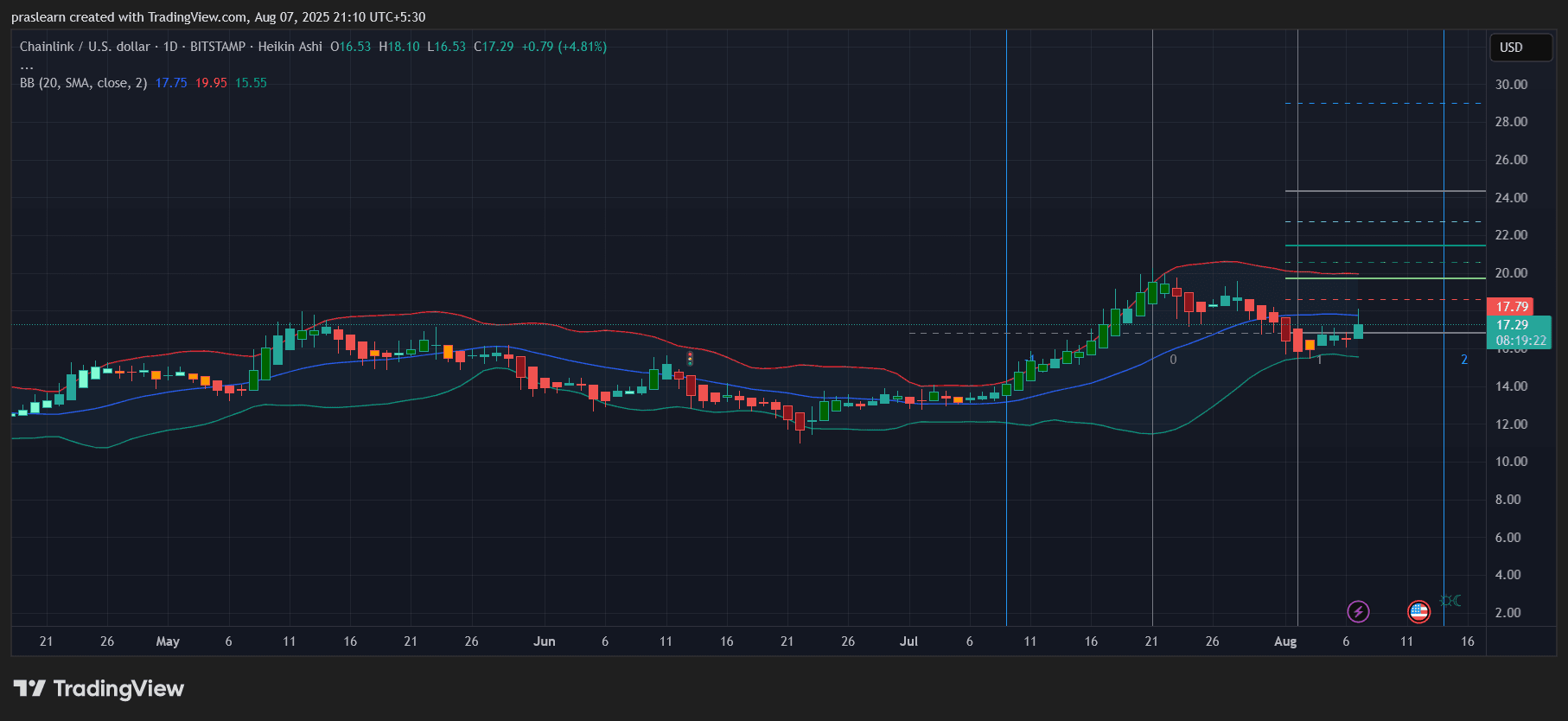 LINK/USD Daily Chart- TradingView
Looking at the daily chart, LINK price closed at $17.29 with a 4.81 percent gain on the day. The candle broke above the 20-day moving average (blue midline on Bollinger Bands), signaling a potential trend reversal after a recent correction.
The Chainlink price is now attempting to reclaim the upper Bollinger Band area. The last strong rally peaked near $22, and the red upper band is now sitting around $19.95. A move past that would confirm bullish momentum returning.
What really stands out is the Heikin Ashi candle structure. After several days of bearish or indecisive candles, today’s strong green close shows increasing momentum and reduced selling pressure. This aligns with the psychological impact of the reserve news — long-term support from institutional flows gives investors confidence to hold or buy more.
Can the Chainlink Reserve News Actually Move the Market?
The launch of the reserve doesn’t immediately inject capital into LINK’s trading volume. But what it does do is shift sentiment. When traders see that Chainlink is building a sustainable treasury from real revenue — not just grants or VC funds — it reframes the token's utility. LINK isn’t just a gas token for oracles anymore. It becomes a revenue-backed digital asset.
In the short term, the announcement gives bulls a reason to return. In the medium to long term, it sets the foundation for stronger tokenomics. More revenue means more LINK accumulated into the reserve. If market supply stays fixed or limited, this becomes a basic supply and demand equation.
Key Levels to Watch
- Support: $15.55 and $17.75 (lower and middle Bollinger Bands)
- Resistance: $19.95 (upper band) and $22.00 (previous local high)
If LINK price can close above $18.50 in the next two sessions, a push to test $20 seems likely. On the flip side, a failure to hold above $17 could drag it back into the $15.50–$16.50 consolidation zone.
Final Thoughts
The reserve launch changes the narrative. Instead of just another Oracle project, Chainlink is positioning LINK as a token backed by real enterprise use and actual revenue flows. That won’t pump the price overnight, but it does lay the groundwork for more sustainable growth.
The chart reflects that optimism. Chainlink price is trying to recover from its dip, and today’s breakout candle adds fuel. If momentum holds and volume picks up, $20 could come back into play sooner than expected.
Disclaimer: The content of this article solely reflects the author's opinion and does not represent the platform in any capacity. This article is not intended to serve as a reference for making investment decisions.
You may also like
How much CPO demand will Nvidia Rubin Ultra generate? Bernstein: Optical value per Pod will increase fivefold
Bernstein believes that the co-packaged optics (CPO) and fiber demand driven by Nvidia's Rubin Ultra architecture will surge significantly, with the optical content per Pod rising from $1 million to $5.4 million. This will propel the size of Nvidia's optical ecosystem market to $46.8 billion by 2028 (a 91% annual increase). Although the industry faces supply bottlenecks with InP substrates, the outlook remains positive. The institution reiterates its “outperform” rating for Lumentum, Coherent, and Ciena.

UBS Q3 implements a two-way strategy with gold options, heavily invests in technology stocks, and builds positions in SK Hynix (SKHY.US)
UBS Group (UBS.US) has submitted its Q3 holdings report (13F) as of September 30, 2026.

SpaceX (SPCX.US) reportedly attempts “de-Nvidiaization” at the rack level: developing Kessel cabinets to bypass L6 compute boards, purchasing only chips
SemiAnalysis: SpaceX has developed its own Kessel cabinet, bypassing Nvidia's L6 cards to provide more options for manufacturing its own hardware.

$3.7 billion “data center power equipment prepayments” abandoned! What did "the most active buyer of gas turbines", SoftBank, see?
In the second quarter of fiscal year 2026, SoftBank reported a net loss of $7.1 billion, primarily due to a $3.7 billion impairment charge from a $9.5 billion advance payment for power generation equipment for US data centers—of which about $2.9 billion was non-refundable and effectively lost. The CFO admitted that SoftBank placed orders before the project plan was finalized, and is now conducting a comprehensive review of its procurement strategy. "The most aggressive purchaser of gas turbines has now written off the deposit in this way."
Crypto prices
More


