
Bitcoin ETFs end 4-day bleeding streak with $92M inflows, can BTC follow?

The U.S.-listed Bitcoin-tracking exchange-traded funds have finally broken their losing streak, snapping back with a positive trading session after days of heavy outflows.
- U.S.-listed Bitcoin ETFs pulled in $91.6 million in net inflows on August 6, snapping a multi-day outflow streak.
- Bitcoin is currently hovering near $115,000, down about 6.5% below its $123,000 all-time high.
- Analysts say the next key level to watch is $117,200.
According to SoSoValue data, Bitcoin ETFs pulled in approximately $91.6 million in net inflows on August 6. This marked a recovery after four straight sessions of outflows, during which the funds lost over $1.5 billion.
BlackRock’s IBIT led the charge, pulling in $42 million. Bitwise’s BITB followed with $26.4 million, while Grayscale’s GBTC logged $14.5 million in inflows. VanEck’s HODL joined the trend with more modest numbers, recording $4.1 million. However, not every fund joined the rebound, as Ark & 21Shares’ ARKB posted $5.4 million in outflows.
The funds’ four-day slump came as Bitcoin ( BTC ) itself struggled, slipping below the $120,000 mark after a strong rally. With money now flowing back into the ETFs, the question is whether Bitcoin’s price action will follow the same path.
Can Bitcoin reclaim $120,000?
At the time of writing, Bitcoin is hovering around $115,023, up 0.89% on the day. The asset has moved mostly sideways in recent weeks, stuck below the $115,000 mark since early August.
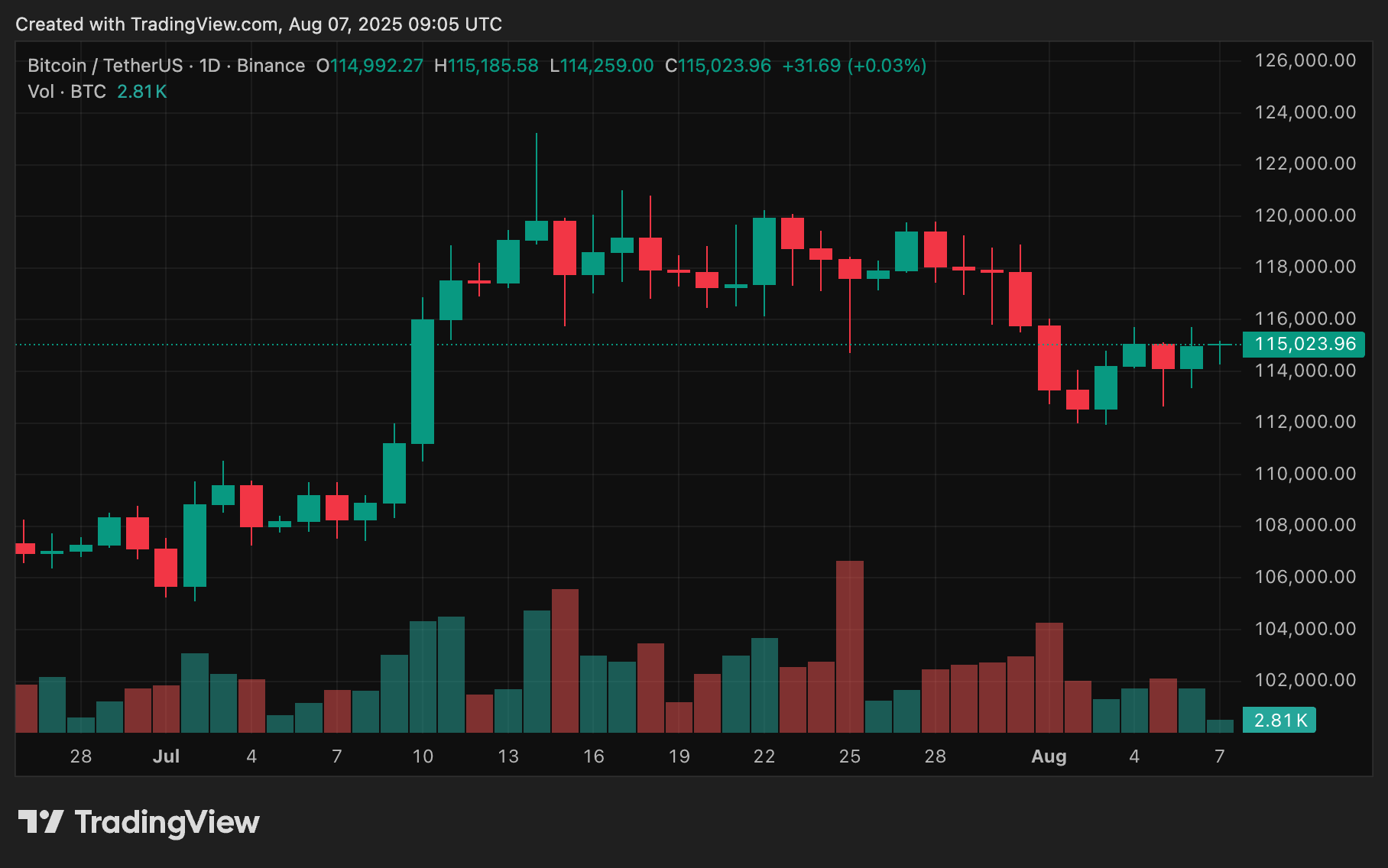 Bitcoin’s price chart | Source: crypto.news
Bitcoin is down about 3% on the week, and approximately 6.5% from its $123,000 all-time high. The slump in price has been largely attributed to profit-taking efforts among both retail and institutional investors, who are seeking to cash out after the latest rally.
But market data shows that the selling trend is now easing. According to an August 6 Glassnode report , only 45% of recent Bitcoin offloads came from holders in profit. This suggests that the sell pressure is cooling off, and the relief is expected to help steady prices in the near term.
However, for BTC to recover and push higher, the combination of heavy institutional inflows from the ETFs and corporate buying, which served as the main catalyst of the latest rally, will need to return. While the recent ETF inflows are modest compared to July’s peak, corporate interest hasn’t cooled. More public companies continue to add BTC to their balance sheets , painting an optimistic picture.
Technically, analysts have set $117,200 as the key zone to watch. According to market watcher Rekt Capital, if Bitcoin can break above this mark and hold, it would show strength and could open the door to further gains. However, if prices keep getting rejected, it could be a sign that the rally is losing steam.
Disclaimer: The content of this article solely reflects the author's opinion and does not represent the platform in any capacity. This article is not intended to serve as a reference for making investment decisions.
You may also like
How much CPO demand will Nvidia Rubin Ultra generate? Bernstein: Optical value per Pod will increase fivefold
Bernstein believes that the co-packaged optics (CPO) and fiber demand driven by Nvidia's Rubin Ultra architecture will surge significantly, with the optical content per Pod rising from $1 million to $5.4 million. This will propel the size of Nvidia's optical ecosystem market to $46.8 billion by 2028 (a 91% annual increase). Although the industry faces supply bottlenecks with InP substrates, the outlook remains positive. The institution reiterates its “outperform” rating for Lumentum, Coherent, and Ciena.

UBS Q3 implements a two-way strategy with gold options, heavily invests in technology stocks, and builds positions in SK Hynix (SKHY.US)
UBS Group (UBS.US) has submitted its Q3 holdings report (13F) as of September 30, 2026.

SpaceX (SPCX.US) reportedly attempts “de-Nvidiaization” at the rack level: developing Kessel cabinets to bypass L6 compute boards, purchasing only chips
SemiAnalysis: SpaceX has developed its own Kessel cabinet, bypassing Nvidia's L6 cards to provide more options for manufacturing its own hardware.

$3.7 billion “data center power equipment prepayments” abandoned! What did "the most active buyer of gas turbines", SoftBank, see?
In the second quarter of fiscal year 2026, SoftBank reported a net loss of $7.1 billion, primarily due to a $3.7 billion impairment charge from a $9.5 billion advance payment for power generation equipment for US data centers—of which about $2.9 billion was non-refundable and effectively lost. The CFO admitted that SoftBank placed orders before the project plan was finalized, and is now conducting a comprehensive review of its procurement strategy. "The most aggressive purchaser of gas turbines has now written off the deposit in this way."
Crypto prices
More


