
ETH/BTC Nears Key Level: Could Ethereum Outpace Bitcoin Again?

Ethereum’s ETH/BTC ratio is at a turning point, with a bullish setup forming and Bitcoin Dominance slipping. Analysts are divided on whether this signals a breakout or a cautionary pullback.
Ethereum is gaining attention as its price rebounds above the $3,700 mark, while Bitcoin (BTC) remains stuck around $114,000.
The ETH/BTC exchange rate is now entering a critical phase. If it can break above the current resistance zone amid the weakening trend of Bitcoin Dominance, ETH may pave the way for a new growth cycle.
ETH/BTC Up
The ETH/BTC ratio currently stands at 0.03059. It has fluctuated around its bottom range for nearly a year and is now nearing a key technical resistance level. Every time ETH/BTC hits such lows, it bounces back—a cyclical phenomenon.
An analysis on X also pointed out that this trading pair is approaching resistance at the 0.382 Fibonacci retracement level. This is a point technical traders often interpret as a potential signal for a trend reversal.
In response, another analyst noted that the current market structure of ETH/BTC is very “bullish.”
However, for ETH to break out of its sideways trend, another crucial indicator must be closely monitored: Bitcoin Dominance (BTC.D). According to MerlijnTrader, BTC.D has started to show signs of weakening, and liquidity is gradually shifting toward altcoins—including ETH.
“Once we see $BTC.D drop and $ETHBTC rise, the real altseason will start,” an analyst on X observed.
That said, the current 62% zone for BTC.D is a sensitive threshold. Analyst Daan cautioned that if BTC.D breaks above this level, the market could swing back in favor of Bitcoin. In that case, ETH might continue to underperform in comparison.
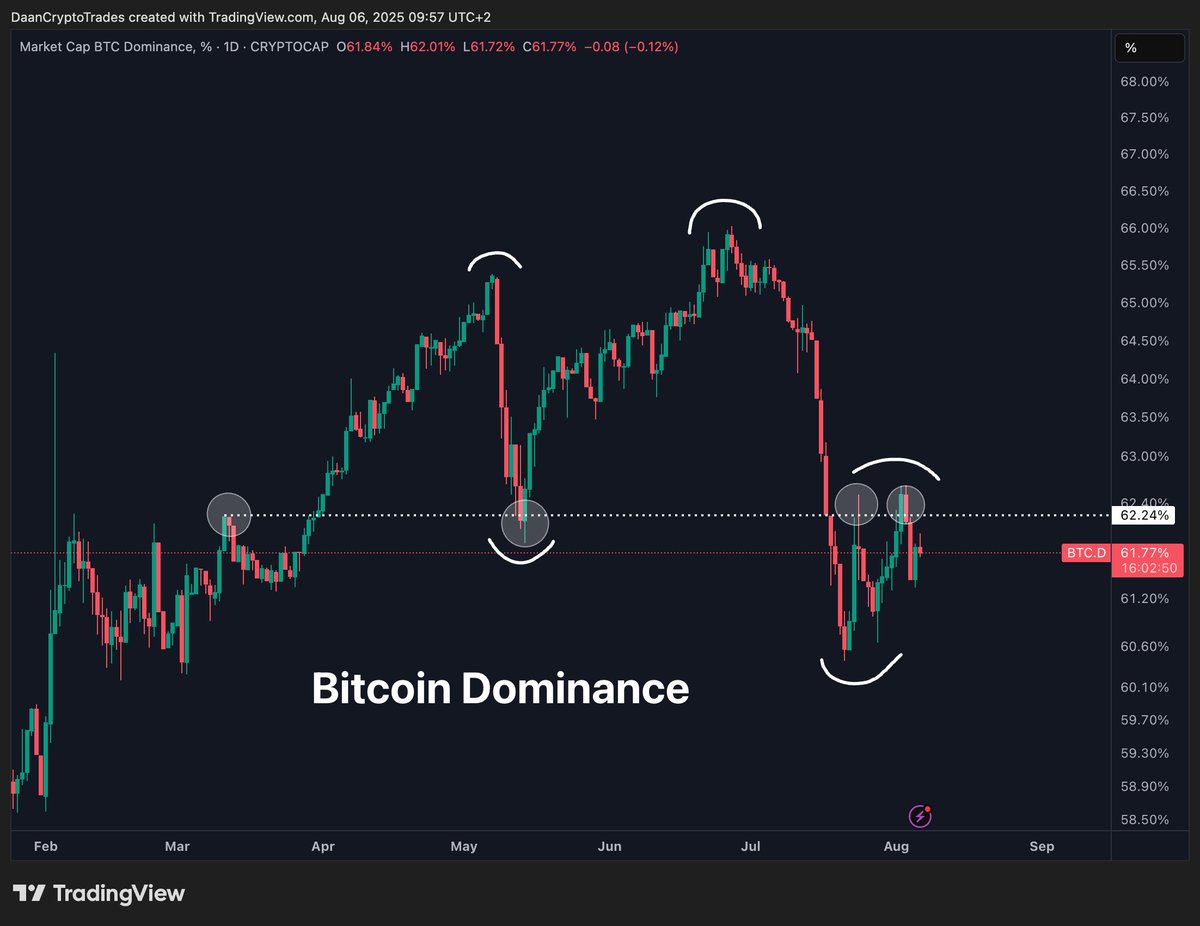 Bitcoin Dominance Chart. Source:
Daan on X
Optimistic Forecasts But Caution
In the current context, veteran analyst Thomas Lee suggested that ETH could reach $16,000—provided that ETH/BTC returns to its 2021 peak (~0.08837). However, this appears to be a long-term price projection.
From another perspective, BitMine BMNR argued that if ETH/BTC maintains the same ratio as in August 2024 (~0.050), then ETH could potentially reach around $5,700 based on BTC’s current price.
“ETH is a far better risk/reward today,” BitMine BMNR remarked.
While many forecasts remain optimistic for ETH, the market appears relatively subdued. According to Polymarket, the probability of ETH setting a new all-time high (ATH) before 2026 is 54%.
At present, ETH is trading around the $3,700 zone. To surpass its ATH from November 2021, ETH would need to grow by approximately 25%.
Disclaimer: The content of this article solely reflects the author's opinion and does not represent the platform in any capacity. This article is not intended to serve as a reference for making investment decisions.
You may also like
How much CPO demand will Nvidia Rubin Ultra generate? Bernstein: Optical value per Pod will increase fivefold
Bernstein believes that the co-packaged optics (CPO) and fiber demand driven by Nvidia's Rubin Ultra architecture will surge significantly, with the optical content per Pod rising from $1 million to $5.4 million. This will propel the size of Nvidia's optical ecosystem market to $46.8 billion by 2028 (a 91% annual increase). Although the industry faces supply bottlenecks with InP substrates, the outlook remains positive. The institution reiterates its “outperform” rating for Lumentum, Coherent, and Ciena.

UBS Q3 implements a two-way strategy with gold options, heavily invests in technology stocks, and builds positions in SK Hynix (SKHY.US)
UBS Group (UBS.US) has submitted its Q3 holdings report (13F) as of September 30, 2026.

SpaceX (SPCX.US) reportedly attempts “de-Nvidiaization” at the rack level: developing Kessel cabinets to bypass L6 compute boards, purchasing only chips
SemiAnalysis: SpaceX has developed its own Kessel cabinet, bypassing Nvidia's L6 cards to provide more options for manufacturing its own hardware.

$3.7 billion “data center power equipment prepayments” abandoned! What did "the most active buyer of gas turbines", SoftBank, see?
In the second quarter of fiscal year 2026, SoftBank reported a net loss of $7.1 billion, primarily due to a $3.7 billion impairment charge from a $9.5 billion advance payment for power generation equipment for US data centers—of which about $2.9 billion was non-refundable and effectively lost. The CFO admitted that SoftBank placed orders before the project plan was finalized, and is now conducting a comprehensive review of its procurement strategy. "The most aggressive purchaser of gas turbines has now written off the deposit in this way."
Crypto prices
More


