
Bitcoin’s Post-ATH Amnesia: Price Trapped in “Low-Liquidity Air Gap”

Bitcoin is struggling below $116K after falling into a low-liquidity “air gap” following its recent all-time high. On-chain data shows short-term holders are under pressure, leverage is cooling, and ETF flows are negative.
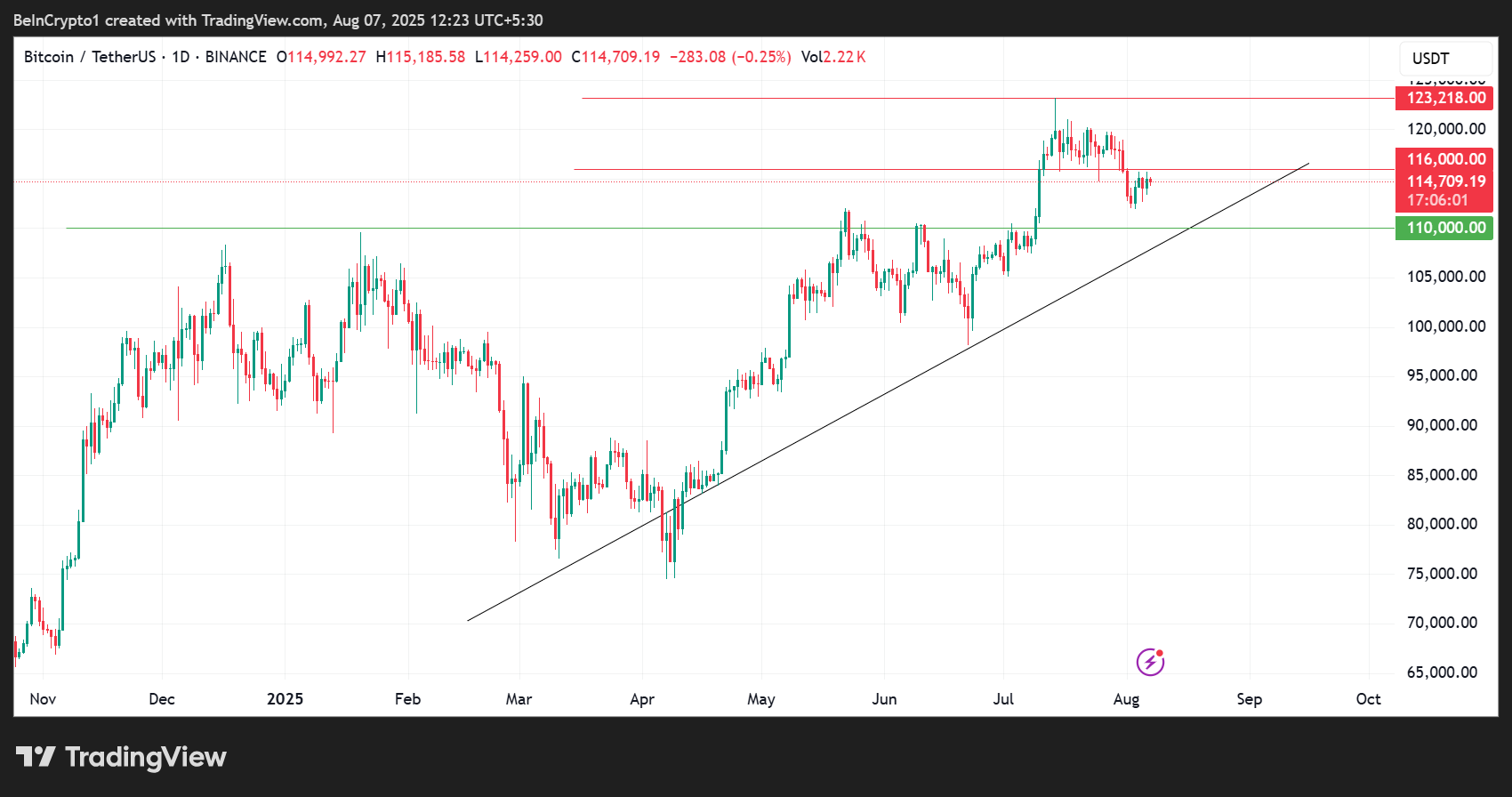
After peaking above $123,000 in mid-July, Bitcoin (BTC) has slipped into a state of indecision, now trading in what on-chain analysts at Glassnode call a “low-liquidity air gap.”
Analysts at QCP Capital also noted that investors are recalibrating expectations around global growth and liquidity.
Between the Peaks, Bitcoin’s Air Gap Signals a Market on Edge
Bitcoin’s post-all-time high correction has driven the BTC price below the $116,000 support level. On the one hand, short-term holders are rattled, while on the other, opportunistic buyers are unable, at least so far, to reclaim the cost basis of recent top buyers.
 Bitcoin (BTC) Price Performance. Source:
TradingView
On July 31, Bitcoin broke below a critical support cluster between $116,000 and $123,000, entering a thin liquidity zone stretching to $110,000.
This “air gap” is a region where few coins have previously changed hands. Such zones typically require significant new demand or capitulation to establish a fresh base.
Glassnode’s data shows that around 120,000 BTC was acquired between July 31 and August 4, after prices rebounded from a local low of around $112,000. While this signals buy-the-dip interest, it has not been enough.
The Bitcoin price still hovers below the key resistance at $116,900, now the cost basis for short-term holders who bought near the local top.
“The rebound has thus far lacked sufficient strength to reclaim resistance. Without a quick rebound in demand, confidence amongst these new investors may start to weaken,” Glassnode noted.
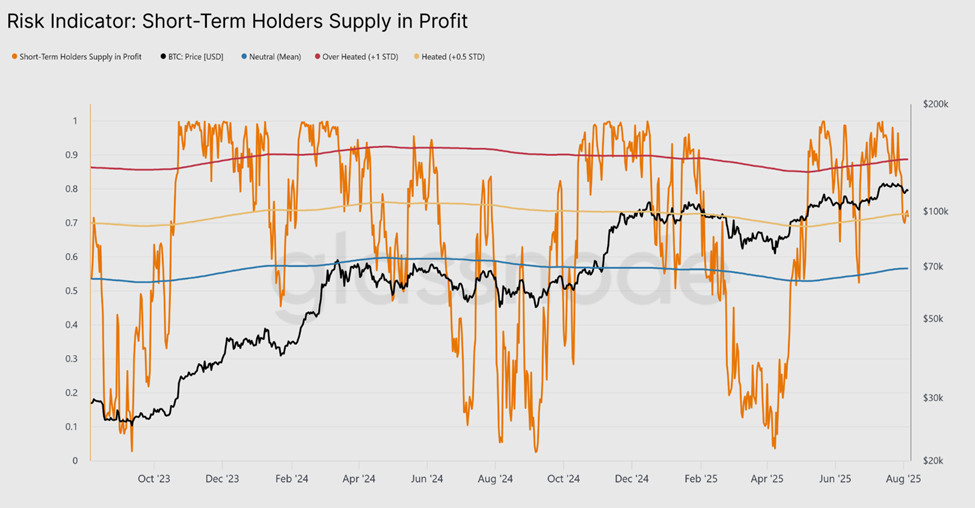
Short-term holder (STH) profitability, often used as a measure of confidence, is already feeling the pressure. According to Glassnode data, this metric has dropped from 100% to 70%, aligning with historical bull market midlines.
 Short-term holders Supply in Profit. Source:
Glassnode
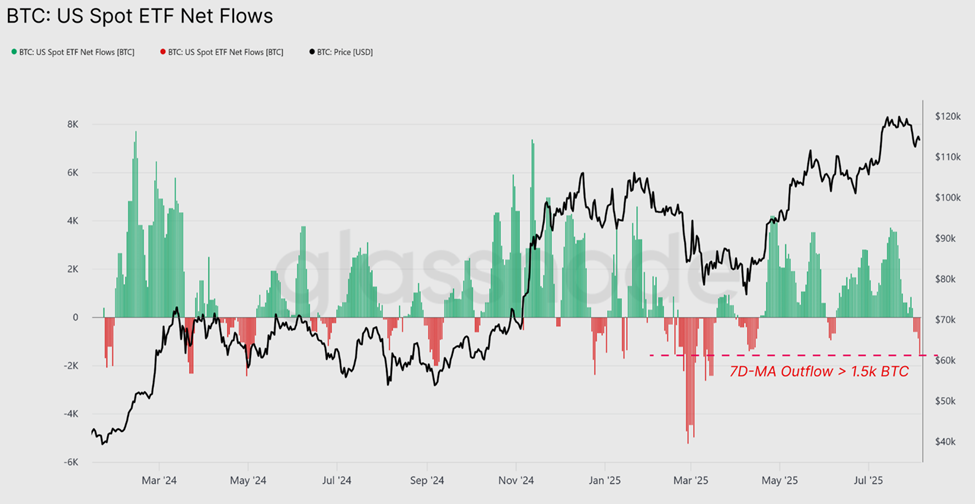
Though not yet alarming, any deeper correction could turn sentiment sharply. Meanwhile, ETF flows have not helped either. A 1,500 BTC outflow on August 5 marked the largest since April, adding to short-term bearish pressure.
 Spot Bitcoin ETF Net Flows. Source:
Glassnode
BTC Needs Fresh Demand Amid Cooling Leverage and Flickering Accumulation
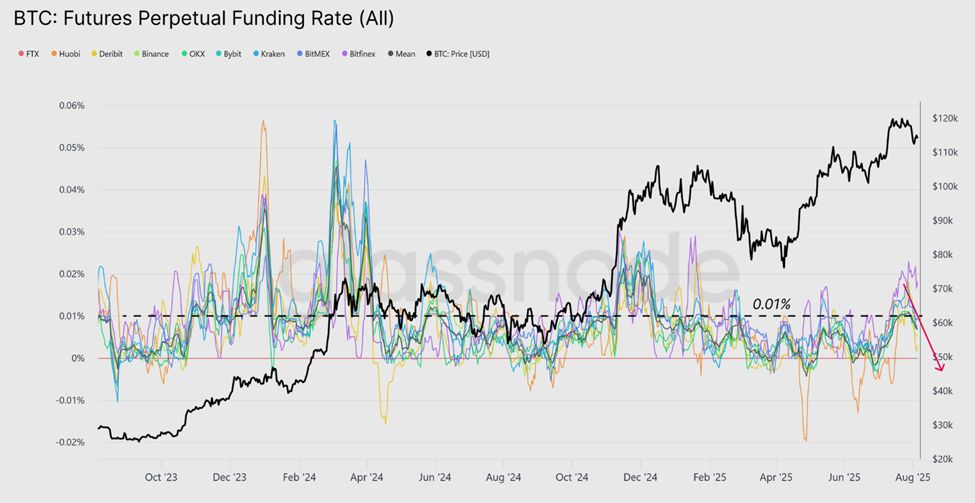
Meanwhile, funding rates across perpetual futures have cooled, slipping below the 0.1% range. This drop in premiums signals waning enthusiasm for leveraged longs, reflecting the current market hesitation.
 Bitcoin Funding Rates. Source:
Glassnode
Despite the weakness, the broader macro structure remains intact. Bitcoin’s monthly closing in July se was the highest in its history.
Historical data suggests these shakeouts, especially those that flush excess leverage, often precede renewed accumulation phases.
Glassnode’s heatmap confirms accumulation behavior, with all wallet categories flashing green. However, recovery hinges on demand. A sustained move above $116,900 would be a strong signal that buyers are regaining control.
Until then, BTC appears locked between two key levels, the floor at $110,000 and a ceiling at $116,000. ETF inflows, volatility compression, and options market behavior could offer early signs of recovery.
Bitcoin is in a post-ATH amnesia, caught between fading momentum and fragile confidence, waiting for its next move.
Disclaimer: The content of this article solely reflects the author's opinion and does not represent the platform in any capacity. This article is not intended to serve as a reference for making investment decisions.
You may also like
How much CPO demand will Nvidia Rubin Ultra generate? Bernstein: Optical value per Pod will increase fivefold
Bernstein believes that the co-packaged optics (CPO) and fiber demand driven by Nvidia's Rubin Ultra architecture will surge significantly, with the optical content per Pod rising from $1 million to $5.4 million. This will propel the size of Nvidia's optical ecosystem market to $46.8 billion by 2028 (a 91% annual increase). Although the industry faces supply bottlenecks with InP substrates, the outlook remains positive. The institution reiterates its “outperform” rating for Lumentum, Coherent, and Ciena.
UBS Q3 implements a two-way strategy with gold options, heavily invests in technology stocks, and builds positions in SK Hynix (SKHY.US)
UBS Group (UBS.US) has submitted its Q3 holdings report (13F) as of September 30, 2026.
SpaceX (SPCX.US) reportedly attempts “de-Nvidiaization” at the rack level: developing Kessel cabinets to bypass L6 compute boards, purchasing only chips
SemiAnalysis: SpaceX has developed its own Kessel cabinet, bypassing Nvidia's L6 cards to provide more options for manufacturing its own hardware.

$3.7 billion “data center power equipment prepayments” abandoned! What did "the most active buyer of gas turbines", SoftBank, see?
In the second quarter of fiscal year 2026, SoftBank reported a net loss of $7.1 billion, primarily due to a $3.7 billion impairment charge from a $9.5 billion advance payment for power generation equipment for US data centers—of which about $2.9 billion was non-refundable and effectively lost. The CFO admitted that SoftBank placed orders before the project plan was finalized, and is now conducting a comprehensive review of its procurement strategy. "The most aggressive purchaser of gas turbines has now written off the deposit in this way."
Crypto prices
More


