
Could Japan Get an XRP ETF Before the US?

SBI Holdings has sparked XRP ETF rumors, but the firm won't take action until Japan’s regulatory landscape is clearer. The product would likely be a basket, not a single XRP ETF.
Social media rumors of a Japanese XRP ETF have taken the crypto community by storm after a new report from SBI Holdings. Citing regulatory progress, the firm sketched out theoretical plans for new crypto ETFs.
However, the firm isn’t going to make an official move until the legal situation improves. Nonetheless, SBI Holdings has a well-documented history of interest in XRP. If anyone’s going to lead the ETF race in Japan, it’s a great candidate.
New XRP ETF Rumors
One topic that persistently attracts attention in crypto is the XRP ETF. This product began trading in Brazil in April and went live in Canada in June, but US regulators keep dragging their feet.
Thanks to recent developments, social media rumors suggest that Japan will be the next country to launch this product.
So, why is this? SBI Holdings, a Japanese financial conglomerate, recently posted its Q2 2025 Financial Results. Among many topics, it referenced potential regulatory developments in the country, which could enable the firm to create new token-based ETFs.
One of its ETF proposals focused on indirect crypto exposure, while the other included XRP:
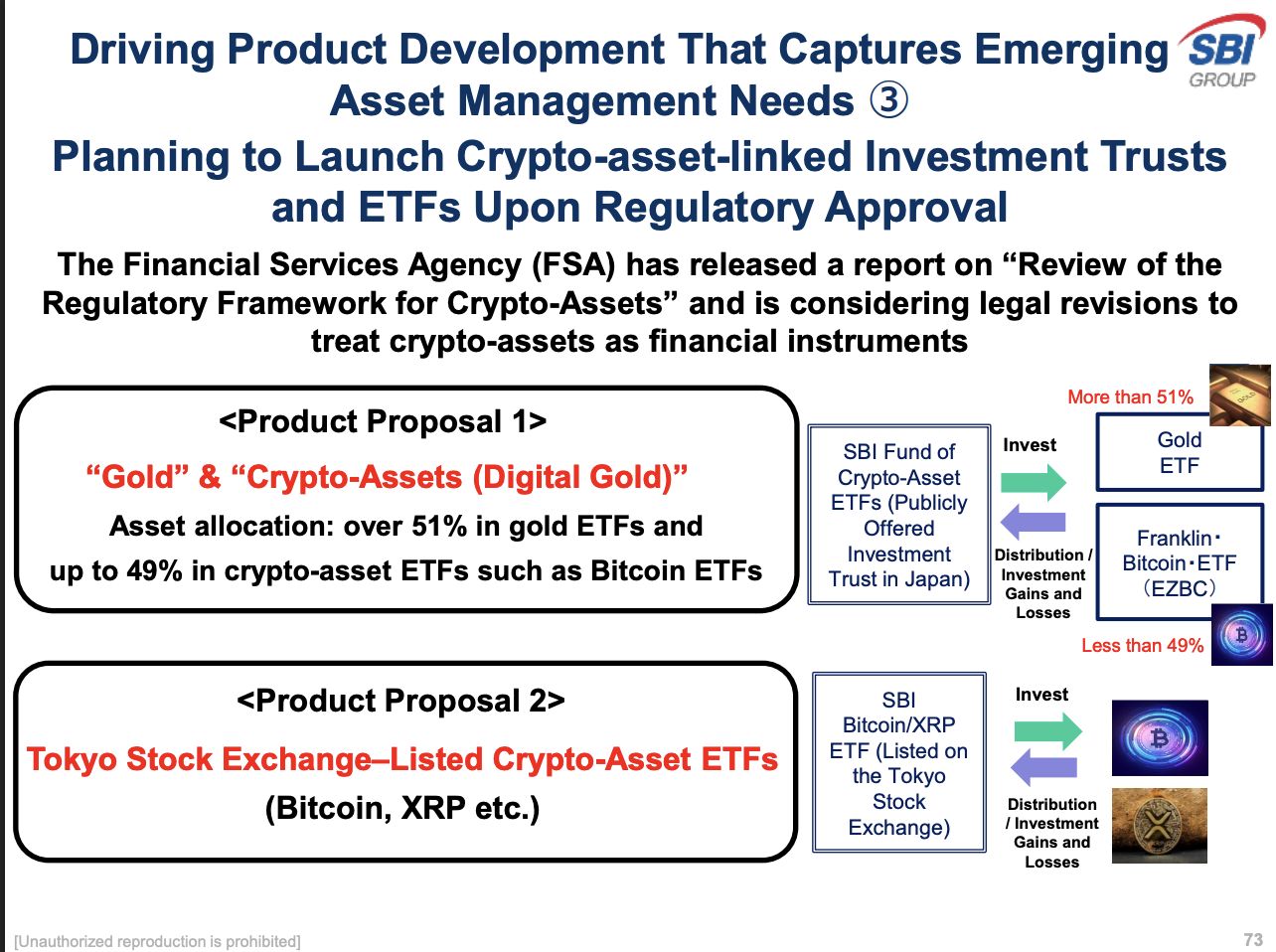 SBI Holdings’ ETF Proposals. Source:
SBI
Is the Hype Credible?
There’s certainly a bullish case for why SBI could establish an XRP ETF.
For one thing, the firm has an established history with Ripple, as it’s currently one of the largest users of XRP on Ripple’s Global Payments Network. Moreover, it even allows customers to acquire XRP using credit card points.
However, social media rumors implied or erroneously claimed that SBI’s XRP ETF application was already in progress. Unfortunately, that’s an exaggeration.
At least Japan is actually getting serious about crypto regulation; one of its top financial regulators recently began operating a Working Group on Web3 policy. This signal encouraged SBI to prepare these hypothetical products.
Nonetheless, SBI won’t make a move until it gets more clarity from the authorities. Furthermore, this advertised product isn’t actually an XRP ETF. It’d be a basket product, combining XRP with several other leading tokens.
The US, as a matter of fact, already approved such a product, although it faces a few setbacks before market access.
Still, SBI has a definite history of partnership with Ripple and interest in XRP. If anybody in Japan is going to launch an XRP ETF, they’re a strong candidate.
For now, however, it’ll have to wait for regulatory approval, just like XRP fans in most jurisdictions worldwide.
Disclaimer: The content of this article solely reflects the author's opinion and does not represent the platform in any capacity. This article is not intended to serve as a reference for making investment decisions.
You may also like
How much CPO demand will Nvidia Rubin Ultra generate? Bernstein: Optical value per Pod will increase fivefold
Bernstein believes that the co-packaged optics (CPO) and fiber demand driven by Nvidia's Rubin Ultra architecture will surge significantly, with the optical content per Pod rising from $1 million to $5.4 million. This will propel the size of Nvidia's optical ecosystem market to $46.8 billion by 2028 (a 91% annual increase). Although the industry faces supply bottlenecks with InP substrates, the outlook remains positive. The institution reiterates its “outperform” rating for Lumentum, Coherent, and Ciena.

UBS Q3 implements a two-way strategy with gold options, heavily invests in technology stocks, and builds positions in SK Hynix (SKHY.US)
UBS Group (UBS.US) has submitted its Q3 holdings report (13F) as of September 30, 2026.

SpaceX (SPCX.US) reportedly attempts “de-Nvidiaization” at the rack level: developing Kessel cabinets to bypass L6 compute boards, purchasing only chips
SemiAnalysis: SpaceX has developed its own Kessel cabinet, bypassing Nvidia's L6 cards to provide more options for manufacturing its own hardware.

$3.7 billion “data center power equipment prepayments” abandoned! What did "the most active buyer of gas turbines", SoftBank, see?
In the second quarter of fiscal year 2026, SoftBank reported a net loss of $7.1 billion, primarily due to a $3.7 billion impairment charge from a $9.5 billion advance payment for power generation equipment for US data centers—of which about $2.9 billion was non-refundable and effectively lost. The CFO admitted that SoftBank placed orders before the project plan was finalized, and is now conducting a comprehensive review of its procurement strategy. "The most aggressive purchaser of gas turbines has now written off the deposit in this way."
Crypto prices
More


