
Pi Coin’s All-Time Low Price Journey: What’s Driving the Decline?

Pi Coin struggles near an all-time low as Bitcoin’s volatility and ongoing outflows weigh heavily. A shift in sentiment and reclaiming key support are crucial for a potential recovery.
Pi Coin has recently faced a challenging price action, culminating in the formation of a new all-time low (ATL) earlier last week.
Despite the ongoing downtrend, Pi Coin remains close to hitting a new ATL, as investor sentiment continues to worsen, reflecting a lack of optimism in the market.
Pi Coin Holders Are Choosing Not To Hold
The correlation between Pi Coin and Bitcoin currently stands at 0.93, indicating a strong connection between the two assets. As Bitcoin experiences volatility and uncertainty, Pi Coin tends to follow its trajectory.
With Bitcoin’s price wobbling in recent days, Pi Coin’s price remains susceptible to the same market conditions. Bitcoin’s price uncertainty is a critical factor, as it often drives Pi Coin’s movements.
For token TA and market updates: Want more token insights like this? Sign up for Editor Harsh Notariya’s Daily Crypto Newsletter .
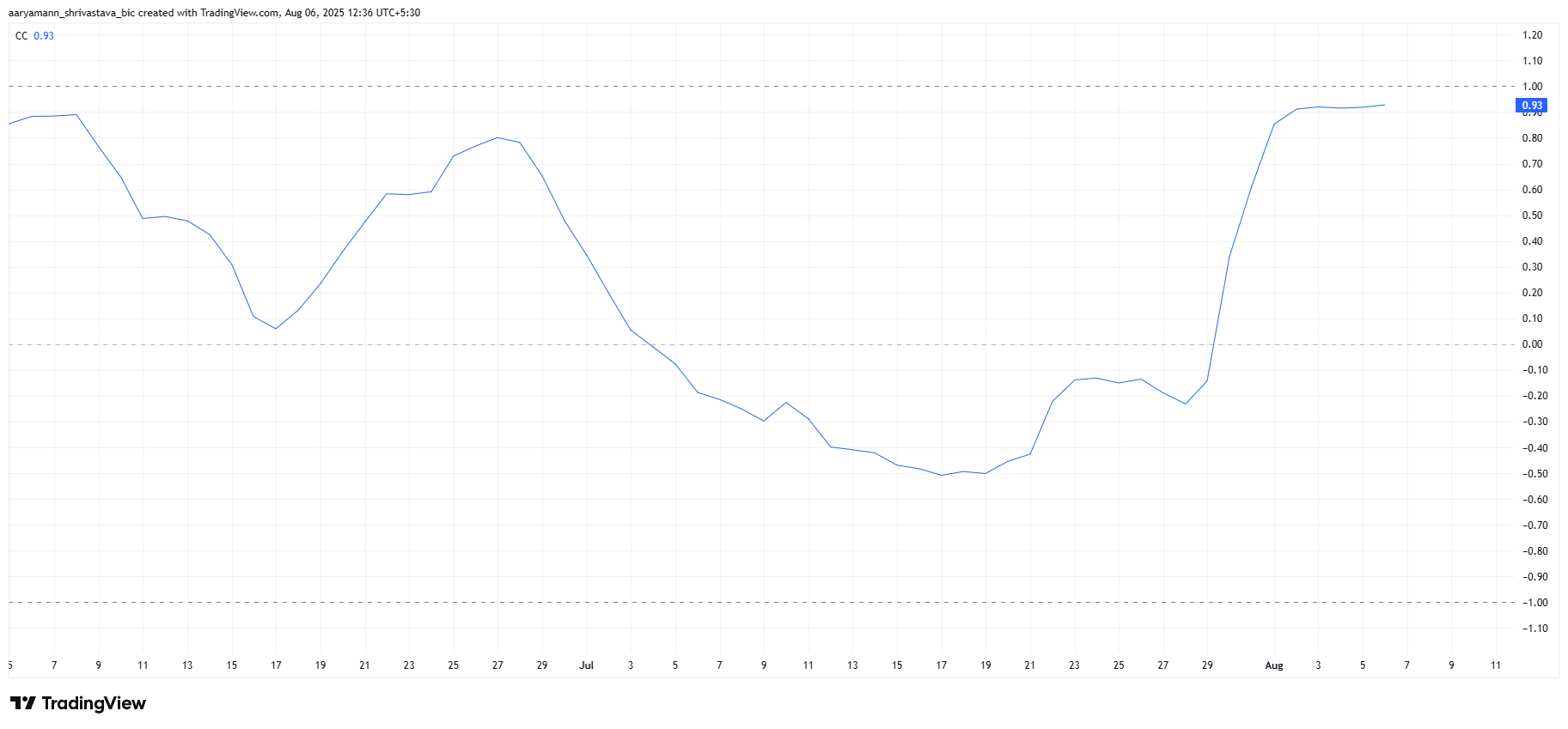 Pi Coin Correlation With Bitcoin. Source:
Pi Coin’s macro momentum is dominated by negative investor sentiment, as evidenced by the Chaikin Money Flow (CMF) indicator. The CMF has been steadily declining, showing that outflows are overwhelming inflows.
The continued decline in investor confidence is contributing to the overall negative momentum. This suggests that investors are bearish toward Pi Coin, with a significant portion of the market opting to sell their holdings.
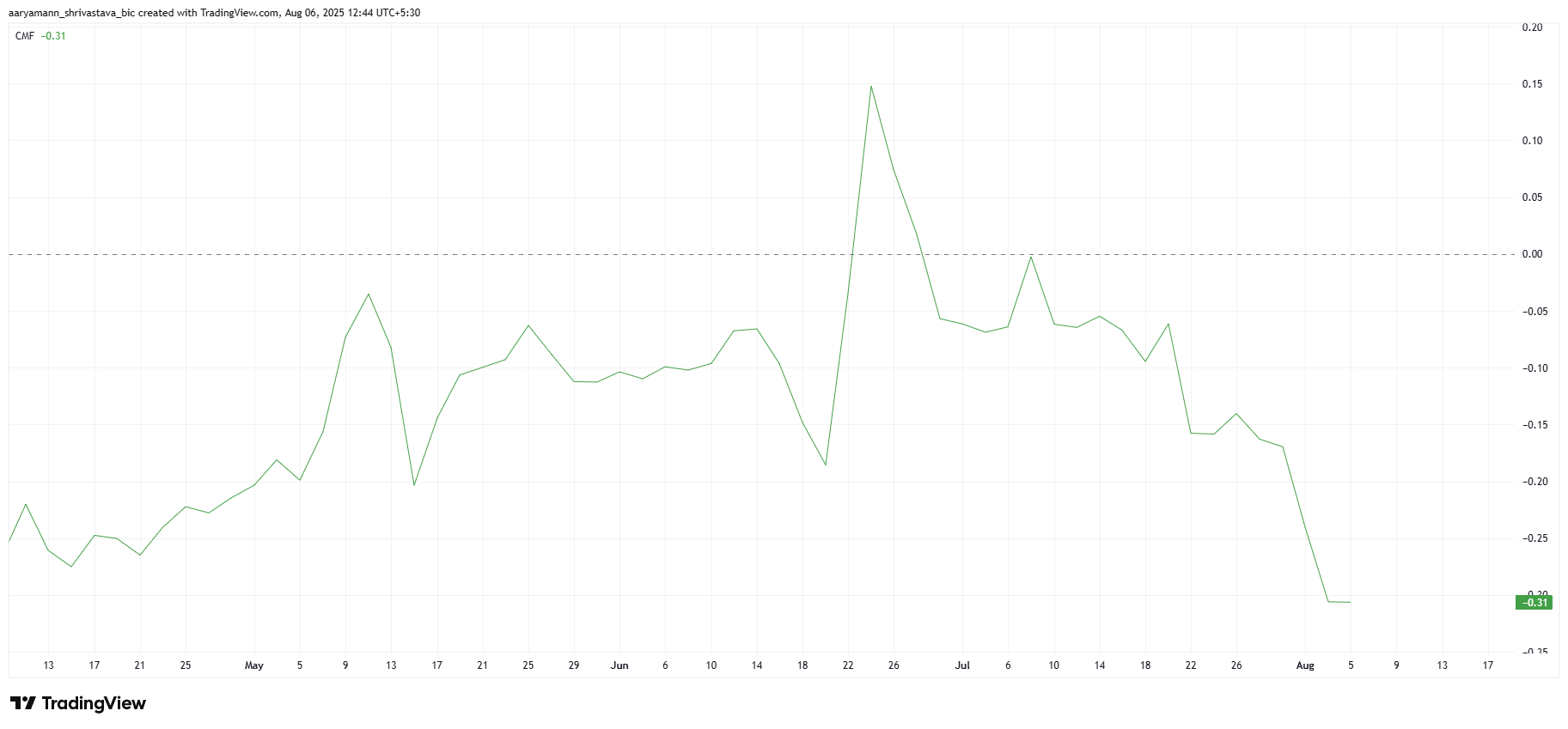 Pi Coin CMF. Source:
Can Pi Price Bounce Back?
Pi Coin’s price is currently at $0.340, just 5.54% away from revisiting its recent ATL of $0.322. Given the current market conditions, Pi Coin remains under significant pressure, making it likely that the price will continue to decline. A new ATL below the current $0.310 could be in the near future.
Given the ongoing outflows and the correlation with Bitcoin’s price movements, Pi Coin’s price trajectory appears bleak. It’s expected that the price will maintain its downtrend unless a shift in investor sentiment occurs. A decline through the support levels is highly probable, pushing the price toward further losses.
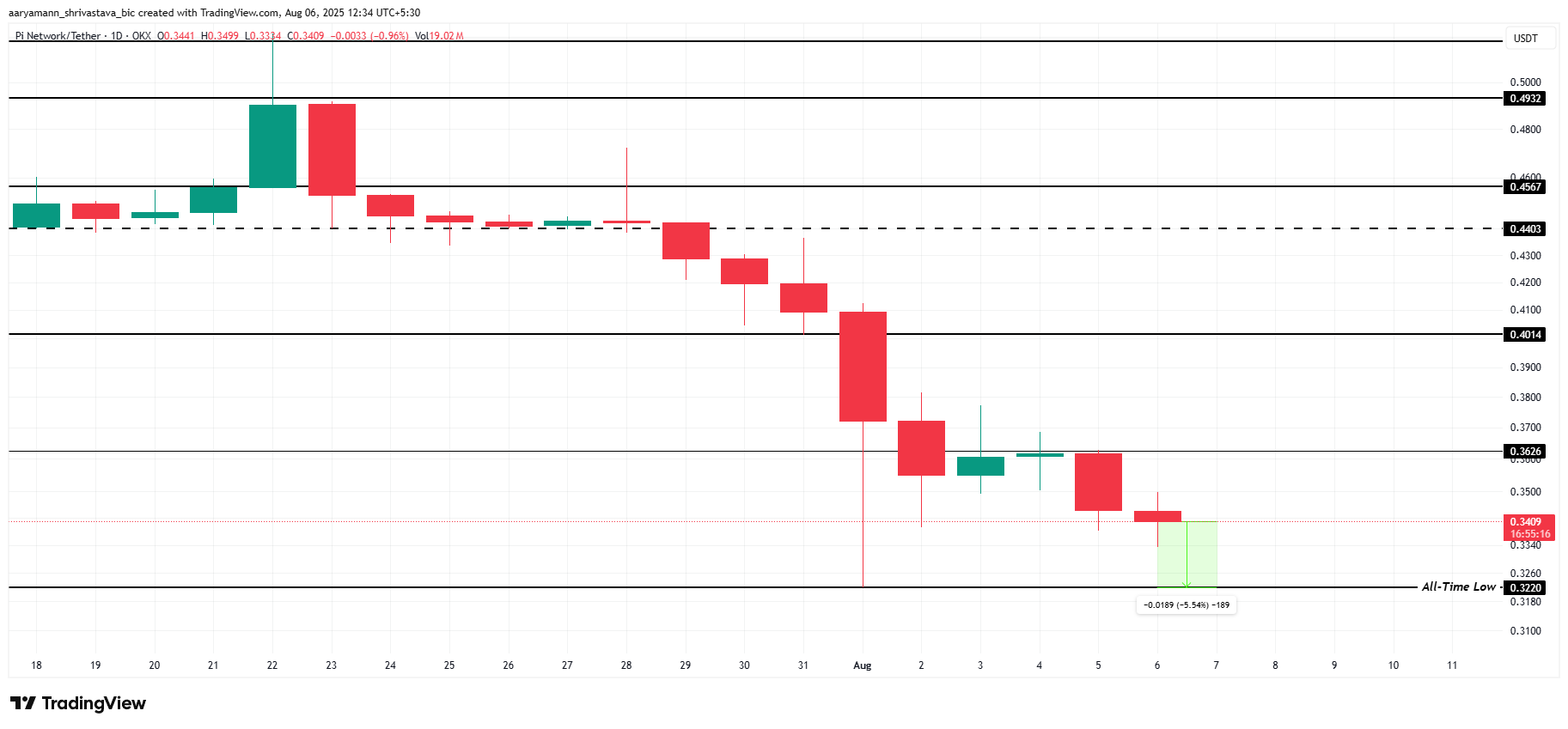 Pi Coin Price Analysis. Source:
However, in the unlikely scenario that Pi Coin experiences a reversal, it would need to secure $0.362 as a support floor to initiate a rally. If the price manages to break this barrier, it could rise to $0.401, invalidating the current bearish outlook and offering hope for a price recovery.
Disclaimer: The content of this article solely reflects the author's opinion and does not represent the platform in any capacity. This article is not intended to serve as a reference for making investment decisions.
You may also like
How much CPO demand will Nvidia Rubin Ultra generate? Bernstein: Optical value per Pod will increase fivefold
Bernstein believes that the co-packaged optics (CPO) and fiber demand driven by Nvidia's Rubin Ultra architecture will surge significantly, with the optical content per Pod rising from $1 million to $5.4 million. This will propel the size of Nvidia's optical ecosystem market to $46.8 billion by 2028 (a 91% annual increase). Although the industry faces supply bottlenecks with InP substrates, the outlook remains positive. The institution reiterates its “outperform” rating for Lumentum, Coherent, and Ciena.

UBS Q3 implements a two-way strategy with gold options, heavily invests in technology stocks, and builds positions in SK Hynix (SKHY.US)
UBS Group (UBS.US) has submitted its Q3 holdings report (13F) as of September 30, 2026.

SpaceX (SPCX.US) reportedly attempts “de-Nvidiaization” at the rack level: developing Kessel cabinets to bypass L6 compute boards, purchasing only chips
SemiAnalysis: SpaceX has developed its own Kessel cabinet, bypassing Nvidia's L6 cards to provide more options for manufacturing its own hardware.

$3.7 billion “data center power equipment prepayments” abandoned! What did "the most active buyer of gas turbines", SoftBank, see?
In the second quarter of fiscal year 2026, SoftBank reported a net loss of $7.1 billion, primarily due to a $3.7 billion impairment charge from a $9.5 billion advance payment for power generation equipment for US data centers—of which about $2.9 billion was non-refundable and effectively lost. The CFO admitted that SoftBank placed orders before the project plan was finalized, and is now conducting a comprehensive review of its procurement strategy. "The most aggressive purchaser of gas turbines has now written off the deposit in this way."
Crypto prices
More


