
TradFi giant SBI Holdings floats first-ever Bitcoin, XRP ETF launch in Japan
Key Takeaways
- SBI Holdings expects to launch Japan's first crypto ETFs, focusing on XRP, Bitcoin, and a blended 'Digital Gold' ETF.
- The crypto ETF will provide investors with direct exposure to both XRP and Bitcoin via traditional financial instruments.
SBI Holdings, Japan’s financial conglomerate with active operations in banking, securities, asset management, and fintech, has floated plans to introduce Bitcoin and XRP exchange-traded funds (ETFs) on the Tokyo Stock Exchange, subject to forthcoming regulatory changes.
In its latest financial results presentation , SBI has outlined two proposals designed to capture the growing demand for digital asset management and take advantage of potential legal revisions currently under review by Japan’s Financial Services Agency (FSA).
The first is a hybrid investment trust combining traditional gold ETFs with crypto-asset ETFs like Franklin’s Bitcoin ETF (EZBC), with up to 49% allocated to crypto.
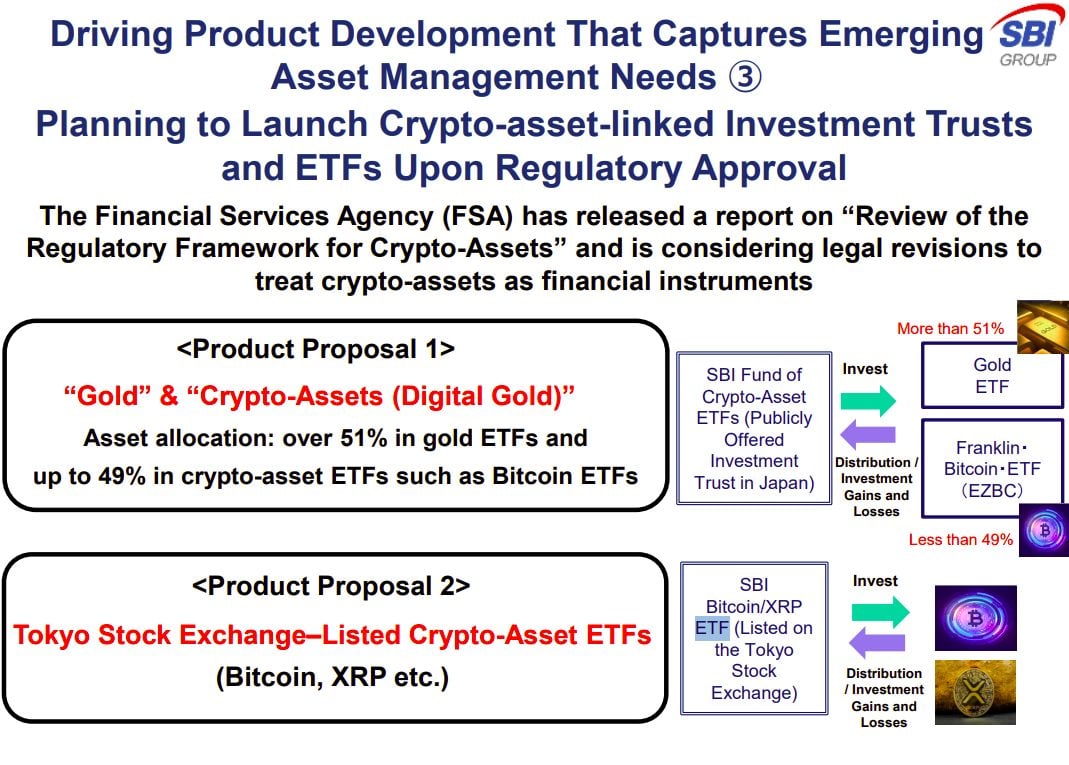
The second is a crypto ETF proposed for listing on the Tokyo Stock Exchange. The SBI Bitcoin/XRP ETF is cited as an example, signaling readiness to launch pending regulatory approval. These ETFs would trade like any listed security, targeting wider retail and institutional access.
Earlier this year, the FSA released a discussion paper on revising the crypto regulatory framework, proposing to reclassify crypto assets as financial instruments, balancing innovation with investor protection and closing regulatory gaps.
The proposal would pave the way for the legalization and regulation of crypto ETFs, meaning these products could be officially offered in Japan under strict regulatory oversight comparable to traditional securities.
SBI’s move could increase the institutional adoption of XRP and other digital assets in Japan’s regulated investment market. Japan has maintained a relatively structured approach to crypto regulation compared to other major economies.
SBI Holdings has shown interest in crypto assets and blockchain technology through various business ventures and partnerships.
In April 2024, Franklin Templeton and SBI Holdings entered into a partnership to form a new crypto ETF management company in Japan. The parties have signed a Memorandum of Understanding to provide young investors with greater access to diversified investment vehicles, including crypto-based ETFs.
Disclaimer: The content of this article solely reflects the author's opinion and does not represent the platform in any capacity. This article is not intended to serve as a reference for making investment decisions.
You may also like
How much CPO demand will Nvidia Rubin Ultra generate? Bernstein: Optical value per Pod will increase fivefold
Bernstein believes that the co-packaged optics (CPO) and fiber demand driven by Nvidia's Rubin Ultra architecture will surge significantly, with the optical content per Pod rising from $1 million to $5.4 million. This will propel the size of Nvidia's optical ecosystem market to $46.8 billion by 2028 (a 91% annual increase). Although the industry faces supply bottlenecks with InP substrates, the outlook remains positive. The institution reiterates its “outperform” rating for Lumentum, Coherent, and Ciena.

UBS Q3 implements a two-way strategy with gold options, heavily invests in technology stocks, and builds positions in SK Hynix (SKHY.US)
UBS Group (UBS.US) has submitted its Q3 holdings report (13F) as of September 30, 2026.

SpaceX (SPCX.US) reportedly attempts “de-Nvidiaization” at the rack level: developing Kessel cabinets to bypass L6 compute boards, purchasing only chips
SemiAnalysis: SpaceX has developed its own Kessel cabinet, bypassing Nvidia's L6 cards to provide more options for manufacturing its own hardware.

$3.7 billion “data center power equipment prepayments” abandoned! What did "the most active buyer of gas turbines", SoftBank, see?
In the second quarter of fiscal year 2026, SoftBank reported a net loss of $7.1 billion, primarily due to a $3.7 billion impairment charge from a $9.5 billion advance payment for power generation equipment for US data centers—of which about $2.9 billion was non-refundable and effectively lost. The CFO admitted that SoftBank placed orders before the project plan was finalized, and is now conducting a comprehensive review of its procurement strategy. "The most aggressive purchaser of gas turbines has now written off the deposit in this way."
Crypto prices
More


