
BTC Market Pulse: Week 32
Bitcoin’s rally pauses as momentum cools across spot, futures, options, and ETF markets. With liquidity thinning and risk appetite moderating, signs of seller exhaustion emerge - yet fragile market structure leaves BTC vulnerable to further downside.
Overview
With the market retesting the low-liquidity range below the $114k threshold level, the euphoria phase is on pause as Bitcoin undergoes a period of recalibration. Signals across market sectors point to cooling momentum, cautious positioning, and a moderation in risk appetite.
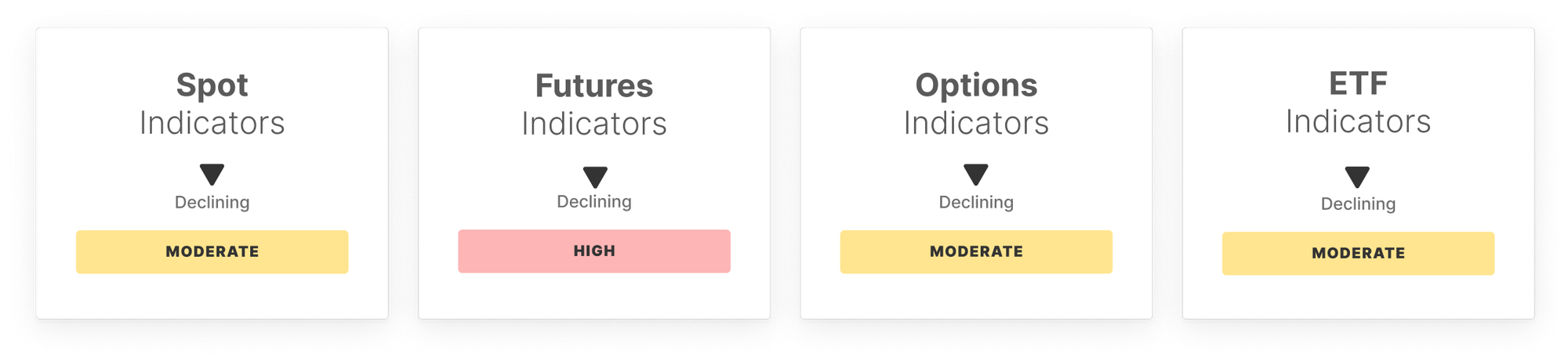
In the Spot Market, conditions weakened notably as the RSI fell from 47.4 to 35.8, dipping below its low band and signaling oversold territory. Spot CVD deteriorated sharply from -$107.1M to -$220.0M, reflecting intensifying sell-side pressure. Spot volume also declined from $8.4B to $7.5B, suggesting softer participation and liquidity during the retest of support.
The Futures Market saw Open Interest ease from $45.6B to $44.9B, hinting at mild position unwinding. Long-side funding dropped 33% to $3.1M, marking a pullback in leveraged bullish demand. Perpetual CVD fell from -$1.2B to -$1.8B, deep below its low band, underscoring aggressive distribution and forced disengagement among traders.
In the Options Market, Open Interest contracted 8.4% to $39.8B, reflecting reduced speculative activity. The volatility spread narrowed from 23.84% to 16.26%, showing less risk being priced in. However, 25 Delta Skew surged above its high band to 5.51%, signaling heightened demand for downside protection and rising hedging sentiment.
The ETF Market saw net inflows drop 24.9% to $269.4M, well below the low band, indicating weak institutional demand. Trading volume rose 9.9% to $19.8B, suggesting a responsive but cautious environment. ETF MVRV eased from 2.4 to 2.3, showing slightly lower profitability but ongoing unrealized gains.
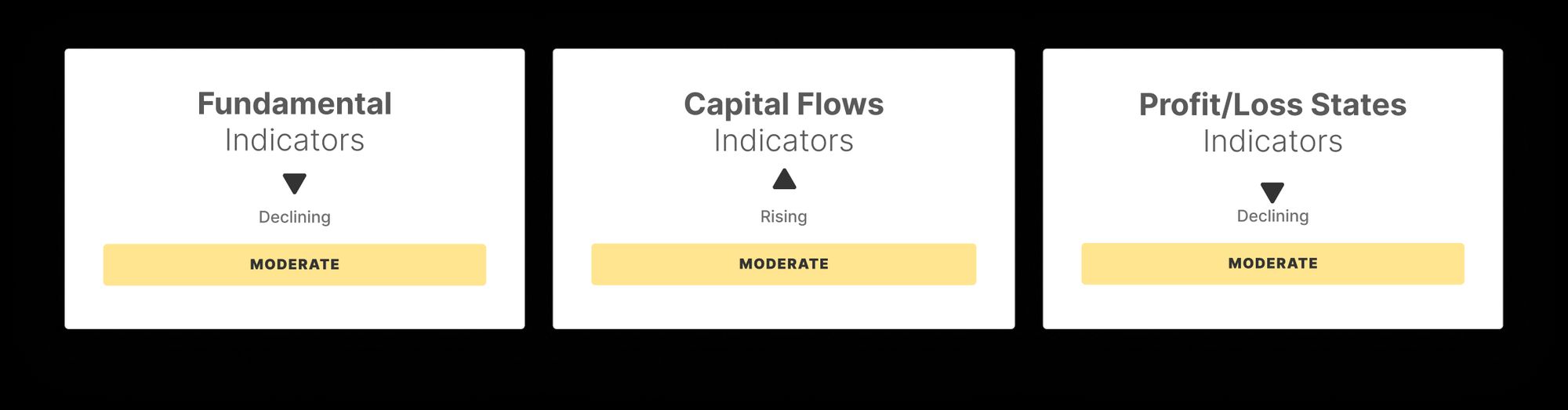
On-chain fundamentals were mixed: active addresses rose 3.6% to 729k, while transfer volume dropped 13.9% to $9.4B and fees declined 14.4% to $483.2K, signaling quieter network activity. Realized Cap Change stayed elevated at 6.3%, reflecting strong but cooling capital inflows.
Capital flows remained steady with the STH/LTH ratio at 17.3% and Hot Capital Share at 36.0%, showing balanced liquidity. Profitability metrics cooled as Percent Supply in Profit fell to 93.6%, NUPL dropped to 8.6%, and Realized P/L Ratio contracted to 1.9, reflecting more cautious sentiment.
In sum, the market has shifted from euphoria to reassessment, with oversold conditions and seller exhaustion hinting at potential for a bounce. However, fragility is growing, and the structure remains vulnerable to external negative catalysts or delayed demand revival.
Off-Chain Indicators
On-Chain Indicators

Don't miss it!
Smart market intelligence, straight to your inbox.
Subscribe nowDisclaimer: The content of this article solely reflects the author's opinion and does not represent the platform in any capacity. This article is not intended to serve as a reference for making investment decisions.
You may also like
How much CPO demand will Nvidia Rubin Ultra generate? Bernstein: Optical value per Pod will increase fivefold
Bernstein believes that the co-packaged optics (CPO) and fiber demand driven by Nvidia's Rubin Ultra architecture will surge significantly, with the optical content per Pod rising from $1 million to $5.4 million. This will propel the size of Nvidia's optical ecosystem market to $46.8 billion by 2028 (a 91% annual increase). Although the industry faces supply bottlenecks with InP substrates, the outlook remains positive. The institution reiterates its “outperform” rating for Lumentum, Coherent, and Ciena.

UBS Q3 implements a two-way strategy with gold options, heavily invests in technology stocks, and builds positions in SK Hynix (SKHY.US)
UBS Group (UBS.US) has submitted its Q3 holdings report (13F) as of September 30, 2026.

SpaceX (SPCX.US) reportedly attempts “de-Nvidiaization” at the rack level: developing Kessel cabinets to bypass L6 compute boards, purchasing only chips
SemiAnalysis: SpaceX has developed its own Kessel cabinet, bypassing Nvidia's L6 cards to provide more options for manufacturing its own hardware.

$3.7 billion “data center power equipment prepayments” abandoned! What did "the most active buyer of gas turbines", SoftBank, see?
In the second quarter of fiscal year 2026, SoftBank reported a net loss of $7.1 billion, primarily due to a $3.7 billion impairment charge from a $9.5 billion advance payment for power generation equipment for US data centers—of which about $2.9 billion was non-refundable and effectively lost. The CFO admitted that SoftBank placed orders before the project plan was finalized, and is now conducting a comprehensive review of its procurement strategy. "The most aggressive purchaser of gas turbines has now written off the deposit in this way."
Crypto prices
More


