

Ethereum’s EIP-7999 proposal aims to simplify transaction fees by allowing users to set a single maximum fee, enhancing predictability and user experience.
-
EIP-7999 introduces a unified fee market for Ethereum transactions.
-
Gas fees have significantly decreased following the Dencun upgrade.
-
Ethereum’s transaction fee revenue remains the highest among blockchains despite competition.
Ethereum’s EIP-7999 proposal simplifies transaction fees, improving user experience and capital efficiency. Read more for insights.
| Ethereum | $2.48 billion | +3% |
| Tron | $2.15 billion | +100% |
| Solana | $750 million | +2838% |
What is EIP-7999?
EIP-7999 is a proposal aimed at streamlining Ethereum’s transaction fee structure. It allows users to specify a single maximum fee for multiple resources, simplifying the payment process.
How Does EIP-7999 Improve User Experience?
This proposal enhances user experience by eliminating the need to estimate multiple fee components, allowing for a more predictable transaction process. It aims to improve capital efficiency and reduce complexity.
Frequently Asked Questions
What is the impact of the Dencun upgrade on gas fees?
The Dencun upgrade significantly reduced Ethereum’s gas fees by 95%, from $86 to $0.39, improving transaction efficiency.
How does EIP-7999 compare to previous fee structures?
EIP-7999 offers a more straightforward approach by allowing a single maximum fee, contrasting with the previous multi-component fee system.
Key Takeaways
- EIP-7999 simplifies transaction fees: Users can set a single maximum fee.
- Gas fees have decreased significantly: Following the Dencun upgrade, fees dropped by 95%.
- Ethereum remains a leader: Despite competition, it generated the highest transaction fee revenue in 2024.
Conclusion
The introduction of EIP-7999 represents a significant step towards simplifying Ethereum’s transaction fee structure. As gas fees have decreased dramatically, this proposal aims to enhance user experience and maintain Ethereum’s leadership in the blockchain space.
The move follows significant gas fee reductions after the Dencun upgrade, and comes amid intensifying competition across blockchains.
Ethereum co-founder Vitalik Buterin and developer Anders Elowsson have introduced EIP-7999, a proposal to streamline Ethereum’s transaction fee structure.
Released on Tuesday, the proposal seeks to establish a unified multidimensional fee market, allowing users to specify a single aggregate maximum fee for multiple resources.
The proposal, if adopted, would eliminate the need to estimate and manage multiple fee components when submitting transactions and let users specify one all-encompassing maximum fee, making paying for transactions simpler and more predictable.
The proposal is described as a way to “simplify fee management by letting users specify a single max fee across multiple transaction resources, improving capital efficiency and user experience.”
It is under community review and discussion ahead of potential implementation.
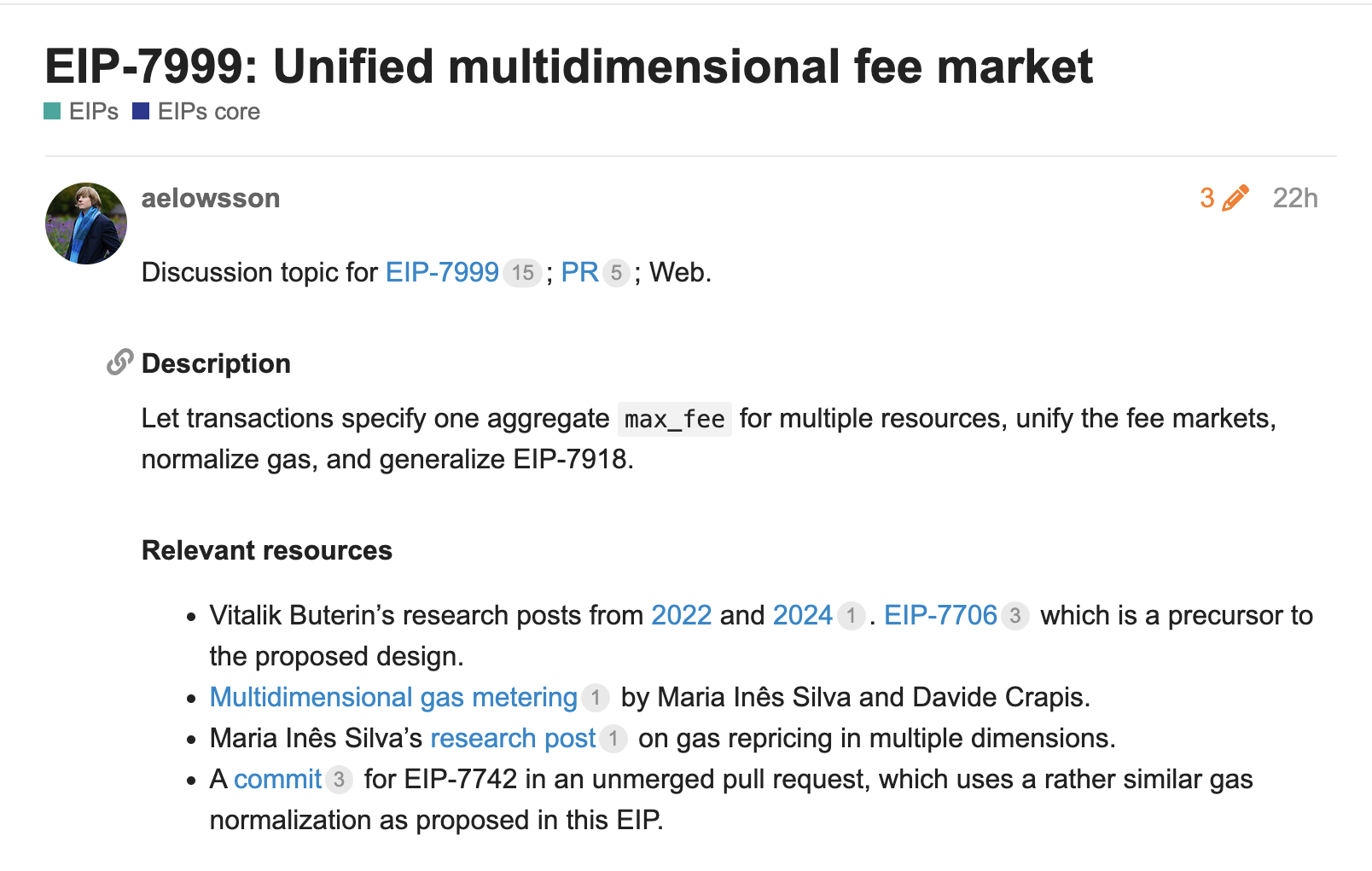
Source: Ethereum Magicians
Ethereum’s long-time problem with gas fees
Ethereum’s gas fees have been a persistent challenge since the network’s rapid growth in 2017, when a surge in decentralized applications (DApps) led to increased congestion and soaring transaction costs.
The situation worsened during the 2021 DeFi summer and NFT boom, when average gas fees often exceeded $50 per transaction.
In response, Ethereum implemented the EIP-1559 upgrade in August 2021, which introduced a base fee burn and aimed to stabilize fees. Although it helped moderate fee spikes, periods of high congestion still resulted in volatile and sometimes prohibitive gas costs.
To further ease the burden, layer 2 scaling solutions like Optimism and Arbitrum gained popularity, processing transactions offchain to lower fees. However, Ethereum’s mainnet fees remained a concern, prompting ongoing development efforts culminating in the Dencun upgrade in March 2024.
Dencun’s impact: gas fees fall as competitors gain ground
The Dencun upgrade, implemented on March 13, 2024, introduced nine Ethereum Improvement Proposals (EIPs) to improve scalability and lower transaction costs, particularly for layer-2 solutions.
Within a year, average gas fees for common transactions dropped 95%, from about $86 to $0.39, according to Etherscan data. Ethereum’s native token price fell over 50%, reflecting broader market challenges.
Ethereum still remained the top blockchain by transaction fee revenue in 2024, earning $2.48 billion, a 3% increase over 2023. However, fee income was volatile after Dencun, as competitors gained ground.
In the same year, Tron’s fees more than doubled to $2.15 billion, driven mainly by stablecoin transactions, and Solana’s fees surged 2,838% to $750 million amid a spike in network activity.
According to data from Token Terminal, over the last 365 days, Ethereum’s revenue generated by fees stands at $757.4 million at this writing.
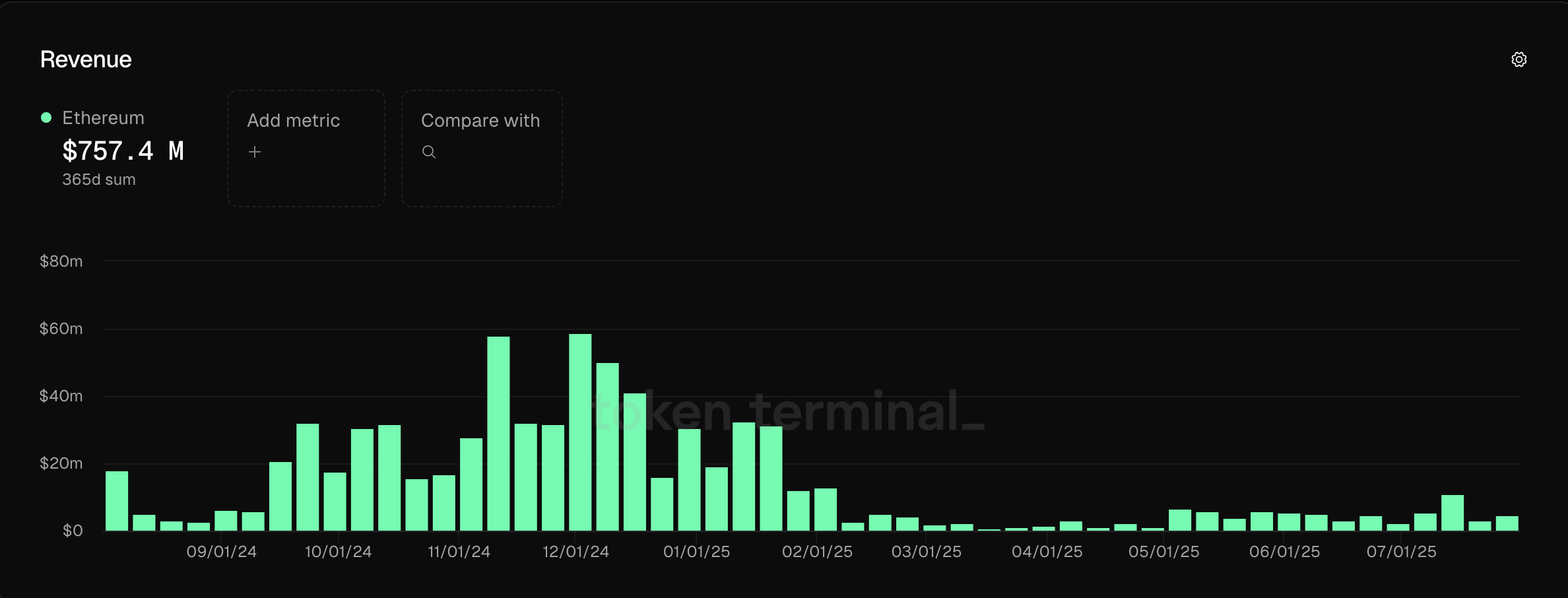
Ethereum’s network total revenue in 365 days. Source: Token Terminal





